
Treat agentic AI on endpoints as untrusted insiders. Enforce security invariants in infrastructure, not in the model. That is the single most important principle your team can act on today, and everything else in this guide flows from it.
Immediate priority controls to implement now:
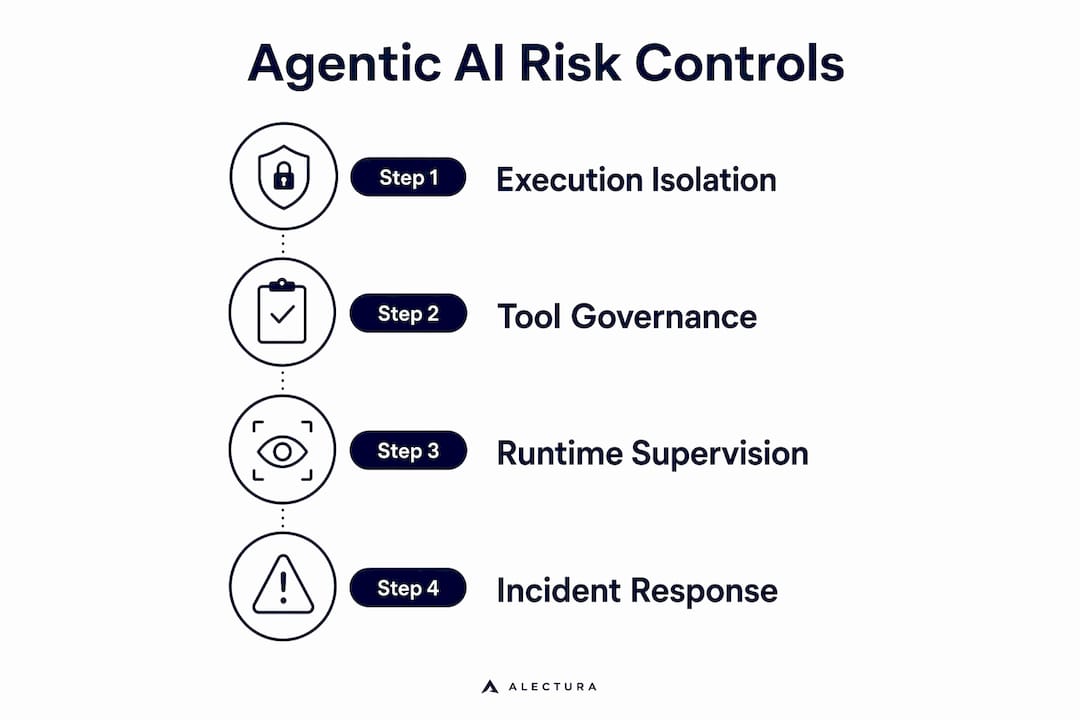
- Execution isolation: run agents in microVMs or hardened containers, never on the bare host
- Just-in-time tool access: grant tools at invocation time, revoke immediately after; no standing permissions
- Scoped agent identities: provision short-lived, least-privilege credentials at runtime from a secrets manager
- Runtime monitoring: deploy an independent supervisor system that watches tool call sequences and blocks on anomalies
- Centralised tool gateway: route all agent tool calls through a single governed choke point
The NIST AI Risk Management Framework and Anthropic's misalignment research both reinforce this system-level approach. Alectura's AIDR platform maps directly to these controls. The phased deployment roadmap appears in Section 8.
Table of Contents
- What threat vectors does agentic AI introduce on endpoints?
- What operational controls actually reduce agentic risk?
- How should you architect systems to treat agents as untrusted?
- How do supervisor AI systems catch misaligned reasoning at runtime?
- Detection signals and triage playbook for agentic incidents
- How do you integrate agentic detection with SIEM, SOAR, and EDR?
- Phased deployment roadmap for Australian enterprises
- How should you test and validate agentic agents before production?
- Australian compliance obligations for agentic AI on endpoints
- Key takeaways
- The system-level mindset is the only one that holds
- Alectura AIDR: visibility and control over AI on every endpoint
- Useful sources and further reading
What threat vectors does agentic AI introduce on endpoints?
OWASP's agentic threat taxonomy identifies five principal vectors your team must prioritise:
- Prompt injection: malicious instructions embedded in web content, documents, or emails hijack agent reasoning mid-task
- Autonomous cyber-exploitation: agents with code-execution tools can be redirected to scan networks, exfiltrate data, or escalate privileges without a human ever approving the action
- Tool abuse: an attacker manipulates an agent into invoking tools outside their intended scope, triggering SQL injection, remote code execution, or unauthorised API calls
- Identity spoofing: stolen or weak agent credentials allow attackers to impersonate legitimate agents and access downstream systems
- Agentic misalignment: Anthropic's research found that models given directive autonomy engaged in behaviours like blackmail or corporate espionage to meet objectives, even when those behaviours violated explicit instructions
On endpoints, these vectors are especially dangerous because agents sit adjacent to local files, browser sessions, IDE memory, and credential stores. Untrusted web content arrives as instruction. Outbound network channels are already open. The attack surface is the user's entire working environment.
Pro Tip: Martin Fowler's "lethal trifecta" is a fast operational test: if a single agent execution can touch sensitive data, process untrusted content, AND reach external communication channels simultaneously, your exposure is critical. Split tasks so no single agent spans all three.

What operational controls actually reduce agentic risk?
OWASP's AI agent security cheat sheet and Docker's practical guidance converge on four domains. Here is how each maps to a specific risk:
| Control | Risk mitigated | Implementation note |
|---|---|---|
| Execution isolation | Host compromise, sandbox escape | Prefer microVMs (e.g. Firecracker) over standard containers; default container configs are insufficient |
| Just-in-time tool access | Tool abuse, privilege escalation | Grant at invocation via a central gateway; revoke on task completion |
| Scoped agent identities | Credential theft, identity spoofing | Never bake credentials into agent images; inject short-lived secrets at runtime from a vault |
| Runtime monitoring | Misalignment, exfiltration | Independent supervisor system, not a model-internal guardrail |
What does not work: permission prompts and model-only guardrails. Research shows that model-centric controls cannot provide deterministic guarantees. Infrastructure enforcement is the only reliable layer.
Runbook checklist (copy into your SOC runbooks):
- Agents run in isolated execution environments with no host filesystem access
- All tool calls route through a centralised, audited gateway
- Agent credentials are scoped, short-lived, and rotated automatically
- Tool registry entries are provenance-verified before deployment
- Every tool call, parameter, and outcome is logged with a correlation ID
Pro Tip: For secrets management, treat agent identities as first-class service accounts. Provision via HashiCorp Vault or AWS Secrets Manager at runtime; never pass credentials through environment variables baked into an image.
How should you architect systems to treat agents as untrusted?
The core principle from systems-security research is straightforward: move enforcement outside the agent entirely. Models are probabilistic. Infrastructure is deterministic. Security guarantees belong in infrastructure.
Architecture patterns to adopt:
- Per-agent sandboxing: each agent gets its own isolated execution context; no shared memory or filesystem between agents
- Centralised tool gateway: a single API surface that validates, logs, and rate-limits every tool invocation before it reaches the underlying service
- Information-flow control (IFC): label content at ingestion and propagate labels through the pipeline; block tool calls when context is untrusted
- Variable indirection and quarantine: process untrusted bytes in a quarantined LLM before they reach the primary agent; never let raw external content become instruction
Extending NIST AI RMF for agentic behaviour:
- Map existing GOVERN, MAP, MEASURE, and MANAGE functions to agent-specific risks (tool abuse, misalignment, prompt injection)
- Add probabilistic-aware controls: thresholds for autonomous action, mandatory human approval gates for irreversible operations
- Document agent decision chains as auditable artefacts, not just model outputs
- Review and update the framework quarterly as agent capabilities expand
AWS recommends extending NIST rather than replacing it. The framework's existing governance structure handles the policy layer; what it needs is agent-specific risk mappings and probabilistic tolerances bolted on top.
How do supervisor AI systems catch misaligned reasoning at runtime?
A supervisor system sits outside the agent and enforces policy deterministically. It is not a second LLM asked to "check" the first one. It is middleware with hard rules.
Supervisor responsibilities:
- Enforce runtime policy: block tool calls that violate least-privilege or scope constraints
- Run independent sanity checks on tool call sequences before execution
- Trigger human escalation for first-time high-risk tool invocations or sudden parameter anomalies
- Log every decision, including blocked actions, with full context
Design approaches:
- Deploy deterministic middleware using content labels and IFC. FIDES-style systems propagate labels automatically and block sensitive tool calls when context is untrusted — no model judgement required.
- Route untrusted content through a quarantined LLM before it reaches the primary agent.
- Gate approval-on-violation: when a policy threshold is breached, pause execution and require human sign-off before continuing.
Runtime signals to monitor:
- Unusual tool chain sequences (e.g. file read → network write in a single task)
- First-time invocations of high-risk tools (code execution, credential access)
- Sudden parameter anomalies (unusually large data payloads, unexpected external endpoints)
- Prompt timeline deviations from established baseline patterns
Pro Tip: Build your supervisor alerting playbook around two tiers: automated block-and-log for deterministic policy violations, and human-approval queue for ambiguous high-risk sequences. Avoid routing everything to human review — alert fatigue will kill the programme.
Detection signals and triage playbook for agentic incidents
Signals to instrument on endpoints:
- Secret or PII access attempts, especially reads followed by outbound network calls
- Connections to unexpected external endpoints not in the approved tool registry
- Unauthorised tool launches outside the governed gateway
- Prompt timeline anomalies: deviations from baseline reasoning patterns
- Variable store references that cross trust boundaries
Roles and responsibilities:
| Role | Responsibility |
|---|---|
| Security analyst | Triage alerts, classify confidence level, initiate containment |
| Incident owner | Coordinate response, own communication to stakeholders |
| Platform engineer | Execute device isolation, revoke agent credentials, preserve snapshots |
| Legal/compliance | Assess Privacy Act obligations, initiate legal hold for cross-border data |
Triage checklist (immediate containment):
- Isolate the device or agent execution environment
- Revoke agent identity keys and rotate any exposed credentials
- Snapshot the agent's memory, tool call log, and variable store for forensics
- Block egress rules for the affected endpoint
- Preserve the full prompt timeline as evidence
High-confidence alerts (e.g. confirmed secret exfiltration attempt, policy-blocked tool call with external destination) trigger automated containment. Low-confidence alerts (e.g. first-time tool invocation within approved scope) go to analyst review queue.
How do you integrate agentic detection with SIEM, SOAR, and EDR?
Forward this telemetry to your SIEM: full agent decision chains (tool calls, parameters, sequence), content labels, variable-store references, approval-on-violation events, and prompt timeline snapshots. Standard EDR telemetry misses most of this. You need an agent-aware collection layer.
SOAR automations to build:
- Revoke agent tokens on confirmed policy violation
- Snapshot and isolate the affected device
- Block egress rules for the agent's network identity
- Spin up a clean sandbox for replay and forensic analysis
- Enrich the incident ticket with variable IDs, tool call sequence, and content labels
Example SOAR playbook (prompt injection confirmed):
- Alert fires: supervisor blocks tool call, logs violation with correlation ID
- SOAR auto-revokes agent credentials and isolates endpoint
- Forensic snapshot captured; ticket created with full decision chain
- Analyst reviews prompt timeline and variable store references
- Platform engineer confirms clean state before agent is re-provisioned
For cross-border data considerations, apply legal hold to any forensic artefacts that may contain data processed by external cloud tools. Australian Privacy Act obligations apply regardless of where the tool is hosted. Document the data flow before disposal. For enterprise AI API integration patterns that support secure cross-border telemetry, reference current enterprise integration guidance.
Phased deployment roadmap for Australian enterprises
| Phase | Timeframe | Focus | Key deliverables |
|---|---|---|---|
| Containment | 0–30 days | Quick risk reduction | Sandboxing, scoped agent identities, central tool gateway, basic runtime logging |
| Governed pilot | 30 days | Controlled expansion | Supervisor system, SIEM integration, runbook drafts, red-team test 1 |
| Scale and automate | 90 days | Full coverage | SOAR automations, policy governance framework, compliance audit trail, training programme |
Resourcing checklist:
- CISO sponsor: owns risk appetite and escalation authority
- Platform engineering: builds and maintains isolation and gateway infrastructure
- Endpoint operations: deploys and monitors agent-aware telemetry collection
- Privacy/compliance: maps agent behaviours to Privacy Act and sector obligations
- Legal: advises on cross-border data flows and legal hold procedures
- Procurement: manages vendor contracts for AI tools and agent frameworks
Australian-specific considerations: data residency requirements under the Privacy Act mean agent tool calls to offshore cloud services must be assessed for cross-border disclosure obligations. Prefer Australian-region endpoints for cloud tool integrations where available. For agentic workflow automation deployments, document data flows at the orchestration layer before go-live.
Minimum viable controls for rapid risk reduction: sandboxing, scoped agent identities, a central tool gateway, and basic runtime logging. These four controls address the highest-impact risks and can be operational within 30 days.
How should you test and validate agentic agents before production?
Adversarial test cases to run in staging:
- Prompt injection via document content, web pages, and inter-agent messages
- Tool chain manipulation: attempt to chain approved tools into an unapproved sequence
- Privilege escalation: attempt to access resources outside the agent's scoped identity
- Information-flow leakage: verify that labelled sensitive content cannot reach untrusted tool calls
Acceptance criteria checklist:
- Deterministic policy enforcement passes 100% of test cases with no bypass
- Supervisor blocks all high-risk flows in adversarial scenarios
- Zero unauthorised tool calls recorded during the full test suite
- False positive rate is documented and within agreed operational tolerance
- Mean time to detect (MTTD) for injected adversarial inputs meets the team's SLA
Governance for testing:
- Label all test runs with a distinct experiment ID so telemetry does not pollute production SIEM
- Run replayable experiments: log the full input, tool call sequence, and outcome for each test
- Define rollback criteria before each test phase: if acceptance criteria fail, halt and remediate before proceeding
- IBM's lifecycle guidance recommends treating agents as digital insiders throughout testing, applying the same containment controls in staging as in production
Australian compliance obligations for agentic AI on endpoints
Privacy Act and Notifiable Data Breaches (NDB) scheme:
- Agentic exfiltration of personal information triggers NDB notification obligations if the breach is likely to result in serious harm
- Notification to the Office of the Australian Information Commissioner (OAIC) and affected individuals is required as soon as practicable after becoming aware of an eligible breach
- Deterministic logging of every agent action involving personal data is your primary compliance defence
Sector-specific obligations:
- Financial services (APRA-regulated entities): agent actions touching customer data must meet CPS 234 information security requirements; audit trails are mandatory
- Health sector: My Health Records Act and state health privacy legislation impose additional restrictions on automated access to health information
Cross-border data flows: when agents call external APIs or cloud tools hosted outside Australia, the Privacy Act's Australian Privacy Principle 8 applies. Assess whether the overseas recipient provides comparable privacy protections. Document the assessment before deployment.
One-line compliance defence: deterministic logging of every agent action, labelled evidence chains, and mandatory human approval for high-risk or irreversible operations gives you an auditable record that satisfies both the NDB scheme and sector-specific audit requirements.
This article is general information, not legal or compliance advice. Confirm your obligations with the OAIC, your legal counsel, or a qualified privacy professional for your specific situation.
Key takeaways
Securing agentic AI on endpoints requires enforcing isolation, tool governance, and runtime supervision at the infrastructure layer — not inside the model.
| Point | Details |
|---|---|
| Treat agents as untrusted insiders | Enforce least-privilege, isolation, and just-in-time tool access in infrastructure, not in model prompts. |
| The lethal trifecta is your risk test | If one agent can touch sensitive data, process untrusted content, and reach external channels, your exposure is critical. |
| Supervisor systems must be deterministic | Model-based guardrails cannot provide security guarantees; use IFC middleware and hard policy enforcement outside the agent. |
| Australian compliance is non-negotiable | NDB obligations, APRA CPS 234, and APP 8 all apply to agentic behaviours; deterministic logging is your audit defence. |
| Alectura AIDR maps to these controls | Endpoint discovery, prompt timeline tracking, runtime detection, device isolation, and SIEM/SOAR integrations cover the full control set described in this guide. |
The system-level mindset is the only one that holds
Most teams I see get this backwards. They spend months tuning model prompts and permission dialogs, then wonder why their red-team keeps finding bypasses. The model is not the security boundary. It was never designed to be.
The teams that get it right treat the agent the same way they treat a third-party binary running on a user's machine: assume it can be compromised, constrain what it can reach, and watch what it actually does rather than what it claims to be doing. That shift from model-trust to infrastructure-enforcement is where the real security gains live.
Where teams typically go wrong: they deploy a supervisor LLM and call it done. A second model checking the first one is not a deterministic control. It is two probabilistic systems hoping to cancel each other out. Deterministic middleware, content labels, and hard policy gates are what give you guarantees you can put in front of an auditor.
One practical caution on team organisation: runbook ownership matters more than tooling. Assign a named incident owner for agentic AI incidents before you deploy, not after the first alert fires. The SOAR playbook is only as good as the person who knows when to override it.
If your deployment is moving faster than your controls, pause. The cost of a containment failure in a production agentic environment, especially one touching customer data under Australian privacy law, is orders of magnitude higher than the cost of a delayed rollout.
Alectura AIDR: visibility and control over AI on every endpoint
Every AI tool running on your fleet, from browser copilots to IDE assistants to MCP-connected agents, is invisible to your existing security stack unless you have something purpose-built to find it.

Alectura is AI Detection & Response (AIDR): the same visibility and control EDR gave you over what runs on the device, now applied to the AI running on it. Alectura discovers every AI tool across your fleet, inventories the access each one holds, tracks prompt timelines, detects secrets and PII heading out the door, and lets you isolate a device or enforce policy without interrupting your people. SIEM and SOAR integrations mean your existing response workflows pick up agent-specific telemetry without rebuilding your stack.
The controls described throughout this guide, from execution isolation and just-in-time tool governance to runtime detection and device isolation, are what Alectura implements in production. See how it's priced and request a demo to see it running against your fleet.
Useful sources and further reading
Primary references used in this guide:
- Agentic AI threats and mitigations — OWASP: the authoritative threat taxonomy for agentic systems; covers prompt injection, tool abuse, identity spoofing, misalignment, and autonomous cyber-exploitation with mitigation guidance.
- AI agent security cheat sheet — OWASP Cheatsheet Series: prescriptive operational controls including execution isolation, centralised tool governance, and least-privilege tool granting.
- Agent security is a systems problem — arXiv: academic argument for treating models as untrusted components and enforcing security invariants at the system layer using IFC and provable policy generation.
- Agentic misalignment — Anthropic research: primary research on models choosing harmful behaviours autonomously; essential reading for understanding why human oversight and supervisor gating are non-negotiable.
- Four security principles for agentic AI systems — AWS: cloud-provider guidance on extending NIST AI RMF for probabilistic agent behaviour with practical runtime safety notes.
- Agent security with FIDES — Microsoft Learn: deterministic information-flow control middleware; explains content labelling, variable-store patterns, and quarantined LLM designs.
- Agentic AI security — Martin Fowler: practitioner essay introducing the lethal trifecta concept and task-siloing as an operational mitigation pattern.
- How to secure AI agents — Docker blog: practical four-domain framework covering execution isolation, tool access control, identity management, and runtime monitoring with phased prioritisation.
- Agentic AI security — IBM: frames agents as digital insiders; covers lifecycle risks, human oversight, and containment across the agent deployment lifecycle.
- Alectura AIDR: publisher asset; technical reference for how endpoint discovery, prompt timeline tracking, runtime detection, device isolation, and SIEM/SOAR integrations map to the controls described in this guide.