
Adopt a four-domain, fail-closed governance model and run an endpoint discovery pilot this week. That is the short answer. Everything below is the implementation detail your team needs to make it stick.
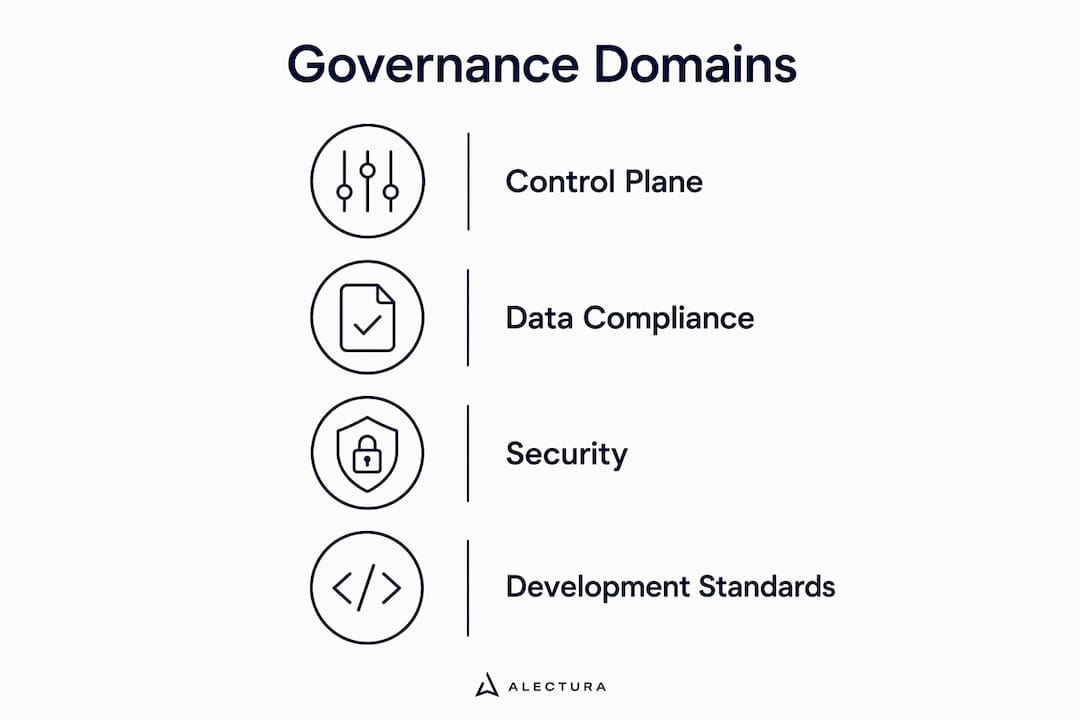
The four domains to enforce:
- Control plane: ownership, identity, access scopes, and audit trail
- Data governance and compliance: classification, residency, redaction, and DLP
- Security: endpoint threat protection, SOC integration, SIEM and SOAR
- Development standards: approved frameworks, policy-as-code, and secure integration patterns
Immediate action checklist:
- Run an endpoint discovery sweep to inventory every AI agent, copilot, and browser assistant active across your fleet.
- Register the agent inventory with your SIEM so agent activity is visible inside existing SOC workflows.
- Apply a temporary deny-by-default policy for all outbound tool access until scoped permissions are assigned.
Table of Contents
- How the four-domain governance framework fits together
- Prioritised steps to govern AI agents on endpoints
- Feeding agent telemetry into your SIEM and SOAR
- Design patterns that prevent unsafe agent actions
- Australian compliance obligations and what they mean for your controls
- Policy templates and checklists your team can adapt today
- KPIs and a maturity model to measure governance progress
- Alectura AIDR covers the full governance framework from day one
- Key takeaways
- A practitioner's view on what actually matters in week one
- Useful sources for deeper reading
How the four-domain governance framework fits together
Microsoft's enterprise guidance structures AI agent governance across exactly these four domains, and the framing holds up in practice because each domain owns a distinct failure mode.
The control plane is where ownership and identity live. Every agent needs a registered owner, a scoped service account per tool, and an observable audit trail. Without this, you cannot answer the most basic incident question: what did this agent have access to, and who authorised it?
Data governance and compliance covers classification enforcement, data residency controls, redaction before data leaves the endpoint, and the audit evidence your compliance team will need. For Australian enterprises, this domain is where Privacy Act obligations and cross-border data transfer controls get operationalised as technical controls rather than policy documents.
The security domain is your SOC's entry point: endpoint threat protection, runtime enforcement, sandboxing, and the telemetry feeds that flow into SIEM and SOAR. Agents must not be a blind spot in your detection stack.
Development standards govern how agents are built and integrated: approved frameworks, policy-as-code, testing gates, and secure integration patterns for MCP and other tool interfaces. This domain prevents governance debt from accumulating in the build pipeline.
| Domain | Core controls | Primary owner |
|---|---|---|
| Control plane | Identity, ownership registry, access scopes, audit trail | IAM / platform team |
| Data governance | Classification, residency, redaction, DLP, retention | Data / compliance team |
| Security | Threat detection, sandboxing, SIEM/SOAR telemetry, runtime enforcement | SOC |
| Development standards | Approved frameworks, policy-as-code, integration testing | Engineering / AppSec |
Prioritised steps to govern AI agents on endpoints
Treat this as a phased plan, not a big-bang deployment. The goal in the first two weeks is visibility; policy enforcement comes once you know what you are dealing with.
- Phase 0 (weeks 0–2): Discovery. Deploy endpoint discovery across your fleet. Inventory every AI tool, copilot, IDE assistant, and MCP server. Flag tools with access to sensitive data or privileged accounts immediately.
- Phase 1 (weeks 2–8): Pilot. Apply least-privilege tool accounts for a subset of high-risk endpoints. Set outbound deny-by-default rules. Instrument telemetry to your SIEM. Run a small user group through the policy and measure false positives daily.
- Phase 2 (months 2–6): Expand. Roll policies across the broader estate. Integrate SOAR playbooks for automated containment. Extend data residency controls to cover cross-border agent connections.
- Phase 3 (ongoing): Operate. Continuous monitoring, policy tuning, maturity measurement, and quarterly policy reviews.
Pilot validation checklist:
- Discovery accuracy: does the inventory match what IT provisioned plus shadow AI?
- Policy enforcement: are deny decisions deterministic and logged?
- Telemetry completeness: are all required fields reaching the SIEM?
- Incident playbook: has the containment sequence been tested end-to-end?
The Agent Governance Toolkit recommends running each agent in a separate container for OS-level isolation and cleaner telemetry boundaries. That is worth building into your pilot architecture from day one.
Pro Tip: Start with your highest-privilege roles and highest-risk endpoints, not a representative sample. Measure policy false-positive rates in week one and tune thresholds before expanding. A noisy policy that blocks legitimate work will kill adoption faster than any technical gap.

Feeding agent telemetry into your SIEM and SOAR
Agent governance must be visible inside existing SOC workflows, not siloed in a separate console. That means structured telemetry flowing into your SIEM from day one.
Collect these fields for every agent event: agent ID, host ID, user context, policy ID, request and response snapshot, tool name, resource accessed, timestamp, and decision reason. Without the decision reason field, your analysts cannot distinguish a legitimate deny from a misconfigured policy.
Ingestion pattern: Normalise agent events to CEF or Elastic Common Schema before they hit your SIEM. Map policy decision events (allow/deny) to a dedicated source type so you can write detection rules against them without noise from unrelated endpoint telemetry. SOAR playbooks should enrich agent alerts with endpoint context automatically: pull the agent's inventory record, the user's role, and the last five tool calls before the alert fired.
For incident response, the playbook sequence is: detection (policy deny or anomaly alert) → enrich (pull agent record, user context, recent tool calls) → contain (kill process or isolate device) → forensic capture (decision logs, prompt timeline, resource access records) → policy review (did the policy work as intended, or did it catch something it should not have?).
Design patterns that prevent unsafe agent actions
The core principle here comes from the Institute for AI Policy and Strategy: agents should not be able to execute sensitive actions without explicit authorisation, especially under uncertain conditions. Fail-closed is not a nice default; it is the only defensible starting point.
Policy enforcement belongs in deterministic middleware that evaluates every tool call before it reaches the wire. A denied action must be structurally impossible, not merely unlikely. The Agent Governance Toolkit implements exactly this pattern: policy verdicts are computed before tool calls execute, and every decision is logged with a tamper-evident record.
Authorization flow:
- Scoped service accounts per tool, not broad user-level permissions
- Delegation chains using short-lived credentials with explicit expiry
- Explicit human authorisation required for sensitive actions: bulk data export, schema changes, external API calls to new domains
- Deny-lists for destructive commands:
DROP TABLE, mass email dispatch, credential rotation without approval
Runtime safety controls:
- Sandbox privilege rings to contain blast radius if an agent is compromised
- Kill switches and SRE circuit breakers for runaway or looping agent behaviour
- Anomaly detection on tool call frequency and data volume as secondary signals
Australian compliance obligations and what they mean for your controls
Australia's Privacy Act 1988 and the Notifiable Data Breach (NDB) scheme are the primary compliance drivers for most enterprise teams. When an AI agent accesses, processes, or transmits personal information, the Privacy Act's Australian Privacy Principles apply. If an agent causes an eligible data breach, the NDB scheme requires notification to the Office of the Australian Information Commissioner and affected individuals.
Practically, this means your DLP and redaction controls are not just security features; they are compliance evidence. Tamper-evident audit logs of every agent decision are what your legal team will need if a breach notification is required. For data leakage prevention in regulated sectors, the audit trail is often the difference between a manageable incident and a regulatory finding.
APRA-regulated entities face additional obligations. Prudential Standard CPS 234 requires that information security capability is commensurate with the threat environment, and CPS 230 (operational resilience) demands that third-party and technology dependencies are managed with documented controls. Managed agent services and third-party AI tools fall squarely inside that scope.
Audit evidence checklist:
- Policy records: what rules were active, when they were applied, and who approved them
- Decision logs: every allow and deny with timestamp, agent ID, and decision reason
- Identity delegation logs: which service accounts were active and what they accessed
- Telemetry exports to SIEM: retained for the period your incident response policy requires
- Pilot test results: discovery accuracy, false-positive rates, and containment test outcomes
The EU AI Act sets a comparative reference point for cross-border obligations; Australian organisations operating in EU markets should map their controls against its requirements as a secondary compliance layer.
Policy templates and checklists your team can adapt today
Start with these fragments and extend them to fit your environment.
- Tool capability scope policy: define allowed tool categories per agent role (read-only data access, write to approved repositories, no external API calls without explicit listing). Deny everything not on the allow-list.
- Denied action list:
DROP TABLE,DELETE *, mass email dispatch, credential export, schema modification, any write to a production database without a change ticket reference. - Data classification enforcement rule: agents operating on data classified Sensitive or above must redact output before transmission and log the redaction event.
- Retention limit: agent decision logs retained for a minimum of 90 days; prompt timelines retained for 30 days unless an incident is open.
- Agent onboarding checklist: discovery scan confirms agent is inventoried → data classification assigned → tool scope defined → pilot policy applied → telemetry validated in SIEM → user training completed.
- Incident runbook template: detection criteria (policy deny threshold or anomaly score) → containment steps (kill process, isolate endpoint) → forensic capture (decision logs, prompt timeline, resource access) → communications checklist (legal, privacy officer, APRA if regulated) → post-incident policy review trigger.
The OWASP State of Agentic AI Security provides a comprehensive risk category taxonomy that maps well to these policy fragments.
KPIs and a maturity model to measure governance progress
| KPI | Data source | Owner | Cadence |
|---|---|---|---|
| Agent discovery coverage (% of endpoints reporting) | Endpoint agent telemetry | SOC / platform | Weekly |
| Policy enforcement rate (deny vs allow ratio) | SIEM policy decision logs | SOC | Daily |
| Mean time to containment for agent incidents | SOAR case records | Incident response | Per incident |
| False-positive rate on policy denies | Policy decision logs + analyst review | SOC | Weekly |
| Sensitive data exposure count | DLP / redaction logs | Data / compliance | Daily |
| Unauthorised tool call count | Telemetry | SOC | Daily |
Maturity ladder:
- Baseline: discovery only; you know what agents are running.
- Managed: policies active, telemetry flowing to SIEM, deny-by-default enforced.
- Integrated: SOAR playbooks automated, SRE circuit breakers active, APRA/NDB evidence assembled.
- Optimised: automated remediation, continuous policy testing, chaos testing of kill switches, SLO-based agent reliability targets.
The Agent Governance Toolkit includes SRE and audit components, including SLOs, chaos testing, and tamper-evident audit logs, that operational teams can borrow directly for the Integrated and Optimised tiers.
Alectura AIDR covers the full governance framework from day one
Most teams spend weeks building discovery tooling before they can write a single policy. Alectura's AI Detection & Response platform compresses that to days.

Alectura maps directly to all four governance domains: endpoint discovery and agent inventory for the control plane, DLP and redaction for data governance, real-time detection with SIEM and SOAR connectors for security, and centralised policy enforcement with on-device audit logging for development standards. The deny-by-default policy engine enforces decisions at the middleware layer before tool calls execute, exactly the fail-closed pattern the IAPS field guide recommends.
For Australian enterprise teams, the on-device audit logging and tamper-evident decision records mean your NDB and APRA evidence is assembled continuously, not assembled in a panic after an incident. Out-of-the-box SIEM connectors and prebuilt SOAR playbooks mean your SOC does not need to build ingestion pipelines from scratch.
Run a 30–60 day endpoint pilot with Alectura to validate discovery accuracy, test policy enforcement, and measure containment times against your baseline. Check Alectura's pricing to scope the pilot for your fleet size.
Key takeaways
Effective AI agent governance requires a four-domain, fail-closed approach with endpoint discovery running before any policy is written, telemetry flowing into your SIEM from week one, and Australian compliance evidence assembled continuously.
| Point | Details |
|---|---|
| Start with discovery | Run an endpoint sweep before writing policies; you cannot govern what you cannot see. |
| Fail-closed by default | Deny-by-default at the middleware layer makes unsafe agent actions structurally impossible, not just unlikely. |
| SIEM/SOAR integration | Agent telemetry must flow into existing SOC workflows; siloed agent consoles create detection blind spots. |
| Australian compliance | DLP, redaction, and tamper-evident decision logs are the evidence base for Privacy Act, NDB, and APRA obligations. |
| Alectura AIDR | Covers all four governance domains with out-of-the-box discovery, policy enforcement, SIEM connectors, and on-device audit logging. |
A practitioner's view on what actually matters in week one
The governance frameworks are sound. The gap is almost always the same: teams underestimate how many AI agents are already running before the pilot starts. In every discovery sweep, the inventory count comes in higher than IT's asset register suggests. Browser-based copilots, IDE assistants, and embedded AI in SaaS tools rarely appear in procurement records.
The practical lesson is to treat week one as a calibration exercise, not a policy enforcement exercise. Run discovery, compare the count against your known inventory, and use the gap to brief your CISO before you touch a single policy setting. That gap is your risk exposure number, and it is far more persuasive in a budget conversation than any framework diagram.
The second thing to watch: false positives on deny policies will spike in the first 48 hours. Tune thresholds before you expand beyond the pilot group, or you will spend more time managing helpdesk tickets than improving security posture.
Useful sources for deeper reading
- Microsoft AI agent governance guidance: start here for the four-domain framework and SIEM/SOAR integration patterns. SOC engineers and platform engineers should read this first.
- OWASP State of Agentic AI Security: comprehensive risk taxonomy and security controls. Essential reading for SOC engineers building detection rules.
- Agent Governance Toolkit (AGT): reference implementation for policy engines, zero-trust identity, sandboxing, and SRE controls. Platform engineers building policy middleware should start here.
- IAPS AI Agent Governance Field Guide: expert rationale for fail-closed controls and human-in-the-loop approvals. Useful for compliance leads justifying governance investment to leadership.
- EU AI Act: relevant for Australian organisations with EU market exposure; use as a secondary compliance mapping layer alongside Privacy Act obligations.
By role:
- SOC engineer: read Microsoft guidance and OWASP first, then AGT for telemetry field specs and playbook patterns.
- Platform engineer: start with AGT for policy engine architecture and identity mesh specifications.
- Compliance lead: IAPS field guide for governance rationale, then map controls to NDB notification requirements and APRA CPS 234/230 obligations.