
Implement a closed telemetry-to-enforcement loop at the endpoint level — not just observability dashboards — so your SOC can detect and stop malicious or risky agent actions before they complete. The single most useful next step: scope a 30-day inventory pilot across your highest-risk endpoints, instrument prompt timelines and process telemetry first, and use that data to set your enforcement baselines before rolling wider.
AI agents are already running on your fleet. Most security stacks cannot see them.
Table of Contents
- What is AI agent monitoring and why does AIDR matter?
- The telemetry-to-enforcement loop: the critical missing link
- Which endpoint telemetry should you collect?
- How do you discover and inventory AI agents across your fleet?
- Closing the loop: enforcement actions, playbooks, and SOC integrations
- Deployment checklist for Australian enterprises
- How to evaluate AIDR solutions for your enterprise
- Key takeaways
- The gap most teams are still ignoring
- Alectura brings AIDR to your enterprise endpoints
- Useful sources for Australian security teams
What is AI agent monitoring and why does AIDR matter?
AI agent monitoring, or AI Detection & Response (AIDR), is the practice of collecting decision-level telemetry from AI agents running on endpoints, evaluating that telemetry against policy in real time, and enforcing governance actions before violations complete. It is not the same as application performance monitoring or traditional EDR, though it builds on both.
EDR gives you process and network telemetry. What it cannot see is the reasoning layer: which tool an agent called, what prompt it received, what data it touched, and whether that sequence violated policy. Decision-level transparency, end-to-end traceability, and enforceable governance are the three attributes that separate AIDR from point observability tools.
The risks that make this urgent for Australian enterprises:
- Data exfiltration: Copilots with file and API access can silently move sensitive data to external endpoints.
- Prompt injection: Malicious instructions embedded in content the agent reads can redirect its actions entirely.
- Unauthorised tool calls: Agents operating under broad permissions can invoke capabilities their human principal never intended.
- Lateral movement: A compromised agent can pivot across systems using the credentials and MCP connections it already holds.
- Regulatory exposure: Under the Australian Privacy Principles (APPs), a data breach caused by an AI agent carries the same notification obligations as any other breach.
AI agent observability extends traditional MELT data (metrics, events, logs, traces) with AI-specific signals: token usage, tool interactions, and decision traces that answer why an agent acted, not just that it did. AIDR takes that a step further by closing the loop with enforcement.
The telemetry-to-enforcement loop: the critical missing link
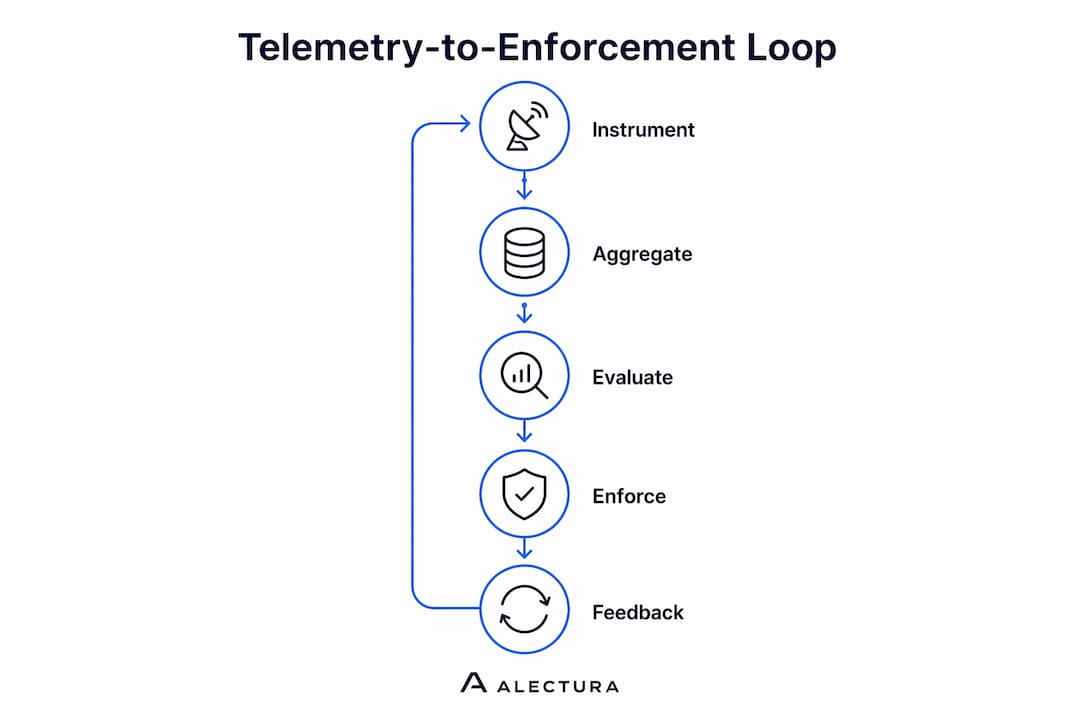
Dashboards without enforcement leave you watching violations happen. Security researchers identify the telemetry-to-enforcement loop as the critical missing link: post-hoc observability cannot stop a prompt injection mid-flight or revoke a token before exfiltration completes.

The loop has five stages: instrument → aggregate → evaluate → enforce → feedback. Each stage must hand off to the next with minimal latency. A GAAT prototype demonstrated this is achievable: end-to-end enforcement at P50 = 127 ms and P99 = 192 ms, with a dramatic reduction in violation escape rate compared to dashboard-only baselines.
That sub-200 ms target is your benchmark. If your enforcement path cannot meet it, policy violations escape before the agent action completes. Measure your Mean Time to Contain (MTTC) and enforcement latency percentiles from day one of your pilot.
Pro Tip: Avoid blanket quarantine as your first enforcement response. Graduated interventions — warn, redact, throttle, isolate — reduce false-positive disruption and give your SOC time to triage. Reserve device isolation for confirmed high-severity events.
Which endpoint telemetry should you collect?
Structured telemetry using OpenTelemetry gen_ai semantic conventions lets you reconstruct multi-turn agent reasoning chains for forensics and compliance. Unstructured logs do not.
| Signal | Why it matters | Collection mechanism | Retention note |
|---|---|---|---|
| Prompt timeline (input/output) | Detects injection, policy drift, data leakage | Agent SDK / OTel gen_ai spans | Redact PII before storage; retain per APP schedule |
| Tool call metadata | Identifies unauthorised capability invocation | OTel span attributes | Retain for incident reconstruction |
| LLM call metadata (tokens, model, latency) | Cost control, anomaly baseline | OTel gen_ai conventions | Aggregate; raw logs 90 days |
| Process and thread provenance | Links agent actions to parent processes | EDR hook / kernel telemetry | Standard EDR retention |
| File access events | Detects exfiltration attempts | EDR hook | Align with DLP policy |
| Network and API calls | Maps external data flows | EDR / network sensor | Retain per data residency rules |
| Credential and token usage | Flags secret leakage or misuse | Secret scanner / agent SDK | Immediate alert on new exposure |
| Browser and extension activity | Finds shadow copilots and BYOA tools | Browser telemetry agent | Privacy-scoped; minimise collection |
| MCP server connections | Discovers unmanaged control plane access | Network + process telemetry | Flag new MCP endpoints immediately |
For Australian deployments, data residency matters. Prompt content containing personal information is likely to be personal information under the APPs. Store it in-region, apply minimisation at the collection point, and document your retention schedule before your pilot goes live.
Detection rules to build first: token-volume anomaly (sudden spike in output tokens), novel tool invocation (first-seen tool call for an agent identity), and outbound API call to an unlisted domain.
How do you discover and inventory AI agents across your fleet?
Discovery is where most enterprises find the biggest surprises. Shadow copilots, BYOA browser extensions, and unregistered MCP servers rarely appear in your asset register.
- Network scanning and DNS analysis. Query DNS logs for known AI provider domains (OpenAI, Anthropic, Azure OpenAI, Google Gemini endpoints). Agents that call external LLMs leave a network trail even when the application is invisible to your EDR.
- Process signature matching. Build signatures for known agent runtimes (Python with LangChain, Node with Vercel AI SDK, IDE extensions). Run these against your EDR process inventory weekly.
- API key and token sweeps. Scan code repositories, environment variables, and secrets managers for AI provider API keys. Each key is a potential unmanaged agent.
- Browser extension inventory. Enumerate installed extensions across your fleet. AI-powered extensions (writing assistants, code completers, summarisers) have direct access to page content including credentials and sensitive documents.
- MCP server discovery. Query process and network telemetry for MCP server signatures. These are often installed by developers and invisible to traditional asset management.
- Telemetry correlation. Cross-reference your OTel spans with your asset register. Any agent identity generating spans that has no corresponding asset record is a gap.
Once you have a list, prioritise by: agents with access to PII or financial data first, then admin-system integrations, then general productivity tools. Ephemeral agents (spun up in CI/CD pipelines or serverless functions) need a separate inventory track — they will not appear in persistent process lists.
Closing the loop: enforcement actions, playbooks, and SOC integrations
Enforcement without a playbook is noise. Map your response actions to severity tiers before you go live.
Graduated responses from lowest to highest severity: L0 Allow (log only, baseline building), L1 Warn (alert SOC, no action), L2 Redact (strip sensitive content from agent output), L3 Throttle (rate-limit or pause agent), L4 Isolate (device or token quarantine).
Three playbooks your SOC needs on day one:
Secret leak: Agent output contains an API key or credential pattern → L2 Redact immediately, L1 alert to SOC, token revocation within 15 minutes, incident ticket auto-created in your SOAR.
Prompt injection: Agent receives instruction from external content that deviates from its registered policy scope → L3 Throttle, SOC triage within 30 minutes, review full prompt timeline for the session.
Unauthorised tool call: Agent invokes a tool not in its registered capability set → L1 alert, capability audit, escalate to L4 if the tool has data-exfiltration potential.
Integration checklist: SIEM (forward all L1+ events), SOAR (automate ticket creation and token revocation), EDR (share process provenance for correlation), MDM (device isolation trigger), DLP (redaction pipeline for L2 actions).
Pro Tip: Build a rollback path for every enforcement action before you deploy it. An L4 isolation that cannot be reversed quickly will create more disruption than the incident it stopped. Test rollback in your pilot environment first.
Runtime governance frameworks recommend multi-tier privilege sandboxing and zero-trust agent identities (cryptographic credentials per agent) to limit lateral movement when an agent is compromised.
Deployment checklist for Australian enterprises
Pilot to production timeline:
- Weeks 1–2: Scope pilot (50–200 endpoints, highest-risk segment), deploy discovery, instrument OTel telemetry, establish baselines.
- Weeks 3–4: Enable L1/L2 enforcement, tune detection rules, measure MTTC and false-positive rate.
- Month 2: Expand to next risk tier, integrate SIEM and SOAR, complete SOC runbook sign-off.
- Month 3+: Phased fleet rollout, compliance reporting live, quarterly tuning cycle.
Cost drivers to budget:
- Per-endpoint licence (the primary variable; see Alectura's pricing for enterprise tiers)
- Telemetry volume and storage (prompt timelines are large; minimisation reduces cost)
- Integration engineering (SIEM/SOAR connectors, 2–5 days typical)
- Retention and data residency (in-region storage carries a premium)
- Support SLA tier (critical for SOC teams needing sub-4-hour response)
Australian compliance mapping:
- APPs 1, 3, 6, 11: Document what personal information your telemetry captures, why, and how long you retain it.
- Notifiable Data Breaches scheme: AIDR logs are your evidence trail if an agent-caused breach triggers notification obligations.
- Data residency: Confirm your AIDR vendor stores prompt content and audit logs in Australia or in a jurisdiction your privacy policy permits.
Cross-team alignment matters as much as the technology. Bring legal and privacy into your pilot scope decision — they will flag APP obligations you might miss. IT needs to know about the EDR hook before it ships. The GAAT research showed that closed-loop enforcement dramatically reduces violation escape rate, but only when the enforcement path is actually deployed and tuned.
How to evaluate AIDR solutions for your enterprise
Seven dimensions that separate enterprise-ready AIDR from developer observability tools:
- Discovery breadth: Does it find shadow copilots, browser extensions, and MCP servers, not just instrumented agents?
- Real-time enforcement: Is enforcement on-device (sub-200 ms) or network-only (higher latency, blind to local actions)?
- Integrations: Native connectors for your SIEM, SOAR, EDR, MDM, and DLP stack, not just webhook exports.
- Audit and compliance features: On-device audit logs, data residency controls, and report templates for Australian obligations.
- Scalability and footprint: What is the per-endpoint CPU and memory overhead at P99 load?
- Pricing model: Per-endpoint subscription with a defined pilot tier is the standard; avoid solutions that only price by event volume (costs become unpredictable at scale).
- SOC workflow support: Does the vendor provide alert triage guidance, false-positive SLAs, and runbook templates?
Questions worth asking vendors: What is your enforcement path latency at P99? Can policy be enforced on-device without a cloud round-trip? How do you handle ephemeral agents in CI/CD pipelines? What Australian data residency options exist?
Pilot acceptance criteria: detection coverage above 90% of instrumented agents, false-positive rate below 5% after two weeks of tuning, enforcement latency P99 under 200 ms, at least one SIEM integration live, and a SOC runbook successfully executed against a simulated incident.
Pro Tip: Run a tabletop exercise against a simulated prompt injection during your pilot. It will expose gaps in your playbook faster than any configuration review.
The MI9 runtime governance framework proposes continuous authorisation and graduated containment as the architectural pattern for enterprise-grade AIDR — useful as a reference when evaluating whether a vendor's enforcement model is genuinely runtime or just post-hoc alerting.
Key takeaways
Effective AI agent monitoring requires a closed telemetry-to-enforcement loop at the endpoint level, with sub-200 ms enforcement latency and structured telemetry that supports both real-time detection and forensic reconstruction.
| Point | Details |
|---|---|
| Close the loop, not just the dashboard | Post-hoc observability cannot stop violations; enforcement must complete before agent actions do. |
| Sub-200 ms is your latency benchmark | GAAT prototype data shows P99 enforcement at 192 ms is achievable and reduces violation escape rate by 97.6%. |
| Discovery finds what your asset register misses | Shadow copilots, browser extensions, and MCP servers will not appear in traditional inventories. |
| Australian APPs apply to agent telemetry | Prompt content containing personal information is regulated; document retention and residency before your pilot. |
| Alectura covers the full AIDR loop | Endpoint discovery, prompt timeline tracking, real-time detection, and enforcement actions in a single platform. |
The gap most teams are still ignoring
The conversation in Australian enterprise security has moved fast on EDR and XDR. What has not kept pace is the recognition that AI agents are a fundamentally different threat surface — not because they are exotic, but because they are already everywhere and almost nobody has inventoried them.
The instinct I see most often is to treat AI agent risk as an application security problem and hand it to the dev team. That is the wrong frame. When a copilot with access to your finance system receives a prompt injection from a malicious document and exfiltrates data, that is an endpoint security incident. The dev team did not cause it and cannot contain it. Your SOC needs the telemetry, the playbook, and the enforcement capability to respond — and most SOCs do not have any of those three things for AI agents yet.
The false-positive problem is real but solvable. The teams that struggle are the ones that deploy enforcement before they have two weeks of baseline telemetry. The ones that get it right run discovery and logging first, build their baselines, then graduate to enforcement with tuned thresholds. That sequence is not glamorous, but it is the difference between a tool your SOC trusts and one they disable after the first wave of alerts.
Cross-team collaboration is the other underrated factor. Legal and privacy need to sign off on what telemetry you collect before it goes to production. IT needs to understand the EDR hook. Without that alignment, your pilot will stall at the approval stage, not the technical stage.
Alectura brings AIDR to your enterprise endpoints
Most enterprise security stacks have a blind spot the size of every AI tool your people use daily. Alectura closes it. Where traditional EDR stops at process and network telemetry, Alectura's AIDR platform extends visibility to the reasoning layer: discovering every AI tool across your fleet, tracking prompt timelines, detecting secrets, PII, and prompt injection in real time, and enforcing graduated responses from redaction through to device isolation.

For Australian enterprises, Alectura supports on-device audit logging and data residency configurations that map directly to APP obligations and the Notifiable Data Breaches scheme. Integration with your existing SIEM, SOAR, and EDR stack is built in, not bolted on. Deployment follows the pilot-to-production model outlined above, with per-endpoint pricing that scales predictably as you expand coverage.
Start with a 30-day pilot on your highest-risk endpoints. Book a demo or review per-endpoint pricing to scope your pilot budget.
Useful sources for Australian security teams
"Governance-aware telemetry that closes the loop between observability and enforcement is not a future capability — prototype systems already demonstrate sub-200 ms enforcement with dramatic reductions in violation escape rate." — GAAT research, arxiv.org/html/2604.05119
- Governance-Aware Agent Telemetry (GAAT): The primary research reference for enforcement latency benchmarks and the telemetry-to-enforcement architecture. Directly supports Sections 3 and 7.
- MI9 Runtime Governance Framework: Defines continuous authorisation, agency-risk indexing, and graduated containment for agentic systems. Supports Sections 3 and 8.
- IBM: AI Agent Observability: Accessible explanation of MELT extension for AI agents; useful for teams building the case internally. Supports Section 2.
- OpenTelemetry gen_ai conventions (via Sentry developer guide): Practical implementation guide for structured telemetry and semantic spans. Supports Section 4.
- Microsoft Agent Governance Toolkit: Reference implementation for multi-tier privilege rings, zero-trust agent identity, and sandboxing. Supports Sections 6 and 7.
- Alectura AIDR: Vendor landing page for the AIDR platform referenced throughout this article; starting point for pilot scoping and feature evaluation.