
What is AI data loss prevention on endpoints?
AI data loss prevention (AI DLP) is the real-time detection and control of sensitive data moving through AI tools running on enterprise endpoints. That covers copilots in the browser, coding assistants in the IDE, and AI agents embedded in the apps your people already use every day.
Core AI DLP functions include:
- Discovery and inventory of AI tools active across the fleet
- Real-time monitoring of prompts, uploads, and AI-generated responses
- Redaction and blocking of sensitive content before it leaves the endpoint
- Audit logging for governance and incident response
The Australian Privacy Principles require organisations to protect personal information from unauthorised access, and that obligation extends directly to AI-driven data processing. Alectura's AI Detection & Response (AIDR) platform addresses this at the endpoint level, providing discovery, policy enforcement, and compliance logging without disrupting workflow.
Table of Contents
- Inbound and outbound AI data risks in Australian enterprises
- How to implement AI Detection & Response for your security team
- Why real-time redaction matters more than post-incident review
- Australian data privacy regulations shaping AI DLP policy
- Training AI models to recognise sensitive data in your environment
- Risk assessment for AI-driven data loss scenarios
- Incident response planning for AI data leakage events
- Employee awareness programmes for AI data loss risks
- Alectura gives your security team real control over endpoint AI
- Key takeaways
Inbound and outbound AI data risks in Australian enterprises
Two distinct risk vectors matter here. Inbound risk is sensitive data your staff send into AI tools via prompts or file uploads. Outbound risk is sensitive data an AI surfaces in its responses, pulled from internal sources through retrieval or grounding.
A significant portion of AI prompts analysed by Harmonic Security in Q2 2025 contained sensitive content. That figure reflects routine behaviour: sharing a support ticket, uploading a spreadsheet, asking a copilot to summarise an inbox. The exposure is rarely deliberate.
44.7% of AI prompts in Q2 2025 contained sensitive content — Harmonic Security
Australian enterprise security frameworks require explicit controls on both vectors. The OAIC's AI and privacy guidance is clear that successful governance moves from passive detection to active enforcement: real-time redaction or blocking, paired with transparent audit trails. Passive log collection after the fact is not enough.
Alectura enforces policy at the moment of interaction, notifying users when a guardrail triggers rather than silently logging events for later review.

How to implement AI Detection & Response for your security team
Start with visibility. You cannot govern what you cannot see, and most enterprises have AI tools running on endpoints that never appeared in a procurement request. Alectura's AIDR platform discovers and inventories every AI tool across the fleet, including MCP server connections and third-party integrations, before any policy is applied.
From there, the implementation sequence is straightforward:
- Inventory all AI tools and the data access each holds
- Classify sensitive data types relevant to your environment (PII, credentials, IP)
- Define policies mapped to classification levels, not blanket blocks
- Enforce at the endpoint with real-time detection and prompt timeline tracking
- Integrate with your SIEM and SOAR for centralised alerting and response
Microsoft Purview DLP demonstrates the pattern for copilot DLP: policies block Copilot from processing prompts containing sensitive information types, preventing both internal and external data exposure. The same logic applies across any AI tool on the endpoint.
Why real-time redaction matters more than post-incident review
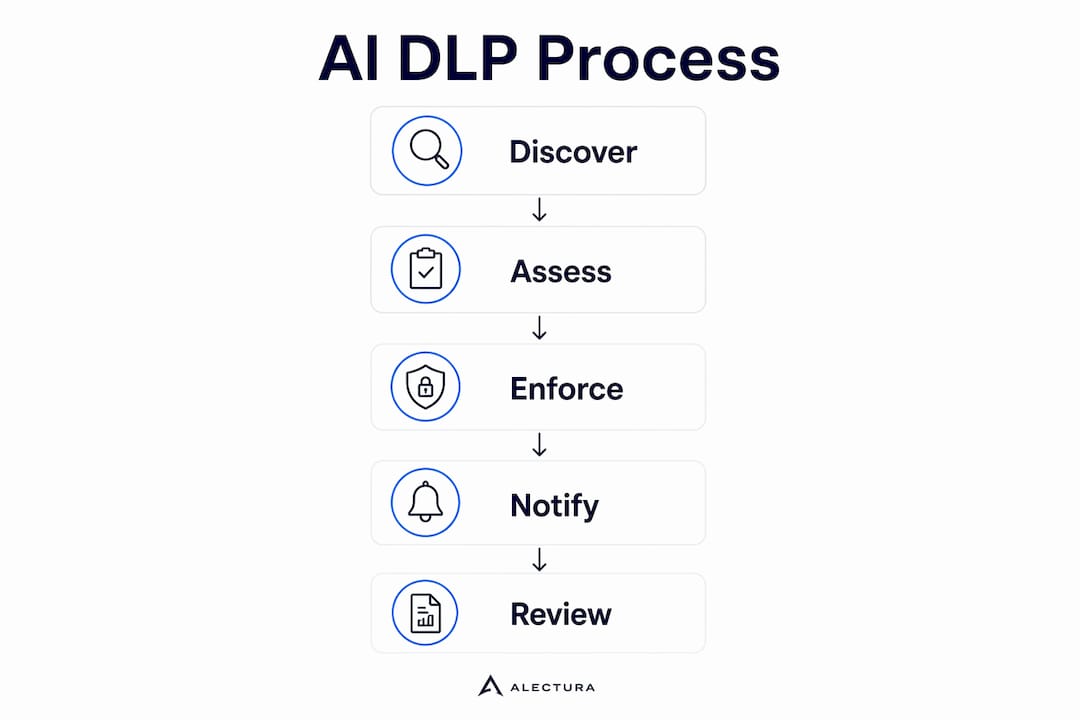
Blocking a high-risk AI interaction at the moment it occurs prevents the exposure entirely. Reviewing a log three days later does not. Real-time redaction strips sensitive values from a prompt before the AI model receives them, preserving the workflow while protecting the data.
For Australian enterprises, this distinction carries regulatory weight. A breach notification obligation under the Notifiable Data Breaches scheme is triggered by actual exposure, not by a logged event that was never actioned. Catching the interaction before the data leaves the endpoint keeps the organisation on the right side of that threshold.
User notifications at the moment of risk also convert security events into learning moments, reducing repeat behaviour without requiring separate training interventions.
Australian data privacy regulations shaping AI DLP policy
The Privacy Act 1988 and the Australian Privacy Principles sit at the centre of any enterprise AI DLP framework. APP 11 requires organisations to take reasonable steps to protect personal information from misuse, interference, loss, and unauthorised access. When AI tools on endpoints can read, summarise, and transmit that information, "reasonable steps" now includes endpoint-level AI controls.
The Notifiable Data Breaches scheme adds urgency: eligible data breaches involving personal information must be reported to the OAIC and affected individuals. An AI tool exfiltrating customer records through a poorly governed prompt is an eligible breach.
Sector-specific obligations layer on top. Healthcare organisations must satisfy the My Health Records Act; financial services firms operate under APRA's CPS 234. Both frameworks expect demonstrable controls, not aspirational policies.
Training AI models to recognise sensitive data in your environment
Generic sensitive information types — credit card numbers, passport numbers, Medicare numbers — are a starting point, not a finish line. Australian enterprises carry data that requires custom classification: ABNs, TFNs, state-specific licence identifiers, and internal project codes that carry commercial sensitivity without fitting a standard pattern.
Effective AI DLP training involves:
- Defining custom sensitive information types specific to your data environment
- Testing detection accuracy against real prompt samples before enforcement mode
- Iterating on false positives to avoid blocking legitimate workflows
- Reviewing classification rules as the AI tools in use evolve
Starting in simulation mode, as Microsoft's default Purview DLP policy does, lets security teams understand the impact of a policy before it blocks anything. That approach reduces friction at rollout and builds confidence in the ruleset.
Risk assessment for AI-driven data loss scenarios
AI-driven data loss scenarios differ from traditional DLP events in one important way: the user often has no idea they are causing a risk. Pasting a client contract into a generative AI tool to get a summary feels like a productivity win, not a security incident.
A useful risk assessment framework for AI DLP covers:
- Tool inventory risk: which AI tools have access to sensitive data stores?
- Prompt behaviour risk: what data types are staff most likely to include in prompts?
- Integration risk: which MCP servers or third-party connectors extend AI tool reach?
- Response risk: can AI-generated outputs surface data the user should not see?
Scoring each vector by likelihood and impact gives security teams a prioritised enforcement roadmap rather than a blanket block-everything approach that kills adoption.
Incident response planning for AI data leakage events
An AI data leakage incident needs its own response playbook, separate from a traditional endpoint breach. The prompt timeline is the key artefact: which user, which tool, which data, at what time. Without that log, attribution and scope assessment are guesswork.
A practical AI leakage response plan includes:
- Immediate isolation of the affected endpoint or AI tool session
- Prompt timeline retrieval from the AIDR platform
- Scope assessment of what data was exposed and to which AI provider
- NDB notification triage against the Privacy Act threshold
- Policy update to close the gap that allowed the interaction
Alectura's on-device compliance logging means the prompt timeline exists before the incident, not after a frantic log-collection exercise.
Employee awareness programmes for AI data loss risks
Technical controls work better when staff understand why they exist. An employee who receives a real-time notification that their prompt was blocked, with a plain-language explanation, is far more likely to adjust behaviour than one who receives a quarterly policy reminder email.
Effective awareness programmes for AI data loss focus on:
- Scenario-based training using real prompt examples from your environment
- Clear guidance on which AI tools are approved and which are not
- Feedback loops from security events back into training content
- Role-specific modules for high-risk teams handling regulated data
The goal is not to make staff afraid of AI tools. It is to make the safe path the obvious path.
Alectura gives your security team real control over endpoint AI
Most enterprise security stacks were built before AI tools became a fixture on every endpoint. They cannot see what a copilot is reading, what a coding assistant is sending, or what an AI agent is doing through an MCP integration.
Alectura is built specifically for this gap. AIDR discovers every AI tool running across your fleet, tracks prompt timelines, detects sensitive data in real time, and lets your team enforce policy without blocking the productivity your people depend on. It integrates with your existing SIEM and SOAR, so AI security events land in the same workflows your team already runs. Per-endpoint subscription pricing means you scale coverage as the fleet grows, with no hidden complexity.
If your team is responsible for AI data security across Australian enterprise endpoints, see how Alectura works or review per-endpoint pricing to scope a deployment.
Key takeaways
Effective AI data loss prevention requires endpoint-level visibility, active enforcement at the moment of interaction, and audit logging that exists before an incident occurs, not after.
| Point | Details |
|---|---|
| Prompt exposure is pervasive | 44.7% of AI prompts in Q2 2025 contained sensitive content, per Harmonic Security. |
| Active enforcement over passive logging | Real-time redaction and blocking prevents exposure; post-incident log review does not. |
| Australian Privacy Principles apply | APP 11 and the Notifiable Data Breaches scheme require demonstrable endpoint AI controls. |
| Risk assessment must cover AI-specific vectors | Prompt behaviour, tool integrations, and AI response risks each need separate scoring. |
| Alectura covers the full AIDR lifecycle | Discovery, policy enforcement, prompt timeline logging, and SIEM integration in one platform. |