
AI Detection and Response (AIDR) protects prompts, models, agents, and AI data flows in real time, and can automate containment when a threat is confirmed. For Australian enterprises, the recommended next step is straightforward: run a discovery pass across your endpoint fleet, then scope a pilot with Alectura AIDR before considering broader rollout.
Three things your security team can do right now:
-
Discover every AI tool running across managed endpoints, including browser copilots, IDE assistants, and MCP-connected agents
-
Map high-risk data flows where AI tools touch PII, credentials, or commercially sensitive content
-
Select a pilot scope of 50–200 endpoints that represent your highest-risk user groups (developers, finance, legal)
Table of Contents
What is AI detection and response (AIDR)?
AIDR is a security discipline that gives your team runtime visibility and control over the AI layer running across your environment. Where EDR watches what processes run on a device, AIDR watches what AI runs on it: the prompts users send, the agents acting on their behalf, the models those agents call, and the API and MCP connections those models use to reach data and external services.
The scope of what AIDR must cover is wider than most security teams initially expect:
-
Prompt content and response outputs from LLM interactions
-
Agent runtime behaviour, including tool calls and memory access
-
Model and agent identifiers, versions, and permission scopes
-
MCP server endpoints and API connections
-
File access events triggered by agent actions
-
Authentication events tied to machine-to-machine channels
-
Browser copilot sessions and IDE-embedded assistants
The contrast with existing tools is worth spelling out clearly:
| Dimension | EDR/XDR | DLP | AIDR |
|---|---|---|---|
| Detection scope | Process, file, network events | Data in motion/at rest | Prompts, agent runtime, model calls, MCP/API flows |
| Intent analysis | Signature and behavioural heuristics | Pattern matching (regex/classifiers) | Semantic intent analysis of prompt and response content |
| Agent visibility | None | None | Full agent relationship mapping and tool-call telemetry |
| Automated response | Process kill, network isolation | Block/quarantine transfer | Isolate agent, redact content, block model call, rollback action |
| Coverage of encrypted AI traffic | Limited (TLS inspection required) | Limited | On-device capture before encryption |
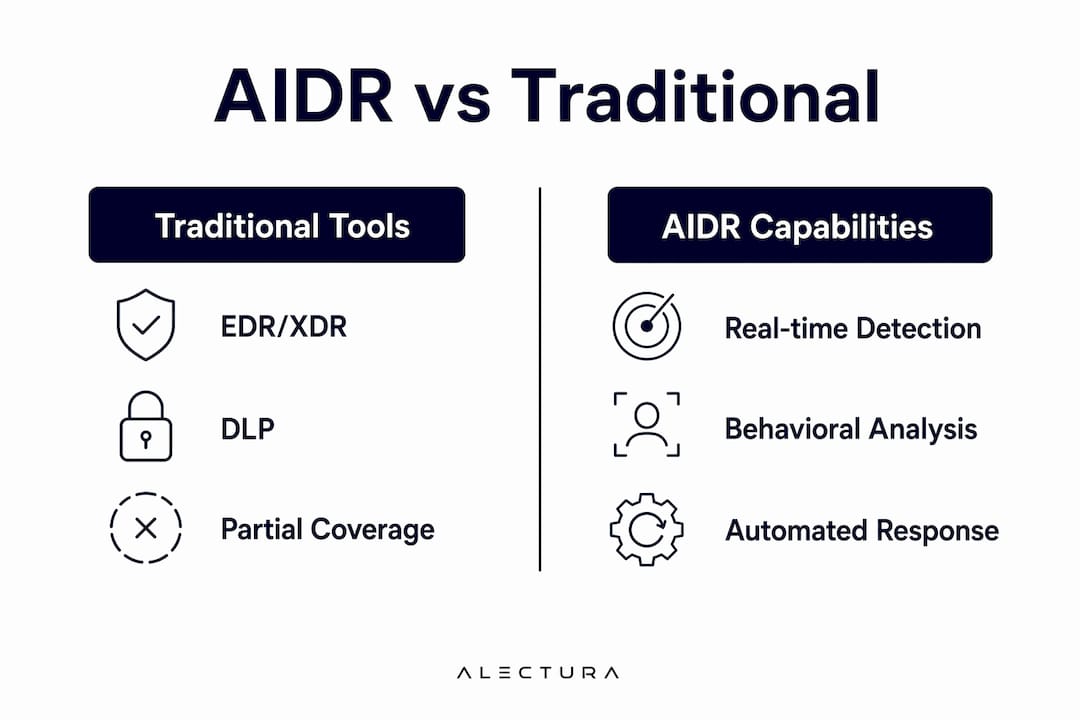
The AIDR framework combines real-time detection, behavioural analysis, and automated response across the AI stack — capturing prompt and response content and mapping agent relationships in ways that EDR and DLP simply were not designed to do.
Why traditional EDR/XDR/DLP falls short for AI-native risks
The honest answer is that EDR and XDR were built for a threat model centred on processes, files, and network connections. AI agents do not fit that model. They operate through natural-language instructions, call external tools over encrypted APIs, and can hold elevated permissions that let them read, write, and exfiltrate data without triggering a single traditional alert.
Specific gaps that matter in practice:
-
Semantic prompt content is invisible to EDR. A malicious instruction embedded in a prompt looks like ordinary HTTPS traffic to a network sensor.
-
Agentic tool chains bypass perimeter controls. An agent that calls a CRM API, then a file store, then an email service is executing a multi-step action that no single network rule catches end-to-end.
-
On-device copilots communicate directly with models, bypassing network proxies entirely. Endpoint-level collection is necessary to capture the full prompt context.
-
Encrypted API flows hide content from DLP. Standard DLP sees the destination but not the payload once TLS is established at the application layer.
-
Elevated agent permissions create a privileged insider risk. An agent granted access to a SharePoint tenant or a code repository can exfiltrate gigabytes of data through what looks like normal API usage.
Consider a realistic scenario: a developer’s IDE assistant is compromised via a malicious MCP server. The agent receives an injected instruction to summarise all open pull requests and email a diff to an external address. The action completes in under 30 seconds. EDR sees a process making an API call. DLP sees an outbound email. Neither sees the injected instruction that caused it, and neither can attribute the action to a specific agent session. Dedicated AIDR frameworks are emerging precisely because agentic systems communicate in ways traditional tools miss.
Pro Tip: Map your MCP server inventory before you scope a pilot. Exfiltration paths most often traverse API and MCP connections with elevated permissions, not the browser sessions your DLP already watches.
Core AIDR capabilities enterprises should require
Procurement conversations tend to get lost in feature lists. The table below cuts to what each capability actually does for your SOC and what to check during a vendor evaluation.

| Capability | Why it matters | What to verify in a pilot |
|---|---|---|
| Runtime agent telemetry | Captures what agents do, not just what users type | Full tool-call logging, memory access events, agent session IDs |
| Intent-based detection | Catches novel threats that have no signature | Semantic analysis of prompt content, not just regex patterns |
| Prompt capture and timeline | Reconstructs the full session for incident investigation | Searchable prompt/response history with timestamps and agent attribution |
| Agent behaviour baselining | Detects deviation from normal agent patterns | Baseline established within pilot window; alerts on anomalous tool calls |
| Data redaction and masking | Prevents PII and credentials reaching the model | Inline redaction before model call, configurable by data type |
| Automated containment | Reduces MTTR by acting at machine speed | Agent isolation, model call block, rollback of agent-initiated actions |
| Policy governance | Enforces rules consistently across all AI tools | Centralised policy authoring, per-collector assignment, audit log export |
| SIEM/SOAR integration | Connects AI incidents to your existing SOC workflow | Native connectors or webhook/API for your SIEM; SOAR playbook triggers |
| Endpoint vs cloud collection | Covers copilots and IDEs that bypass network proxies | On-device agent collector plus cloud/gateway collector for SaaS AI |
Detection approach matters as much as the feature list. The evolution from signature matching to abnormal behaviour and semantic intent analysis is the defining shift in modern threat detection. A vendor relying primarily on keyword lists or regex will miss prompt injection variants that rephrase the malicious instruction. Semantic intent analysis, combined with agent relationship mapping, is what catches those.
Explainable detections are also non-negotiable for SOC operations. Explainable AI techniques that surface why an alert was raised help analysts validate automated detections quickly and reduce false positives, which matters when your team is already stretched.
Response actions should span the full range: redact sensitive content before it reaches the model, block a specific model call, isolate the agent session, or trigger a SOAR playbook for complex remediation. AI-augmented SOAR integration can assess agent activity, isolate compromised agents, and initiate remediation within seconds.
How does AIDR collect and correlate telemetry?
A practical AIDR architecture has six layers, and understanding them helps you plan your deployment and your privacy controls simultaneously.

Collectors sit at the endpoint (a lightweight agent), in the browser (an extension), and in the IDE or application (an SDK or MCP proxy). These capture prompt content, response outputs, tool invocations, and metadata before traffic is encrypted. Endpoint and agent collectors are essential because IDEs and local copilots may communicate directly with models and bypass network proxies entirely.
The ingestion pipeline normalises telemetry from all collector types into a common schema, attaching agent identifiers, device context, and timestamps. The semantic analysis layer applies intent classification and LLM-based reasoning to prompt and response content, flagging injection attempts, sensitive data patterns, and policy violations. LLM-based frameworks can detect novel attack signatures with high accuracy and low latency by combining edge encoding with central transformer analysis.
The correlation engine maps relationships between agents, tools, users, and data assets, linking individual events into incident timelines. The response plane connects to your SOAR and SIEM for automated playbook execution and alert forwarding. The storage and audit layer retains logs for investigation, compliance reporting, and ML model retraining.
Telemetry signals the system must instrument:
-
Prompt content and model response outputs
-
Model and agent identifiers, versions, and session tokens
-
API calls and MCP server endpoint connections
-
File access and write events triggered by agent actions
-
Memory and tool-call sequences within agent sessions
-
Authentication events on machine-to-machine channels
-
Response outputs that contain sensitive data patterns
Pro Tip: Use synthetic telemetry to test detection rules during your pilot. Simulating known attack patterns against your policy set avoids exposing real production data while validating that your rules fire correctly.
Australian compliance considerations
Under the Notifiable Data Breaches scheme administered by the OAIC, organisations must notify affected individuals and the Commissioner when a data breach is likely to result in serious harm. AIDR audit logs provide the session-level evidence needed to assess scope and notify accurately. Minimise production data in your telemetry pipeline: redact PII at the collector before it reaches the ingestion layer, and retain only what your audit obligations require. The Australian Signals Directorate’s Essential Eight framework also informs how you should think about application control and privileged access, both of which AIDR policy governance directly supports.
Business benefits and Australian enterprise use cases
The business case for AIDR rests on four pillars: reduced data-leak risk, faster detection and response for AI-specific incidents, safer GenAI adoption at scale, and regulatory readiness under Australian law.
Analyst fatigue is a real cost. When AI incidents surface as generic network alerts or DLP hits with no agent context, analysts spend hours reconstructing what happened. AIDR surfaces the full prompt timeline and agent action sequence in the initial alert, cutting investigation time materially.
Three use cases that resonate with Australian enterprise decision-makers:
-
Financial services: A major bank’s customer service copilot handles account queries. AIDR monitors every prompt for PII exfiltration attempts, flags when a prompt includes account numbers destined for an unrecognised API endpoint, and redacts the content before the model call completes. The Privacy Act 1988 and Australian Privacy Principles make this a compliance requirement, not just a best practice.
-
Government agencies: A federal department deploys AI assistants for policy drafting. AIDR enforces topic restrictions, blocks prompts that reference classified project names, and logs every agent session for audit. ASD/ACSC guidance on AI security directly supports this use case.
-
Legal and professional services: A law firm’s developers use GitHub Copilot and Claude for contract review. AIDR baselines normal agent behaviour, detects when an agent begins accessing matter files outside its assigned scope, and isolates the session pending analyst review.
Positioning pilot metrics for procurement is straightforward: track sensitive exposures prevented, policy violations caught, and analyst hours saved on AI-specific investigations. These translate directly to risk reduction and operational efficiency arguments that CFOs and boards understand.
How to implement AIDR: a phased rollout for enterprise SOCs
Phased rollout checklist
-
Discovery (weeks 1–2): Deploy read-only collectors across a representative sample of endpoints. Inventory every AI tool, agent, and MCP connection in use. Identify data flows touching PII, credentials, or IP.
-
Risk-scoped pilot (weeks 3–6): Expand to your highest-risk user groups (50–200 endpoints). Enable detection-only mode. Establish agent behaviour baselines. Review alert volume and tune thresholds.
-
Policy authoring (weeks 5–7, overlapping): Draft policies for your top five risk scenarios: PII in prompts, credential exposure, prompt injection, topic violations, and unauthorised MCP connections. Test each against synthetic telemetry.
-
Operational tuning (weeks 7–10): Enable enforcement actions (redact, block) for validated policies. Integrate with your SIEM and SOAR. Run tabletop exercises against your alert-to-remediation playbook.
-
Scale rollout (weeks 10–16): Expand to full fleet in cohorts. Maintain a change-control process for policy updates. Assign policy ownership to named SOC analysts.
-
Ongoing governance: Monthly policy review cadence. Quarterly stakeholder reporting on KPIs. Annual review against updated OAIC guidance and ASD/ACSC advisories.
Alert-to-remediation playbook
-
Triage: Receive alert from AIDR with severity, agent ID, and detection type. Assign to on-call analyst within your SLA window.
-
Validate: Open the prompt and response timeline. Confirm the flagged content matches the detection rationale. Treat AI detections as hypotheses and validate with session-level evidence before acting.
-
Contain: If confirmed, trigger automated containment (agent isolation or model call block) via SOAR playbook or manual action in the AIDR console.
-
Remediate: Revoke agent credentials if compromised. Notify data owners if PII was exposed. Assess NDB notification obligation under OAIC guidance.
-
Post-incident analysis: Document the attack path, update detection rules, and feed findings back into ML model retraining.
Timeline and cost considerations: a well-scoped pilot runs 6–10 weeks. Per-endpoint licensing means your pilot cost is predictable and scales linearly. Budget for performance testing, particularly latency impact on developer endpoints where IDE assistants run continuously. Stakeholder sign-offs should include your CISO, privacy officer, and at least one business unit lead from the pilot group.
How Alectura’s AIDR approach fits Australian enterprises
Alectura maps directly to the capability checklist above. The platform delivers endpoint-level discovery across your fleet, prompt timeline capture with full agent attribution, agent behaviour baselining, inline data redaction, and centralised policy governance with per-endpoint controls. SIEM and SOAR integrations connect AI incidents to your existing SOC workflow without requiring a separate console for day-to-day operations.
Deployment checklist for an Alectura pilot:
-
Define pilot scope: endpoint count, user groups, and AI tools in scope
-
Confirm required integrations: SIEM platform, SOAR tooling, MDM/endpoint management
-
Establish test cases: at least five detection scenarios covering your top risk categories
-
Agree performance SLAs: detection latency targets and acceptable false positive rates for your environment
-
Assign policy owners: named SOC analysts responsible for each policy domain
-
Schedule baseline review: a two-week read-only period before enforcement is enabled
Proof points to request from Alectura during evaluation:
-
Technical architecture documentation and data flow diagrams for privacy review
-
Local support options and incident response SLAs for Australian time zones
How do you measure AIDR effectiveness?
The KPIs below give your team a defensible reporting framework for both operational performance and business impact.
Detection quality:
-
Mean time to detect (MTTD) for AI-specific incidents, measured from agent action to alert
-
Detection precision rate and false positive rate, tracked weekly during pilot and monthly at scale
-
Number of novel threat variants caught by semantic detection versus signature-based rules
Operational performance:
-
Mean time to respond (MTTR) from alert to containment action
-
Analyst hours spent per AI incident, before and after AIDR deployment
-
Policy violation counts by category (PII, credentials, topic, injection attempts)
Business impact:
-
Sensitive data exposures prevented (redactions and blocks executed)
-
Number of managed agents under active policy governance
-
Audit log completeness for NDB assessment readiness
Dashboard fields worth including: detection latency distribution, top affected assets by incident count, agent actions blocked by policy type, and incident severity distribution over time. AI-augmented SOAR can surface these metrics automatically when integrated with your reporting layer.
Target thresholds depend on your environment, but a well-tuned pilot should reach a false positive rate below 5% within the first four weeks of enforcement mode. Report KPIs to stakeholders monthly during rollout and quarterly thereafter.
Key takeaways
AIDR is the security control Australian enterprises need to govern AI tools at runtime, and the fastest path to coverage is a scoped discovery-then-pilot approach with Alectura.
| Point | Details |
|---|---|
| AIDR fills the EDR/DLP gap | Traditional tools cannot see prompt content, agent tool calls, or MCP connections — AIDR can. |
| Discovery comes first | Map every AI tool and MCP connection before you write a single policy or enable enforcement. |
| Semantic detection beats signatures | Intent-based analysis catches prompt injection variants that keyword rules and regex miss entirely. |
| Measure MTTD, MTTR, and exposures prevented | These three metrics make the business case to procurement and the board in language they understand. |
| Alectura covers the full checklist | Endpoint discovery, prompt timeline, agent baselining, redaction, and SIEM/SOAR integration in one platform. |
Why AIDR matters now, and what pilots actually teach you
Most security teams I speak with underestimate how much AI is already running in their environment before they run a discovery pass. The number is almost always higher than the CISO’s estimate, and the access those tools hold is almost always broader than anyone approved. That gap between what people assume and what discovery reveals is the real argument for starting now rather than waiting for a formal AI governance programme to mature.
The lesson that comes up consistently in early deployments is about policy scope. Teams tend to write their first policies too broadly, which generates alert volume that overwhelms analysts and creates pressure to loosen the rules. The better approach is to start narrow: pick your two or three highest-risk scenarios, validate that detection is accurate, and expand from there. A tight pilot with high-confidence detections builds more organisational trust than a wide deployment with a noisy alert queue.
The other thing pilots reveal is that the exfiltration paths are rarely where teams expect them. Attention goes to the browser copilot, but the actual risk often sits in the MCP server an agent uses to reach a cloud storage bucket or an internal API. That is where the sensitive data moves, and that is where AIDR’s agent relationship mapping earns its keep.
Start your Alectura AIDR pilot
Security teams that have completed a discovery pass consistently find AI tools and agent connections their existing stack had no visibility into. Alectura gives you that visibility from day one, then lets you move from discovery to enforcement at a pace your SOC can absorb.

A pilot with Alectura covers endpoint discovery across your nominated scope, prompt timeline capture and agent baselining, detection-only mode for the first two weeks, and a policy authoring session with the Alectura team. Bring your SIEM platform details, your top five risk scenarios, and your pilot endpoint count. Alectura will provide architecture documentation, integration support, and a KPI baseline report at the end of the pilot window.
Request a pilot or review per-endpoint pricing to scope your deployment, or visit Alectura to see the full platform capability set.
Further reading and useful sources
-
OAIC Notifiable Data Breaches guidance — The authoritative Australian source for NDB scheme obligations; essential reading for scoping your AIDR audit retention and breach notification process.
-
ASD/ACSC AI security guidance — Australian Signals Directorate guidance on securing AI systems in government and enterprise environments.
-
Microsoft Defender AI agent detection and protection — Technical reference for how near-real-time agent threat detection works in a major enterprise platform; useful for understanding detection architecture and Advanced Hunting table schemas.
-
ZeroDay-LLM: LLM framework for zero-day threat detection — Peer-reviewed research on combining edge encoders and transformer reasoning for novel attack detection; relevant for evaluating vendor detection claims.
-
Hybrid deep learning framework for zero-day detection — Scientific Reports research on detection accuracy and false positive rates in ML-based threat detection; useful benchmark context for evaluating AIDR performance claims.
-
AI and machine learning in threat detection — NetWitness — Practitioner-level discussion of the shift from signature to behavioural and semantic detection; good framing for SOC analyst training.
-
AI in threat detection — Palo Alto Networks — Covers the man-plus-machine operational model, explainable AI for SOC validation, and use cases including behavioural anomaly detection.
-
AIDR overview — Pangea/CrowdStrike documentation — Technical reference for collector types, policy configuration, and telemetry schema; useful for integration planning and understanding how AIDR components map to your existing stack.