
Unauthorised AI tools are already running inside your organisation. Shadow AI, the industry term for AI applications and agents deployed by employees without IT or security approval, creates genuine blind spots in your security posture that traditional controls simply cannot see. Unlike shadow IT, which covers unsanctioned software broadly, shadow AI introduces a distinct class of risk: tools that can read sensitive data, call external APIs, and take autonomous action, all without appearing in your asset inventory. Detection is not a future priority. For Australian enterprises operating under the Privacy Act 1988 and the Australian Privacy Principles (APPs), it is a current compliance obligation.
Key characteristics and risks to understand before going further:
-
AI tools operate at the endpoint level, often bypassing network proxies entirely
-
Many AI assistants and copilots request broad OAuth permissions on installation
-
Local large language models (LLMs) running in Docker containers generate no network traffic visible to cloud security tools
-
Prompt injection attacks can weaponise an unsanctioned AI tool against your own data
-
Sensitive data, including personally identifiable information (PII) and API keys, can leave the organisation through AI tool interactions without triggering standard data loss prevention alerts
Table of Contents
-
Which tools and technologies are specifically built for detecting shadow AI?
-
Advanced layered detection: what the research shows and how Alectura fits
How does shadow AI differ from shadow IT?
Shadow IT has been a security concern for over a decade. An employee installs Dropbox, connects a personal device to the corporate Wi-Fi, or uses a consumer file-sharing service for a work project. The risk profile is real but relatively well understood: data leaves the approved perimeter, and network monitoring or cloud access security broker (CASB) tools can usually catch it.
Shadow AI is a different problem. The tools involved do not just store or transfer data. They process it, reason over it, and can act on it autonomously. A copilot embedded in a browser extension can read every page an employee visits, including internal dashboards and HR portals. A locally running LLM in Docker has no network footprint at all. An AI agent connected via the Model Context Protocol (MCP) can call internal APIs, write files, and send emails, without any of that activity appearing in your SIEM unless you have specifically instrumented for it.
Traditional shadow IT detection relies heavily on network traffic analysis and DNS filtering. DNS filtering alone cannot differentiate legitimate AI traffic from unauthorised AI traffic, and it misses local processes entirely. Shadow AI detection requires endpoint-level visibility, OAuth permission auditing, and behavioural analysis that most shadow IT programmes were never designed to provide.
The detection complexity gap between the two is wide. Shadow IT tools are passive. Shadow AI tools are active participants in your data environment.
How does shadow AI arise in organisations?
The most common pathway is not malicious intent. An employee discovers that an AI assistant dramatically speeds up a repetitive task, installs it without going through the software approval process, and tells three colleagues. Within a fortnight, a dozen people are using a tool that has read access to their email, calendar, and shared drives.
Remote work and cloud adoption have accelerated this pattern considerably. When employees work from home, they are outside the on-premises proxy. Remote workers are invisible to on-premises proxy monitoring, which means the entire population of remote staff can install and use AI tools with no network-level detection signal at all.
Common shadow AI scenarios in enterprise environments include:
-
Browser-based AI copilots installed as extensions, with access to all pages the user visits
-
Desktop AI assistants such as local LLM clients running via Ollama or similar runtimes, generating no external network traffic
-
Unauthorised API integrations where developers connect internal systems to external AI model endpoints using personal or shared API keys
-
AI-enabled SaaS features activated by employees within approved platforms, but without IT review of the AI-specific data handling terms
-
Power Platform and low-code AI workflows built by business users that call AI services outside the approved vendor list
-
AI agents installed via MCP servers that can access file systems, databases, and communication tools autonomously
Pro Tip: Run a KQL query in Microsoft Defender for Endpoint against AI-related process names and network destinations before assuming your environment is clean. One enterprise that ran this exercise found a significant number of users on unapproved AI services and multiple unapproved AI platforms, along with users running local LLMs in Docker containers.
The speed of AI tool proliferation is the core challenge. Approval processes designed for quarterly software reviews cannot keep pace with tools that employees discover and deploy in an afternoon.
What risks and compliance challenges does shadow AI create?
The risk profile of unmanaged AI tools spans security, privacy, and regulatory compliance simultaneously. Data leakage is the most immediate concern. When an employee pastes internal documents into a consumer AI tool, that content may be used to train future models, stored on servers outside Australia, or exposed in a breach of the AI provider’s systems. The employee almost certainly did not read the terms of service carefully enough to know.
Shadow AI risks include inadvertent exposure of internal information, regulatory non-compliance, and operational disruptions caused by tools operating without governance controls. For Australian organisations, the Privacy Act 1988 requires that PII be handled under specific conditions, including controls over where data is stored and who can access it. An unsanctioned AI tool processing employee or customer PII almost certainly violates those conditions.
Key risks and compliance considerations:
-
PII and sensitive data exposure: AI tools processing customer records, HR data, or financial information without approved data handling agreements
-
API key and secrets leakage: Developers using AI coding assistants that read environment files containing credentials, which may then be transmitted to external endpoints
-
Prompt injection: Malicious content in documents or web pages that instructs an AI agent to exfiltrate data or take unauthorised actions
-
Policy violations: AI tools operating outside approved vendor agreements, creating liability for the organisation
-
Audit trail gaps: AI-assisted decisions with no logging, making post-incident investigation impossible
-
Supply chain risk: AI tools with MCP integrations that connect to third-party services, expanding the attack surface without security review
The compliance gap is structural. Content-focused AI detectors, tools designed to identify whether text was written by an AI, fail to prevent data leakage and provide inadequate security for shadow AI. Organisations that rely on content detection as their primary control are solving the wrong problem entirely.
Australian organisations also face obligations under the Notifiable Data Breaches (NDB) scheme, which requires notification to the Office of the Australian Information Commissioner (OAIC) when a data breach is likely to cause serious harm. An AI tool exfiltrating PII to an external server qualifies. The absence of detection controls makes it impossible to know whether such a breach has occurred, let alone report it within the required timeframe.
How do you detect shadow AI across your organisation?
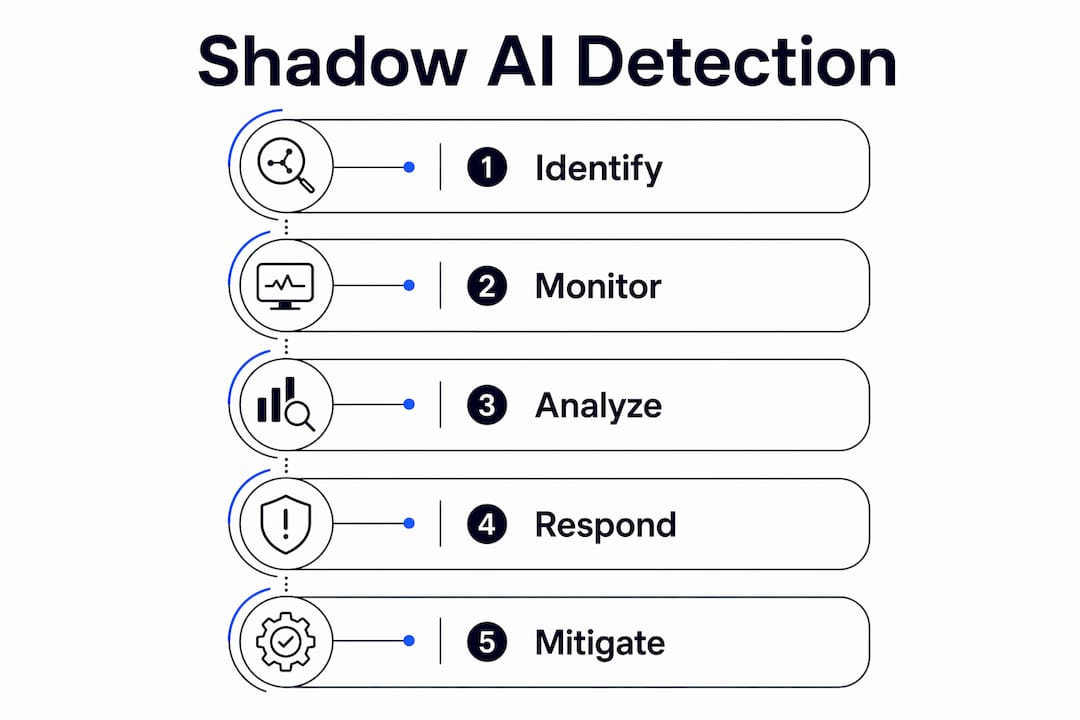
Effective shadow AI detection requires multi-layered coverage. Single-layer tools miss a substantial portion of AI agent activity in enterprise environments. No single control catches everything, and the gaps between controls are exactly where the most dangerous activity tends to occur.
The detection layers that matter, and what each one covers:
-
Cloud EDR with KQL queries: Catches AI web traffic, AI processes, OAuth grants, and local LLMs on managed endpoints. The starting point for any detection programme.
-
SIEM endpoint agents (LEQL): Covers AI processes and local LLMs, including on remote devices. Does not cover web proxy traffic or OAuth.
-
SIEM web proxy (LEQL): Captures AI web traffic for on-site users only. Blind to remote workers and local processes.
-
SIEM cloud audit logs: Covers remote users, OAuth grants, and Power Platform events. Misses direct AI web traffic and local processes.
-
OAuth permission auditing: Maps which AI tools have been granted access to Microsoft Graph, Google Workspace, Slack, GitHub, Salesforce, and other platforms. An OAuth risk matrix covering 80+ scopes across these platforms and 12 AI and automation services provides a structured way to triage high-risk grants.
-
Power Platform monitoring: Catches AI workflows built by business users that call external AI services. Cloud EDR misses these entirely.
| Detection layer | Remote users | AI web traffic | AI processes | OAuth | Local LLMs | Power Platform |
|---|---|---|---|---|---|---|
| Cloud EDR (KQL) | ✅ | ✅ | ✅ | ✅ | ✅ | ❌ |
| SIEM endpoint agent (LEQL) | ✅ | ❌ | ✅ | ❌ | ✅ | ❌ |
| SIEM web proxy (LEQL) | ❌ | ✅ (on-site) | ❌ | ❌ | ❌ | ❌ |
| SIEM cloud audit (LEQL) | ✅ | ❌ | ❌ | ✅ | ❌ | ✅ |
The Microsoft 365 admin centre now includes a public preview Shadow AI interface that lets administrators detect and govern unapproved AI agents across their Microsoft environment. During the preview, detection is available for agents including ChatGPT Desktop, Ollama Desktop, Claude Desktop, and several others. Blocking via Intune policy is currently available only for managed Windows devices enrolled in Microsoft Intune, and policy propagation can take variable time depending on Intune configuration.

Stealth AI crawlers and agents present an additional detection challenge. These tools evade static controls via IP rotation, ASN churn, and user-agent spoofing. Burst traffic patterns and missing referrer headers are the key behavioural signals that signature-based detection misses. Behavioural analytics, not signature matching, is what catches them.
Pro Tip: Validated detection queries for Microsoft Defender for Endpoint (KQL) and Rapid7 InsightIDR (LEQL) are available in the open-source Shadow AI Detection Toolkit, released at DEF CON 34. The toolkit includes 27 queries across 9 detection categories and a 33-question AI tool risk assessment checklist. Run the web traffic query first, count unique users, and use that number as your baseline.
What governance and mitigation strategies actually work?
Detection without response is just observation. The mitigation framework that works in practice combines discovery, policy, enforcement, and training into a continuous cycle rather than a one-time audit.
-
Discover what is running. Run endpoint queries across your fleet before writing a single policy. You cannot govern what you have not found. Use cloud EDR queries, OAuth audit logs, and cloud audit data in parallel to build a complete picture.
-
Classify and risk-triage each tool. Not every AI tool is equally dangerous. A browser spell-checker with AI features is a different risk from an autonomous agent with write access to your file system. Use a structured checklist covering data access scope, external transmission behaviour, vendor data handling terms, and MCP or API integration depth.
-
Establish a formal AI tool approval process. The software request process that works for traditional applications needs a dedicated AI track. Standard software reviews do not assess prompt injection risk, OAuth scope creep, or autonomous action capability.
-
Enforce policy at the endpoint. Approved-tool lists mean nothing without enforcement. For managed Windows devices, Intune policies can block specific AI agents. For broader coverage, endpoint agents that monitor and restrict AI process execution provide the control layer that network-only tools cannot.
-
Audit OAuth grants regularly. High-risk OAuth scopes, particularly those granting read or write access to email, calendar, files, and communication platforms, should be reviewed on a monthly cycle. Revoke grants from unapproved AI tools immediately.
-
Run targeted employee training. Generic security awareness training does not address shadow AI specifically. Employees need to understand why the AI tool approval process exists, what data risks arise from consumer AI tools, and how to request approval for tools they want to use. The goal is reducing the friction of doing the right thing, not just prohibiting the wrong thing.
-
Integrate detection with your SIEM and SOAR. Shadow AI events should feed into the same incident response workflows as any other security event. Isolated detection that does not trigger alerts or automated responses leaves the security team dependent on manual review.
-
Establish an incident response playbook for AI-related breaches. When an AI tool exfiltrates data or a prompt injection attack succeeds, the response steps should be documented in advance. Under the NDB scheme, the clock starts ticking from the moment you become aware of a likely breach.
The organisations that manage shadow AI most effectively treat it as an ongoing programme, not a project with an end date. The tool landscape changes faster than any static policy can track.
What does the Australian regulatory environment require?
Australian organisations face a layered compliance environment when it comes to AI governance, and shadow AI sits at the intersection of several frameworks simultaneously.
The Privacy Act 1988 and the Australian Privacy Principles set the foundational requirements. APP 8 governs cross-border disclosure of personal information, which is directly relevant when an AI tool transmits data to servers outside Australia. APP 11 requires organisations to take reasonable steps to protect personal information from misuse, interference, loss, and unauthorised access. An unsanctioned AI tool processing customer data without security review fails this test.
The Notifiable Data Breaches scheme requires notification to the OAIC and affected individuals when a data breach is likely to cause serious harm. The absence of shadow AI detection controls creates a structural problem here: you cannot notify within the required timeframe if you do not know the breach occurred.
The Security of Critical Infrastructure Act 2018 (SOCI Act) applies to organisations operating critical infrastructure assets across sectors including energy, water, communications, and financial services. For these organisations, the obligation to maintain and test risk management programmes explicitly covers cyber risks, and unmanaged AI tools represent an uncontrolled risk vector that regulators are increasingly scrutinising.
The Australian Signals Directorate (ASD) Essential Eight framework, while not legally mandated for most private sector organisations, is the de facto baseline for Australian government agencies and increasingly referenced by enterprise security teams. Application control, one of the eight strategies, directly addresses the problem of unapproved software executing on endpoints, including AI tools. Patching applications and restricting Microsoft Office macros are also relevant where AI tools exploit these vectors.
The AI Safety Standard being developed by the Department of Industry, Science and Resources signals that formal AI governance requirements for Australian enterprises are coming. Organisations that build shadow AI detection and governance programmes now will be better positioned when those requirements become binding.
For organisations subject to APRA prudential standards, particularly CPS 234 (Information Security), the requirement to maintain information security capability commensurate with the size and extent of threats is directly applicable. APRA has signalled through its supervisory activity that AI governance is a current focus area.
Which tools and technologies are specifically built for detecting shadow AI?
The market for shadow AI detection tools is developing quickly, and the approaches differ substantially depending on where in the stack they operate.

Endpoint-level AI detection platforms represent the most comprehensive approach. These tools operate similarly to endpoint detection and response (EDR) software but are purpose-built for AI agent visibility. They discover AI tools running on the device, inventory the access each tool holds, monitor data flows through MCP and other integrations, and enforce policy without requiring network-level visibility. Alectura builds this category of tool, providing AI Detection & Response (AIDR) that covers the full endpoint-to-cloud AI activity surface.
Cloud EDR with AI-specific query packs extends existing Microsoft Defender for Endpoint or CrowdStrike deployments with detection logic targeting AI tool behaviour. The Shadow AI Detection Toolkit’s 27 KQL and LEQL queries, validated on production data across Microsoft Defender for Endpoint and Rapid7 InsightIDR, give security teams a practical starting point without requiring a new platform deployment.
CASB and SaaS security posture management tools catch AI features activated within approved SaaS platforms and can enforce data handling policies at the cloud application layer. Microsoft Defender for Cloud Apps, for example, can detect and restrict AI features within Microsoft 365 applications. These tools do not cover locally running AI or browser extensions operating outside the managed SaaS environment.
OAuth and identity governance platforms address the permission creep problem. When an AI tool is granted broad OAuth scopes across Microsoft Graph or Google Workspace, identity governance tools can flag high-risk grants, enforce least-privilege policies, and automate revocation of unused or unapproved grants.
Network traffic analysis with AI domain categorisation catches AI web traffic for on-site users and can block access to unapproved AI services at the proxy or firewall level. This layer is useful but limited. It covers only network-connected AI activity and is blind to local LLMs and remote workers not routing through the corporate proxy.
Power Platform and low-code monitoring is a frequently overlooked layer. Business users building AI workflows in Microsoft Power Automate or similar platforms can call external AI services without any code deployment, bypassing both endpoint and network controls. Cloud audit log monitoring specifically targeting Power Platform events is the only reliable way to catch this activity.
The honest assessment is that no single tool covers the full detection matrix. The organisations with the strongest shadow AI security posture use a combination of endpoint-level detection, cloud audit monitoring, OAuth governance, and network controls, integrated into a centralised SIEM for correlation and response.
Advanced layered detection: what the research shows and how Alectura fits
The research on shadow AI detection converges on one finding: layered, endpoint-anchored detection is the only approach that covers the full threat surface. The Shadow AI Detection Toolkit, presented at DEF CON 34, demonstrated this empirically. In a production enterprise environment, approximately 500 Power Platform events were missed by cloud EDR alone, and all remote workers were invisible to on-premises proxy monitoring.
A critical conceptual distinction shapes how detection tools should be evaluated. Shadow AI detection differs fundamentally from content-based AI detection. Tools that identify AI-generated text are solving a different problem entirely. Security-focused shadow AI detection targets API key leakage, unauthorised data transmission, policy violations, and autonomous agent behaviour. Conflating the two leads organisations to invest in the wrong controls.
Current frontier AI models pass only a limited number of situational awareness and stealth challenges in formal evaluations. This means today’s AI models are not yet capable of sophisticated long-term scheming, but they can execute effective one-step stealth strategies in specific contexts. The risk from shadow AI in 2026 is not a rogue superintelligence. It is an unsanctioned tool with broad data access and no governance controls.
| Detection capability | Endpoint-only approach | Network-only approach | Alectura AIDR |
|---|---|---|---|
| Local LLM detection | ✅ | ❌ | ✅ |
| Remote worker coverage | ✅ | ❌ | ✅ |
| MCP integration monitoring | ✅ | ❌ | ✅ |
| OAuth permission visibility | Partial | ❌ | ✅ |
| Power Platform events | ❌ | ❌ | ✅ via cloud audit |
| SIEM/SOAR integration | Varies | Varies | ✅ native |
| Prompt timeline tracking | ❌ | ❌ | ✅ |
| On-device compliance logging | ✅ | ❌ | ✅ |
Alectura’s AIDR platform is built around the principle that AI security requires the same endpoint-anchored visibility that EDR brought to malware detection. The platform discovers AI tools across the fleet, inventories each one and the access it holds, monitors what it connects to through MCP and other integrations, catches sensitive data leaving the organisation, and enforces guardrails without disrupting the employee’s workflow. SIEM and SOAR integrations mean that shadow AI events feed directly into existing incident response processes rather than sitting in a separate console.
For Australian enterprises, the on-device compliance and audit logging capability is particularly relevant. When the OAIC or APRA asks for evidence of controls, a complete audit trail of AI tool activity on every managed endpoint is a substantially stronger response than a network log showing blocked domains.
Pro Tip: When evaluating any AI detection platform, ask specifically whether it covers local LLMs, MCP server connections, and Power Platform events. These three gaps are where most enterprise detection programmes have blind spots, and they are the vectors most likely to be exploited as employees become more sophisticated about AI tool deployment.
Key takeaways
Effective shadow AI detection in Australian enterprises requires endpoint-level visibility, multi-layer coverage, and integration with existing compliance frameworks, not just network monitoring or content analysis.
| Point | Details |
|---|---|
| Multi-layer detection is mandatory | Single-layer tools miss a substantial portion of AI agent activity; combine cloud EDR, SIEM agents, OAuth auditing, and Power Platform monitoring. |
| DNS filtering is insufficient | Network-only controls miss local LLMs and remote workers entirely; endpoint agents are required for complete coverage. |
| Australian compliance obligations are active now | The Privacy Act 1988, NDB scheme, SOCI Act, and APRA CPS 234 all create current obligations that unmanaged AI tools can breach. |
| Content detection solves the wrong problem | Tools that identify AI-generated text do not prevent data leakage; security-focused shadow AI detection targets data flows and agent behaviour. |
| Alectura AIDR covers the full surface | Alectura provides endpoint-level AI discovery, MCP monitoring, prompt timeline tracking, and SIEM integration for centralised governance. |
Alectura gives your security team real visibility over AI
Most security stacks were built before AI agents existed as a threat category. They catch malware, monitor network traffic, and flag policy violations in approved applications. They do not see the copilot reading your employee’s inbox, the local LLM processing contract drafts, or the AI agent calling your internal API through an MCP server. That gap is exactly what Alectura was built to close.
Alectura’s AI Detection & Response platform gives security teams the same endpoint-level visibility over AI tools that EDR gave them over malware. Every AI tool running across your fleet is discovered and inventoried. Every sensitive data flow is monitored. Every MCP connection is tracked. Guardrails can be enforced without slowing down the employees who are using AI tools legitimately. For Australian enterprises navigating the Privacy Act, the NDB scheme, and APRA’s increasing focus on AI governance, that audit trail and those controls are not optional extras.
If you are ready to see what AI is actually running across your endpoints, view pricing and deployment options or visit the Alectura site to request a demonstration.