
What SOC 2 AI compliance actually means for your team
There is no separate SOC 2 for AI. Organisations apply the existing AICPA Trust Services Criteria to AI-specific failure modes: training data poisoning, model drift, prompt injection, and subprocessor risk from third-party LLMs. The audit scope simply extends across your machine learning lifecycle rather than stopping at traditional IT infrastructure.
For Australian enterprises in 2026, SOC 2 Type II is the procurement baseline, not a differentiator. Enterprise buyers in regulated sectors expect it before vendor evaluations begin.
Core elements of SOC 2 AI compliance at a glance:
- Audit type distinction: Type 1 reports cover point-in-time control design; Type 2 audits run 6–18 months for first-time engagements and verify controls operated continuously.
- Standards alignment: The Australian AI Safety Standard is voluntary but widely referenced alongside ISO 42001 and the NIST AI RMF for international alignment.
- AI-specific evidence: Auditors now require model lineage, prompt and inference logging with PII redaction, drift monitoring outputs, and vendor risk assessments for every LLM subprocessor.
- Scope boundary: LLM subprocessors such as OpenAI or Anthropic sit outside your SOC 2 boundary but require documented vendor risk assessments and proof of their independent audit compliance.
Table of Contents
- How do you map Trust Services Criteria to AI risks?
- Who owns AI compliance governance in a SOC 2 audit?
- Alecturalabs gives your team real-time AI visibility for SOC 2
- Key takeaways
How do you map Trust Services Criteria to AI risks?
The five AICPA Trust Services Criteria each carry distinct AI risk exposures, and auditors test evidence against all of them.
Security covers logical access across your MLOps stack. Auditors check role-based access controls, environment segregation between development and production, and secrets management. Shared API keys across environments remain one of the most common audit failures.

Availability maps directly to drift monitoring. Continuous monitoring of AI model performance and early drift detection are critical controls here. A model that degrades silently in production without documented response procedures fails this criterion.
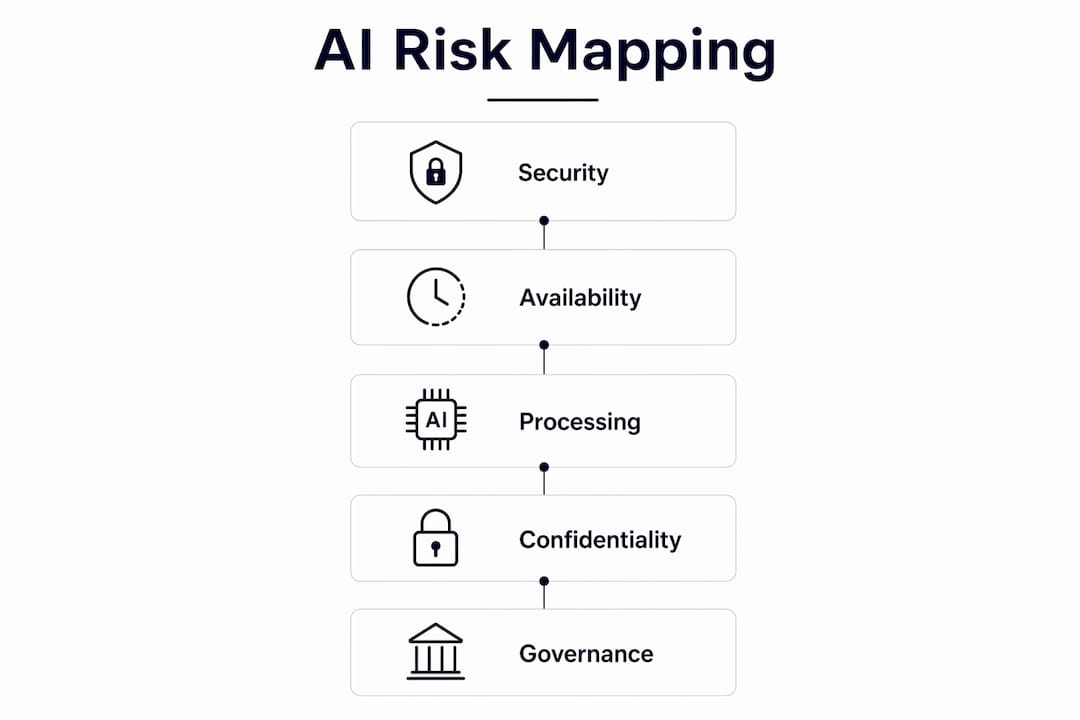
Processing Integrity is arguably the most demanding criterion for AI systems. Auditors want full model lineage tracing from raw training data to the deployed artefact, bias testing reports with demographic breakdowns, and change management tickets for every model deployment.
Confidentiality and Privacy require that inference logs have PII redaction applied before writing. Logging raw prompts containing regulated data is one of the most frequently cited 2026 audit findings.
Integrating COSO framework principles with SOC 2 controls demonstrates governance maturity beyond basic audit requirements. COSO's structured approach to risk assessment and control environments applies directly to AI risks including bias, data protection, and accountability for model decisions.
Pro Tip: Embedding AI governance from the start costs significantly less than retrofitting controls after production launch. Design your control library to satisfy SOC 2, ISO 42001, and NIST AI RMF simultaneously rather than sequentially.
A unified compliance architecture mapping SOC 2, ISO 42001, and NIST AI RMF reduces audit burden and documentation redundancy. Drift monitoring, for example, satisfies SOC 2 processing integrity, ISO 42001 performance monitoring, and post-market monitoring obligations under international AI governance frameworks in a single implementation.
Who owns AI compliance governance in a SOC 2 audit?
Responsibility is distributed, and gaps between teams are where audits fail. Security leads own the control environment: access policies, monitoring infrastructure, and incident response. ML engineers own model versioning, training data lineage documentation, and drift threshold configuration. Legal and privacy teams own data retention policies, PII redaction standards, and LLM subprocessor contracts. Compliance or GRC teams coordinate evidence collection across the observation window and manage auditor communications.
The most common failure is version mismanagement. Lapses in versioning or audit logs for third-party LLM subprocessors lead to frequent audit failures, so teams must maintain complete logs of access, configurations, and contracts across the entire observation period.
Alecturalabs gives your team real-time AI visibility for SOC 2
Most enterprise security stacks cannot see the AI running on endpoints. Copilots in the browser, assistants in the IDE, MCP-connected agents — they read sensitive data and act on it, invisibly.
Alecturalabs is AI Detection and Response (AIDR). It discovers every AI tool across your fleet, inventories the access each one holds, tracks prompt timelines, detects PII leaving the device, and enforces guardrails aligned with SOC 2 Trust Services Criteria. On-device audit logging and SIEM and SOAR integrations feed directly into your compliance evidence pipeline. For Australian enterprise teams preparing for SOC 2 Type II, that continuous, endpoint-level visibility is the audit trail auditors now demand. See Alecturalabs pricing and book a demo today.
Key takeaways
SOC 2 AI compliance requires mapping the AICPA Trust Services Criteria to AI-specific risks and maintaining continuous, auditable evidence across the full model lifecycle.
| Point | Details |
|---|---|
| No separate AI certification | Organisations apply existing AICPA Trust Services Criteria to AI failure modes like drift and data poisoning. |
| Type II is the 2026 baseline | Enterprise procurement teams require Type II reports proving controls operated over 6–18 months, not just existed. |
| Unified framework approach | Mapping SOC 2, ISO 42001, and NIST AI RMF to a single control library cuts audit duplication and documentation overhead. |
| Distributed ownership matters | Security, ML engineering, legal, and GRC teams each hold distinct evidence obligations; gaps between them cause audit failures. |
| Alecturalabs for endpoint AI visibility | Alecturalabs AIDR discovers, inventories, and monitors AI tools at the endpoint level, generating the continuous audit evidence SOC 2 Type II requires. |