
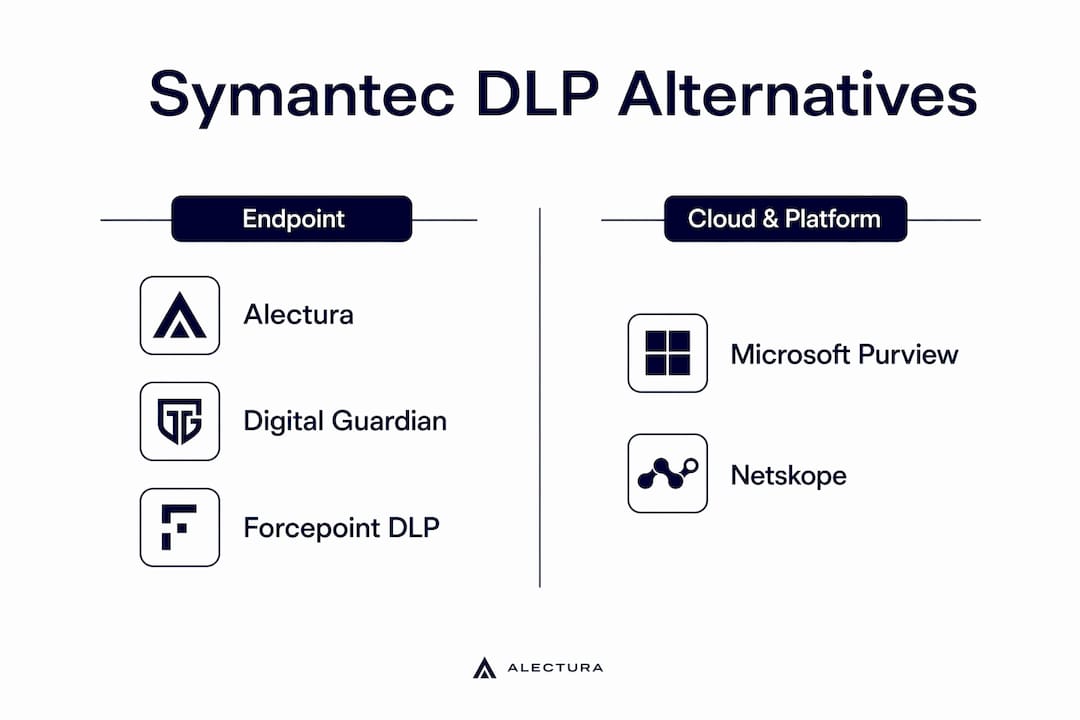
For enterprise security teams that need to discover and govern AI tools running on endpoints, Alectura (AIDR) is the recommended replacement for Symantec DLP. Platform-embedded DLP (Microsoft Purview) suits M365-heavy estates, SSE/cloud DLP (Netskope) fits organisations already routing traffic through an SSE edge, and dedicated legacy suites (Forcepoint DLP, Digital Guardian) remain credible for regulated multi-channel environments with deep structured-data requirements.
TL;DR shortlist:
- Alectura (AIDR) — endpoint AI tool discovery, prompt timeline, on-device redaction, SIEM/SOAR integration; the pick when copilots and IDE assistants are the primary risk surface
- Microsoft Purview (platform-embedded DLP) — best when the majority of sensitive data lives inside M365 and you already hold an E5 licence
- Netskope (SSE/cloud DLP) — inline inspection for web and SaaS traffic where an SSE edge is already deployed; strong GenAI guardrails for browser-based LLMs
- Forcepoint DLP (dedicated suite) — single policy engine spanning endpoint, network, cloud and email; fits regulated enterprises with broad multi-channel coverage requirements
- Digital Guardian (endpoint-focused DLP) — agent-based endpoint control with deep forensics; suits on-prem-leaning organisations with mature security operations
Symantec DLP's market share has declined in recent years, and innovation pace has slowed under Broadcom ownership. Most teams evaluating a replacement are doing so at renewal, and the window is worth using to address a gap Symantec never closed: AI tool visibility on the endpoint.
Table of Contents
- Which Symantec DLP alternatives should you shortlist?
- How do you choose the right Symantec DLP alternative?
- What does each alternative actually deliver in practice?
- How do you migrate from Symantec DLP without disrupting operations?
- When should you choose Alectura vs platform-embedded or SSE approaches?
- Key takeaways
- Why AI Detection & Response changes the DLP conversation
- Pilot Alectura on your highest-risk endpoints
- Useful sources and vendor documents relevant to Australia
Which Symantec DLP alternatives should you shortlist?
| Category | Architectural model | Endpoint & AI tool visibility | Enforcement model | Real-time vs monitoring | EDR/SIEM/SOAR integration | Australia availability |
|---|---|---|---|---|---|---|
| AIDR endpoint platform (e.g. Alectura) | On-device agent | Full: discovers copilots, IDE assistants, MCP servers | Block, redact, guardrail | Real-time on-device | Native SIEM/SOAR; EDR-complementary | Yes — per-endpoint SaaS |
| Platform-embedded DLP (e.g. Microsoft Purview) | Cloud-native, M365-resident | M365 data flows only; limited AI tool telemetry | Policy-based block/alert | Real-time within M365 | Microsoft Sentinel native; limited SOAR | Yes — M365 tenants |
| SSE/cloud DLP (e.g. Netskope) | SSE edge, inline proxy | Web and SaaS traffic; inline GenAI inspection | Inline block, coach, redact | Real-time inline | SIEM via API; SOAR connectors | Yes — NewEdge PoPs in-region |
| Dedicated legacy suite (e.g. Forcepoint DLP) | On-prem, hybrid, cloud | Endpoint + network + cloud via unified policy | Block, quarantine, encrypt | Real-time across channels | SIEM/SOAR via connectors; CASB API | Yes — partner-delivered |
| Endpoint-focused DLP agent (e.g. Digital Guardian) | Agent-based, SaaS or on-prem | Deep endpoint file/process visibility; limited AI telemetry | Block, alert, forensic capture | Real-time on-device | SIEM integration; limited SOAR | Yes — partner-delivered |
POC/trial availability and local support presence are practical procurement filters that separate shortlist candidates from also-rans. Confirm both before committing evaluation cycles.
How do you choose the right Symantec DLP alternative?
Effective DLP strategies align with where data actually resides. For AI-driven organisations, that means starting with the endpoint, not the network perimeter.
Decision criteria by technical fit:
- Where does your sensitive data live? M365-resident data favours platform-embedded DLP. SaaS-first or web-heavy workflows favour SSE. Endpoints running AI tools require an AIDR agent.
- What AI capabilities do you need? Prompt monitoring, on-device redaction, and model-call metadata capture require browser and IDE telemetry that legacy network appliances cannot provide.
- What integrations are non-negotiable? Map your EDR, SIEM, SOAR, CASB and MCP connector requirements before shortlisting. A tool that covers the data channel but cannot feed your SOC workflow adds friction.
- What is the operational cost? Teams routinely spend multiple times the licence cost on tuning and forensic operations. Factor FTE load into the total cost of ownership, not just the per-seat price.
Questions to ask vendors during a POC:
- Can you detect and log prompts sent from browser-based LLMs (ChatGPT, Copilot) and IDE assistants (GitHub Copilot, Cursor)?
- Do you support on-device redaction before data leaves the endpoint, or only post-transmission alerting?
- Which operating systems and endpoint types are covered, including macOS and Linux developer machines?
- What is the out-of-the-box policy count, and how many FTE hours does initial tuning typically require?
- Do you have a local Australian support presence and a published POC programme?
Red flags that predict high operational overhead:
- Regex-only classifiers with no contextual ML — these generate alert noise at scale
- Appliance-only deployment with no cloud or agent delivery option
- No historical scan capability across endpoints or cloud repositories
- Policy counts in the thousands with no rationalisation tooling
- Absence of prompt-level telemetry or AI agent communication visibility
Alert fatigue and heavy maintenance from thousands of legacy rules are the primary reasons DLP programmes fail, not feature gaps.
Pro Tip: Scope your POC around three to five high-risk data types rather than replicating every Symantec policy. A clean-slate approach based on current AI tool usage consistently delivers faster value and lower noise.
What does each alternative actually deliver in practice?
Alectura (AIDR)
Alectura discovers every AI tool running across your fleet: browser copilots, IDE assistants, MCP servers, and AI agents embedded in SaaS apps. It builds a live inventory of each tool, the data it can access, and the external connections it makes. Prompt timeline capture gives SOC teams a forensic record of what was sent to which model and when. On-device redaction strips PII and secrets before they reach an LLM, without blocking the tool entirely. Native SIEM and SOAR integrations mean detections feed directly into existing SOC workflows.
Best for: Organisations where AI tool sprawl on endpoints is the primary risk surface, developer teams running multiple IDE assistants, and any environment where prompt-based exfiltration is a live concern.
Pros: Full AI tool inventory; on-device enforcement without user disruption; prompt timeline forensics; per-endpoint SaaS model with Australian availability.
Cons: Focused on AI tool and endpoint risk; not a replacement for network DLP or email DLP channels.
Platform-embedded DLP (Microsoft Purview)
When most sensitive data lives inside M365, Purview DLP is often the lowest-overhead option for M365-heavy organisations, particularly for those already on E5 licences. Policy management is native to the Microsoft 365 compliance centre, and integration with Microsoft Sentinel is tight. The gap is AI tool visibility outside the M365 boundary: Purview does not discover third-party copilots or IDE assistants running on the endpoint.
Pros: No additional licence cost on E5; native M365 integration; low operational overhead for M365 data.
Cons: Blind to non-M365 AI tools; limited endpoint telemetry outside Microsoft apps; weak on cross-platform environments.
SSE/cloud DLP (Netskope)
Netskope's inline DLP inspects data flowing into and out of applications including ChatGPT and other GenAI tools, according to Netskope's 2025 Cloud and Threat Report, with 94% of organisations now using GenAI. The SSE edge model means protection travels with the user regardless of network. The trade-off is that inline inspection requires traffic to route through the SSE edge, which adds a dependency on network architecture and can introduce latency on high-volume endpoints.

Pros: Inline GenAI guardrails; unified policy across web, SaaS and cloud; strong compliance template library.
Cons: Requires SSE edge routing; limited on-device AI tool discovery; agent footprint varies by deployment mode.
Dedicated legacy suite (Forcepoint DLP)
Forcepoint DLP runs a single policy engine across endpoint, network, cloud and email, which is its clearest operational advantage over point solutions. For regulated enterprises with structured-data-heavy environments, the breadth of channel coverage is hard to match. The deployment investment is real: initial policy configuration and tuning require a dedicated security team, and the per-channel licensing model adds cost at scale.
Pros: Unified multi-channel policy; mature classifier library; CASB API integration; strong compliance reporting.
Cons: Higher deployment complexity; policy management overhead; not purpose-built for AI tool telemetry.
Endpoint-focused DLP agent (Digital Guardian)
Digital Guardian's agent captures deep file and process-level activity on the endpoint, making it a strong fit for insider risk programmes and IP protection in on-prem-leaning environments. Forensic depth is a genuine differentiator. AI tool telemetry is limited compared to purpose-built AIDR platforms, and the SaaS delivery model has matured but still carries some of the operational weight of its on-prem heritage.
Pros: Deep endpoint forensics; strong IP protection use cases; SaaS and on-prem delivery options.
Cons: Limited AI tool discovery; higher agent footprint; less suited to cloud-first or SaaS-first estates.
Pro Tip: For contract and legal document workflows, mapping DLP policies to contract data handling processes early in the POC prevents coverage gaps in high-risk document categories.
How do you migrate from Symantec DLP without disrupting operations?
Phase 1: Pre-migration inventory (weeks 1–3)
- Export and catalogue all active Symantec DLP policies, noting which are enforced versus monitor-only.
- Map sensitive data locations: endpoints, file shares, M365, SaaS apps, and any AI tool integrations already in use.
- Identify the top five data types by incident volume from Symantec logs — these become your POC scope.
- Document current SIEM/SOAR integration points and alert routing.
Phase 2: Pilot (weeks 4–9)
- Select a representative pilot group: 50–200 endpoints covering developer, finance and HR personas.
- Deploy the replacement agent in monitor-only mode; capture baseline telemetry including AI tool activity.
- Test prompt monitoring and on-device redaction against the top five data types identified in Phase 1.
- Measure false-positive rates and user friction scores before moving to enforcement.
Phase 3: Phased rollout (weeks 10–20)
- Enable enforcement incrementally, starting with the highest-risk data types and user groups.
- Rationalise policies rather than replicating every legacy Symantec rule — a clean-slate approach based on current risk reduces noise significantly.
- Train SOC and helpdesk teams on new alert taxonomy and escalation paths.
- Complete SIEM and SOAR integration; validate that detections flow correctly into existing playbooks.
Success metrics to track:
- False-positive rate reduction from Symantec baseline (target: measurable reduction within 60 days)
- Time-to-detect prompt exfiltration events (establish a baseline in the pilot phase)
- Number of remediated incidents per month during rollout
- User friction score from helpdesk ticket volume related to DLP blocks
Note on Australian compliance: When scanning, remediating or storing personal data, confirm alignment with the Privacy Act 1988 (Cth) and the Australian Privacy Principles, particularly APP 11 (security of personal information) and APP 6 (use and disclosure). This article is general information, not legal advice — confirm current obligations with your legal counsel or the Office of the Australian Information Commissioner.
When should you choose Alectura vs platform-embedded or SSE approaches?
The answer depends on where your AI risk actually lives.
Choose Alectura (AIDR) when:
- Developers, analysts or knowledge workers are running copilots, IDE assistants or browser-based LLMs on managed endpoints
- You need a forensic prompt timeline for incident response and compliance evidence
- On-device redaction before transmission is a requirement, not a nice-to-have
- Your existing EDR and SIEM need AI telemetry they are not currently receiving
Choose platform-embedded DLP (Microsoft Purview) when:
- The overwhelming majority of sensitive data lives inside M365 and you hold an E5 licence
- Operational simplicity and low incremental cost outweigh the need for AI tool telemetry
Choose SSE/cloud DLP (Netskope) when:
- Your organisation already routes web and SaaS traffic through an SSE edge
- Inline GenAI guardrails for browser-based tools are the primary requirement and endpoint agent deployment is constrained
Choose a dedicated legacy suite (Forcepoint DLP or Digital Guardian) when:
- Multi-channel coverage across endpoint, network, email and cloud is a compliance requirement
- You have a large security team to absorb the policy management overhead
For mixed environments, running Alectura alongside an SSE or platform DLP during transition is a practical approach. AIDR covers the endpoint AI tool gap while the existing DLP layer handles network and cloud channels. Consolidate once the pilot proves coverage.
Key takeaways
Alectura (AIDR) is the recommended replacement for Symantec DLP when endpoint AI tool visibility and prompt-level enforcement are the primary requirements; architecture alignment with where data lives determines every other choice.
| Point | Details |
|---|---|
| Match architecture to data location | Endpoint AI risk needs an AIDR agent; M365-resident data fits Purview; SSE edge fits Netskope. |
| Budget for operational cost | Teams typically spend 2–3x the licence cost on tuning and forensic operations — plan FTE accordingly. |
| Avoid policy bloat on migration | Rationalise Symantec rules into a smaller set of contextual policies rather than replicating them one-to-one. |
| Australian compliance baseline | Align scanning and remediation with the Privacy Act 1988 and the Australian Privacy Principles before rollout. |
| Alectura for AI tool control | Alectura discovers copilots, IDE assistants and MCP servers on endpoints and enforces guardrails in real time. |
Why AI Detection & Response changes the DLP conversation
The shift from classic DLP to AIDR is not incremental — it is a change in what the threat model actually looks like. Legacy DLP was built to stop files moving to USB drives or being emailed to personal accounts. That threat has not gone away, but it is no longer the primary risk surface for most enterprises. The real exposure now is a developer pasting a database schema into a Cursor prompt, or a finance analyst asking Copilot to summarise a document that contains M&A details. Neither of those events looks like a file transfer. Neither triggers a traditional DLP rule.
SOC teams adding AI telemetry to their playbooks should start with discovery before enforcement. Understand what AI tools are running, what data they can reach, and which MCP integrations are active. Enforcement without that inventory produces the same alert fatigue that killed many Symantec deployments. Keep the initial policy set tight: three to five high-risk data types, monitor-only for the first 30 days, then layer in redaction and blocking once the false-positive baseline is established.
Pilot Alectura on your highest-risk endpoints
If your team is evaluating Symantec DLP alternatives and AI tool visibility is on the requirements list, a focused Alectura pilot is the fastest way to understand the gap in your current stack.

A 4–6 week POC scoped to 50–200 endpoints covers the four capabilities that matter most: AI tool inventory, prompt timeline capture, on-device redaction, and SIEM integration. Success criteria are straightforward: confirm which AI tools are running across the pilot fleet, validate that sensitive data is being caught before it reaches an LLM, and verify that detections flow into your existing SOC workflow without additional tuning overhead. For teams managing contract and document workflows, mapping those data categories in the pilot scope adds immediate compliance value.
Review Alectura's pricing and POC options to scope the pilot for your environment, or visit Alectura to speak with the team directly.
Useful sources and vendor documents relevant to Australia
Industry analysis and buyer's guides:
- Gartner Peer Insights: Data Loss Prevention reviews — verified enterprise reviews across DLP vendors including Symantec, Forcepoint and Microsoft Purview
- Gartner: Top Symantec DLP alternatives and competitors — peer-sourced shortlist of alternatives considered by Symantec DLP buyers
- DLP tools buyer's guide — architectural category breakdown and operational cost analysis
- CIOPages DLP buyer's guide — data-location-first evaluation framework
- 15 best DLP solutions compared — POC and local support checklist guidance
Vendor architecture references:
- Forcepoint DLP product page — unified policy engine, deployment models and GenAI use cases
- Netskope One DLP — SSE-native inline inspection, GenAI guardrails and IDC MarketScape recognition
Australian regulatory references:
| Reference | Relevance |
|---|---|
| Privacy Act 1988 (Cth) and Australian Privacy Principles | Governs collection, use, storage and disclosure of personal information by Australian entities |
| Office of the Australian Information Commissioner (OAIC) | Primary regulator; publishes guidance on data breach notification and APP compliance |
| Australian Signals Directorate (ASD) Essential Eight | Baseline controls framework; DLP and endpoint visibility map to application control and user application hardening |
| Notifiable Data Breaches (NDB) scheme | Mandatory breach notification obligations for entities covered by the Privacy Act |
Confirm POC results against these frameworks before moving to production rollout, and include local support availability as a scored criterion in your procurement evaluation.