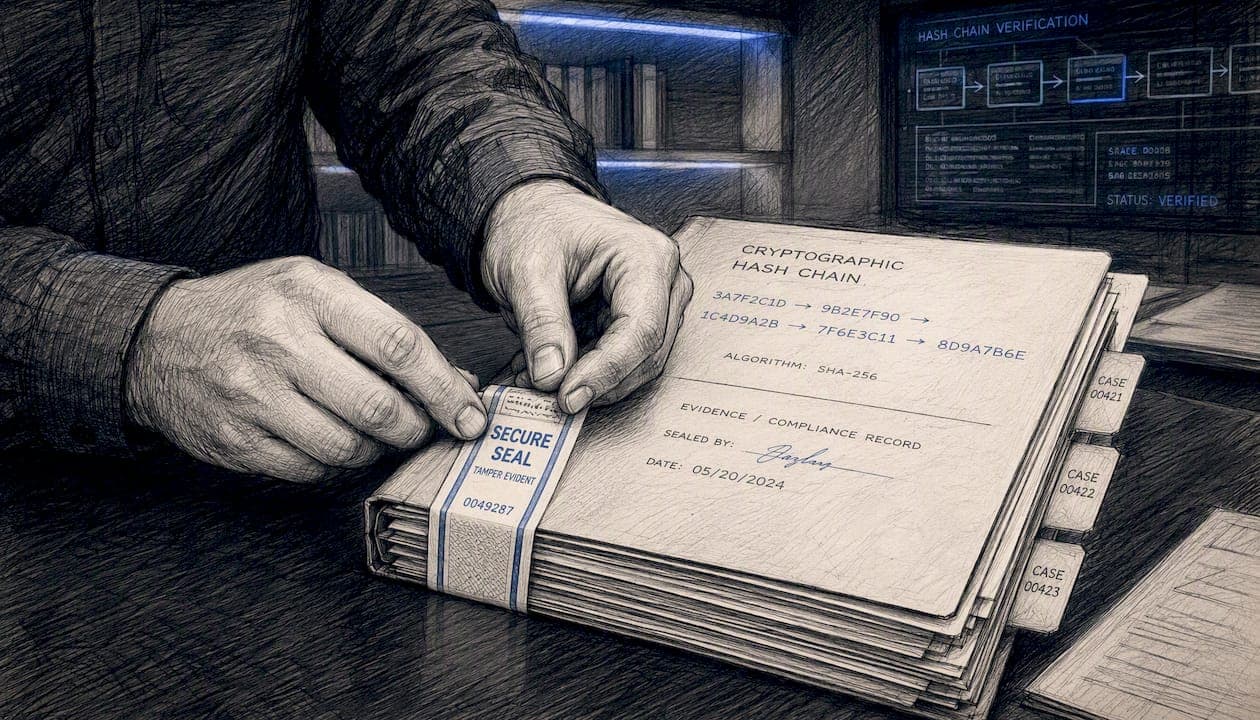
A prompt audit trail is a tamper-evident, replayable record of each prompt and response, the model and tool calls involved, and the actor who triggered them. For Australian security and compliance teams, it is the foundational evidence layer for governance, forensic reconstruction, and regulatory compliance — not a nice-to-have logging feature, but a distinct class of artefact with specific structural requirements.
Three immediate reasons this matters:
- Compliance evidence. Regulators and auditors need to see what the model was asked, what it returned, and which policy checks ran — not just that a request occurred.
- Forensic reconstruction. When an incident involves an AI copilot or agent, you need to replay the exact sequence of prompts, responses, and tool calls to establish what happened and why.
- Policy enforcement. Audit trails let you verify that guardrails fired, that sensitive data was redacted, and that human overrides were recorded.
Pro Tip: Store your audit logs local-first on the endpoint before forwarding to a centralised store. If your SaaS logging provider goes offline during an incident, you still hold the primary evidence.
Key takeaways
A compliance-grade prompt audit trail requires tamper-evident hash chains, structured field capture including tool calls and policy checks, local-first storage, and exportable evidence packages mapped to NIST AI RMF and Australian regulatory expectations.
| Point | Details |
|---|---|
| Capture the right fields | Every event needs decisionId, modelId, actorId, toolCalls, policyCheckRecords, prevHash, and eventHash — missing any one creates an audit gap. |
| Chain events cryptographically | SHA-256 hash chains and Ed25519 signatures make your trail offline-verifiable and tamper-evident without relying on a single log server. |
| Default to balanced privacy mode | Store identifiers and hashes by default; require explicit opt-in for full-content capture to satisfy Australian Privacy Principles. |
| Map fields to NIST AI RMF controls | Align decisionId to GOVERN, prevHash to MANAGE, and policyCheckRecords to GOVERN to justify controls to auditors. |
| Alectura AIDR | Captures prompt timelines and tool calls at the endpoint, producing signed, exportable evidence packages for regulatory and forensic use. |
Table of Contents
- What a prompt audit trail actually records
- Real use cases: what the trail lets you reconstruct
- Why this is not the same as your existing system logs
- How to implement a compliance-grade trail in Australian enterprises
- Mapping your trail to NIST, AI RMF, and Australian regulatory expectations
- How Alectura AIDR captures prompt audit trails in enterprise environments
- Common mistakes and a forensic checklist for auditors
- Why prompt audit trails changed how I run investigations
- Alectura AIDR gives your team audit-ready evidence from day one
- Sources
What a prompt audit trail actually records
An AI audit trail is a chronological, tamper-evident record that links inputs, decisions, outputs, data access events, and the people and policies involved to the specific model or agent that produced them. That definition has teeth only when the schema captures the right fields.
Required fields for a compliance-grade trail:
- prompt (full text or SHA-256 hash in privacy mode)
- response (full text or hash)
- timestamp (ISO 8601, UTC)
- modelId and modelVersion
- providerId
- modelParameters (temperature, top-p, context window)
- toolCalls (name, arguments, return values, sequence)
- actorId (human user or agent identity, with auth context)
- correlationId / decisionId (links events across a multi-step workflow)
- latency and token usage
- policyCheckRecords (which policies evaluated, pass/fail)
- dataAccessEvents (files, APIs, databases touched)
- redactionMetadata (what was redacted and by which rule)
- prevHash (SHA-256 of the preceding event, for chain integrity)
- eventHash (SHA-256 of this event)
The structural choices matter as much as the field list. Each event sits inside an envelope that carries schema version, capture method, and sequence number. The prevHash field chains events together so any deletion or modification breaks the chain — a property that Ed25519 signatures and SHA-256 hash chains make offline-verifiable without relying on a centralised log server.
| Field | Type | Purpose |
|---|---|---|
| eventId | UUID | Unique event identifier |
| decisionId | UUID | Groups all events in one decision workflow |
| timestamp | ISO 8601 | Ordering and retention enforcement |
| modelId + modelVersion | string | Model provenance for reproducibility |
| actorId | string | Non-repudiation, identity linkage |
| toolCalls | array | Agentic action capture |
| policyCheckRecords | array | Guardrail evidence |
| prevHash | SHA-256 hex | Tamper-evidence chain |
| eventHash | SHA-256 hex | Per-event integrity |
| captureMethod | enum | SDK, proxy, middleware — for audit coverage |
A minimal JSONL event in balanced privacy mode stores identifiers and hashes but keeps prompt and response content redacted by default. Full-content capture requires explicit opt-in and triggers additional retention and access controls. The AIAuditLog open-source toolkit implements this three-tier privacy model with SHA-256 digests and optional Ed25519 checkpoint signatures.
Real use cases: what the trail lets you reconstruct
The most direct test of an audit trail is whether an investigator can replay an incident from it. A typical enterprise sequence looks like this:
Incident timeline example — employee data exfiltration via copilot:
- 09:14:02 — Actor
user@corp.ausubmits prompt to browser copilot: "Summarise the HR records for the Sydney office." - 09:14:03 — Model calls
read_filetool on/hr/sydney_roster.xlsx(captured in toolCalls). - 09:14:04 — Policy check fires: PII detected in response. Redaction rule applied; redactionMetadata logged.
- 09:14:05 — Model returns redacted summary. Response hash stored.
- 09:14:07 — User submits follow-up: "Show me the unredacted version." Policy check: blocked. policyCheckRecord: DENY.
- 09:14:08 — Alert forwarded to SIEM. decisionId links all six events.
Without the tool-call capture and policy check records, steps 2 and 5 are invisible. Standard application logs would show two HTTP requests. The audit trail shows an attempted policy bypass.
Replayability is not just about storing events — it is about storing enough context that an auditor who was not present can reconstruct the decision, the data touched, and the guardrails that fired, without relying on the memory of the person who ran the session.
Primary enterprise use cases:
- Regulatory evidence — produce a complete, exportable record of AI-assisted decisions for OAIC, APRA, or sector-specific regulators.
- Incident forensics — reconstruct the exact prompt-response-tool-call sequence that preceded a data breach or policy violation.
- Policy coverage metrics — measure what percentage of AI interactions had policy checks evaluated, and which rules fired most often.
- Post-market monitoring — track model behaviour drift over time by comparing response patterns across versions.
- Legal discovery — export tamper-evident evidence packages for litigation or regulatory investigation.
- Agentic workflow oversight — capture agent actions and data access at runtime so automated provisioning or code-generation agents leave a verifiable record of every action taken.
For credit decisioning, the trail must link the model version, the input features, the output decision, and the policy checks that evaluated fairness rules — all under a single decisionId. For automated provisioning agents, every API call and permission grant needs to appear in toolCalls with arguments, so a later audit can confirm the agent acted within its authorised scope.
| Use case | Critical fields | Export format |
|---|---|---|
| Regulatory evidence | decisionId, actorId, policyCheckRecords | Signed JSONL package |
| Incident forensics | toolCalls, prevHash chain, timestamps | Chronological replay |
| Legal discovery | Full event chain, signatures, retention metadata | Auditor export bundle |
| Agentic oversight | toolCalls, dataAccessEvents, actorId | SIEM-forwarded events |
Why this is not the same as your existing system logs
Telemetry tells you a system is healthy. An audit trail tells you what a decision was, who made it, and whether it complied with policy. Treating telemetry as audit evidence is one of the most common false-confidence mistakes in AI governance programmes.
| Artefact | Objective | Decision trace | Model provenance | Policy check linkage | Tamper evidence |
|---|---|---|---|---|---|
| System telemetry | System health, performance | No | No | No | No |
| Application logs | Request/response audit | Partial | Rarely | No | No |
| AI audit trail | Non-repudiation, legal evidence | Yes | Yes (modelId + version) | Yes | Yes (hash chain + signatures) |
The consequences of missing fields are concrete. No modelId means you cannot prove which version of a model produced a decision — critical when a model is updated mid-investigation. No policyCheckRecords means you cannot demonstrate that guardrails were active. No prevHash chain means a log entry could be deleted or modified without detection.
Pro Tip: When briefing your legal team or external auditors, the question to answer is not "did we log the request?" but "can we prove the why — the decision trace, the policy checks, and the model version — without relying on a single mutable log file?"
How to implement a compliance-grade trail in Australian enterprises
A compliance-grade prompt audit trail requires five controls in place simultaneously: capture, storage, verification, retention, and export. Missing any one of them creates a gap an auditor will find.
Architecture choices first. Local-first, on-device capture gives you evidence that survives a SaaS provider outage or contract termination. A centralised store adds availability and cross-fleet correlation. Most enterprise deployments use both: the endpoint holds an append-only local log, and a SIEM or centralised audit store receives forwarded events. For AI agent governance on endpoints, local capture is especially important because agents can act faster than network forwarding latency.
Implementation checklist:
- Instrument model and agent SDKs or middleware at the capture point — never rely on network proxies alone, since they miss local tool calls.
- Propagate
decisionIdandcorrelationIdacross every step of a multi-turn or multi-agent workflow. - Capture all tool calls with name, arguments, and return values — not just the fact that a tool was called.
- Normalise event schema to a versioned envelope before storage.
- Hash each event (SHA-256) and chain it to the previous event via
prevHash. - Add Ed25519 checkpoint signatures at configurable intervals for offline-verifiable tamper evidence.
- Write to a local append-only store before forwarding to centralised storage.
- Configure retention periods and legal hold flags per data classification.
- Integrate with your SIEM and SOAR for real-time alerting on policy violations and anomalous patterns.
- Build auditor export packages: signed JSONL bundles with verification tooling included.
Privacy controls sit alongside the technical controls. Use GDPR-compatible data minimisation principles: default to balanced privacy mode (identifiers and hashes, content redacted), require explicit opt-in for full-content capture, and implement crypto-shredding so erasure requests under the Australian Privacy Act can be honoured without breaking the hash chain for non-personal fields. The AIAuditLog toolkit's three-tier privacy model — minimal, balanced, full-content — is a practical reference implementation for this.
Pro Tip: Integrate capture into your CI/CD pipeline so audit evidence is generated deterministically alongside code deployments. Treat the audit trail as a byproduct of normal operation, not a separate manual task — otherwise coverage gaps appear every time a new model or tool is deployed.
Mapping your trail to NIST, AI RMF, and Australian regulatory expectations
A compliance-ready trail must be tamper-evident, reconstructable, and linkable to ownership and policies. NIST AI 600-1 and the NIST AI Risk Management Framework provide the control language to justify each field to a risk committee or external auditor.
| Trail element | NIST AI RMF control | Regulatory relevance |
|---|---|---|
| decisionId + sequence | GOVERN (accountability) | OAIC APP (security of PI) |
| prevHash + signatures | MANAGE (integrity) | Evidence integrity for legal discovery |
| modelId + modelVersion | MAP (provenance) | Post-market monitoring obligations |
| captureMethod | MEASURE (monitoring) | Audit coverage evidence |
| policyCheckRecords | GOVERN (policy enforcement) | Guardrail evidence for regulators |
| timestamps + retention | MANAGE (documentation) | Retention floors for legal hold |
| dataAccessEvents | MANAGE (data governance) | OAIC APP 6 (use/disclosure) |
For EU AI Act Article 12 alignment — relevant for Australian enterprises with EU operations — the schema requires decisionId, modelId, prevHash, and timestamps as minimum fields, with a retention floor example of 180 days for high-risk systems. Australian enterprises should map this to their own legal discovery and records retention obligations, which vary by sector (financial services, health, government).
Key points for compliance teams:
- Logging capability is necessary infrastructure, not sufficient for compliance. Organisational controls, retention policies, and process evidence are all required.
- The OAIC's Australian Privacy Principles (APPs) require that personal information in logs is protected, minimised, and erasable on request — crypto-shredding is the technical mechanism.
- SOC 2 AI compliance programmes increasingly require audit trail evidence as part of the Trust Services Criteria for availability and confidentiality.
How Alectura AIDR captures prompt audit trails in enterprise environments
Alectura's AIDR captures prompt timelines, device attribution, and tool calls at the endpoint to produce replayable, tamper-evident evidence that integrates directly with SIEM and SOAR platforms.
Alectura AIDR operates at the endpoint layer — where the AI tools actually run — rather than relying solely on network-level proxies. This means tool calls made by local copilots, IDE assistants, and MCP-connected agents are captured even when they never traverse a monitored network path.
In a typical enterprise pilot, a security team deploys Alectura AIDR across a subset of endpoints running browser copilots and IDE assistants. Within the first week, the prompt timeline view surfaces tool calls that were previously invisible to the SIEM — local file reads, API calls made by agents, and policy check outcomes. When an incident occurs, the team replays the exact prompt-response-tool-call sequence from the local append-only log, exports a signed evidence package, and hands it to the external auditor without needing to reconstruct anything from memory or fragmented application logs.
Alectura AIDR capabilities relevant to audit trail programmes:
- Endpoint discovery and inventory — identifies every AI tool running on the fleet, including unsanctioned copilots and MCP servers.
- Prompt timeline tracking — captures the full sequence of prompts, responses, and tool calls with timestamps and actor identity.
- Local append-only logs — tamper-evident on-device storage before centralised forwarding.
- Configurable privacy redaction — balanced and full-content modes with redaction metadata preserved.
- Evidence export packages — signed, auditor-ready bundles for regulatory submissions and legal discovery.
- SIEM and SOAR integrations — real-time forwarding and alerting for AI agent monitoring workflows.
Pro Tip: Integrate Alectura AIDR into your incident response playbooks before you need it. Teams that pre-configure evidence export workflows and SIEM alert rules resolve AI-related incidents significantly faster than those building the process during an active investigation.
Common mistakes and a forensic checklist for auditors
The most damaging mistake is discovering at incident time that your logs lack the decision trace. By then, reconstruction is impossible and the regulatory exposure is already real.
Common pitfalls:
- Missing model versioning. Logs record that "GPT-4" was used but not the exact deployment version — making it impossible to reproduce the model's behaviour or confirm which guardrails were active.
- Prompt content redacted without hashes. Privacy redaction without storing the SHA-256 hash of the original content means you cannot prove the redacted content was what you claim it was.
- Inconsistent identity correlation. Actor IDs that change between sessions, or that use different formats across tools, break the chain of custody for multi-step workflows.
- Incomplete tool-call capture. Logging that a tool was called but not its arguments or return values leaves the most forensically significant part of an agentic action invisible.
- Vendor lock-in on evidence. Audit logs stored only in a SaaS provider's proprietary format, with no export capability, create a single point of failure for evidence portability.
- No tamper evidence. Append-only storage without hash chains or signatures cannot prove that log entries have not been modified or deleted.
- Inconsistent retention. Different tools retaining logs for different periods, with no legal hold mechanism, creates gaps that surface during discovery.
Forensic checklist for auditors:
- Verify that every event carries a
decisionIdthat groups all steps of a multi-turn or multi-agent workflow. - Validate the hash chain: recompute
eventHashfor a sample of events and confirmprevHashmatches the preceding event's hash. - Check Ed25519 signature validity on checkpoint events using the published verification key.
- Confirm
actorIdis consistent across all events in adecisionIdgroup — inconsistency signals a capture gap or identity normalisation failure. - Audit redaction metadata: every redacted field should carry the rule that triggered redaction and the hash of the original content.
- Test evidence exportability: generate a signed JSONL export package and verify it opens correctly in the verification tooling.
- Confirm retention metadata: check that legal hold flags are set correctly for events under active investigation.
Red flags that indicate a weak trail: no prevHash field; modelVersion absent or set to a generic label; tool calls logged as single-line strings without structured arguments; no policy check records despite guardrails being configured; export function unavailable or producing unsigned output.
Pro Tip: Run hash-chain validation offline, against a local copy of the log, before presenting evidence to an auditor. A chain break discovered during an audit is far more damaging than one found internally — it raises questions about the integrity of every event in the log.
Why prompt audit trails changed how I run investigations
The shift is not subtle. Before implementing a proper audit trail, post-incident investigation meant correlating fragmented application logs, interviewing the person who ran the session, and hoping the browser history was intact. The answer to "what did the model actually do?" was usually a reconstruction from memory, not evidence.
With a replayable prompt audit trail, the first 30 minutes of an investigation now produce a complete chronological sequence: the exact prompts, the tool calls and their arguments, the policy checks that fired, and the identity of the actor. Root cause analysis that previously took days compresses to hours. Escalation to legal or external auditors is faster because the evidence package is already exportable and signed.
The practical tradeoff is storage versus fidelity. Full-content capture of every prompt and response across a large fleet generates significant volume. The answer is not to reduce coverage but to tier it: balanced privacy mode by default, full-content capture triggered by policy violations or high-risk classifications. That approach keeps storage manageable while preserving the evidentiary depth you need for the cases that matter.
The regulatory posture improvement is harder to quantify but equally real. When an Australian regulator asks how you govern AI-assisted decisions, a signed, exportable audit trail is a concrete answer. A description of your logging practices is not.
Alectura AIDR gives your team audit-ready evidence from day one
Most security teams discover their AI logging gaps during an incident, not before. Alectura AIDR closes that gap at the endpoint — where AI tools actually run — capturing prompt timelines, tool calls, and policy check outcomes in a local append-only log before forwarding to your SIEM.

The evidence Alectura AIDR produces is tamper-evident, exportable, and structured for auditor review: signed JSONL packages, configurable privacy redaction, and direct integration with SIEM and SOAR platforms. For Australian enterprises building towards OAIC, APRA, or SOC 2 audit readiness, that means a concrete evidence layer rather than a promise of one.
Evaluate Alectura AIDR and see how endpoint-level prompt timeline capture maps to your compliance programme.
Sources
- AI audit trails: What to log for models and agents, and how a Command Center captures it | Collibra
- sekacorn/AIAuditLog
- Nvlpubs
- Cisa
This article is general information, not a substitute for advice from a qualified lawyer. Consult a qualified legal professional about your own circumstances before acting on anything here.