
For Australian enterprise endpoints, the right answer is endpoint-first AI Detection & Response (AIDR), not general observability. Evaluate vendors using the checklist in section 3, then run the SOC pilot in section 7. Alectura AIDR is the recommended starting point: it intercepts AI traffic at the device level, discovers unmanaged copilots and local assistants, and feeds alerts directly into your SIEM and SOAR workflows.
Three reasons this matters right now:
- Real-time interception: Alectura catches prompt injection attempts and PII exfiltration as they happen, not hours later in a log review.
- Device-level discovery: Browser copilots, IDE assistants, and MCP-connected agents are inventoried across the fleet, including tools your security stack has never seen.
- SOC-ready integrations: SIEM and SOAR connectors mean alerts become automated response actions, not manual tickets.
Table of Contents
- Why endpoint-focused LLM monitoring differs from general observability
- How do you choose the right LLM monitoring or AIDR tool?
- How Alectura AIDR maps to enterprise evaluation criteria
- What tools should you use to validate LLM and agent behaviour?
- What does deployment actually cost and how long does it take?
- SOC pilot checklist: how to validate a vendor in a proof-of-concept
- Key takeaways
- The endpoint is where AI security actually happens
- See Alectura AIDR in action on your endpoints
- Useful sources and further reading
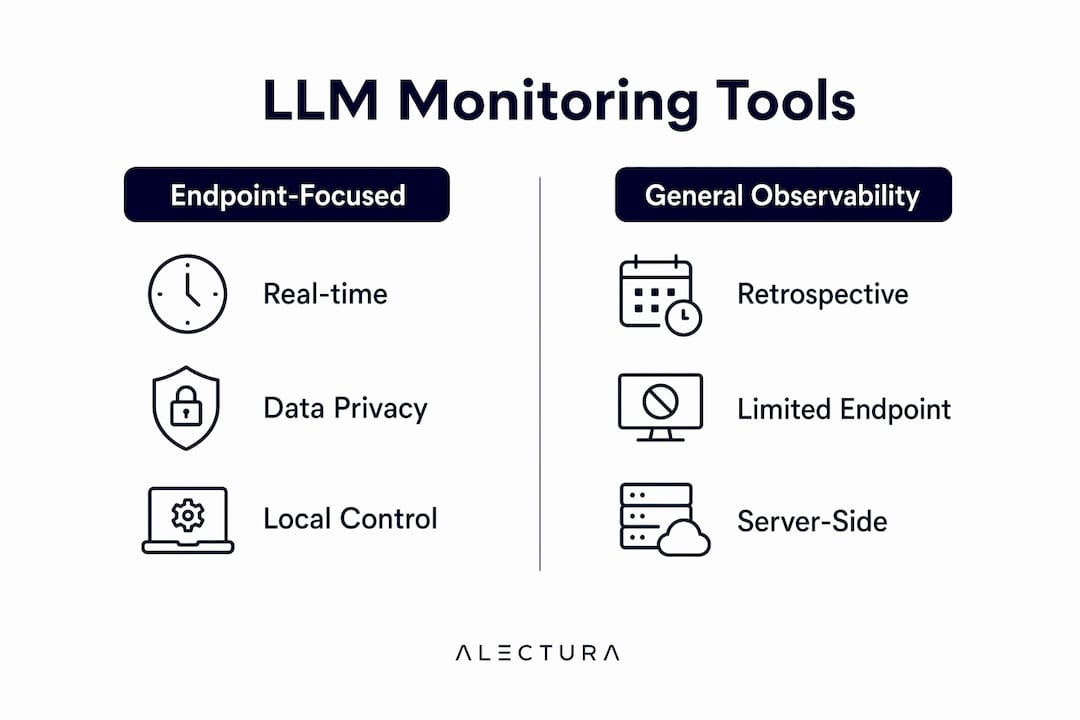
Why endpoint-focused LLM monitoring differs from general observability
Most observability platforms answer one question: what happened? Security teams need a different question answered: did policy break, and can we stop it now? Those are not the same problem, and the tooling that solves one often fails the other.
Server-side observability captures traces after the fact. That works for debugging latency or token costs. It does not work when a local Copilot is reading a sensitive document and sending a summary to an external endpoint, because that traffic never touches your API gateway. True endpoint AI detection requires intercepting at the device level, where local assistants and browser-embedded copilots actually run.
Typical blind spots in observability-only approaches:
- Local LLM assistants and IDE plugins that bypass API gateways entirely
- Browser-based copilots with direct access to clipboard and file system
- MCP server connections that expose internal tools to external AI agents
- Shadow AI tools installed by individuals without IT approval
- Full prompt bodies logged to third-party cloud infrastructure without redaction
Open-source platforms like Spanlens do flag PII at log time and support self-hosting, which is a meaningful step up from uncontrolled logging. But flagging after storage is still retrospective. For a SOC, the gap between "logged" and "intercepted" is where data walks out the door.
Pro Tip: During a pilot, run interception in non-blocking redaction mode first. You get a full audit trail of what would have been stopped without disrupting users, which gives your SOC a clean baseline before you enforce policy.
How do you choose the right LLM monitoring or AIDR tool?
Choose a tool that combines real-time detection with endpoint discovery, strong response controls, and native SIEM/SOAR integration. Anything that only logs is a developer tool, not a security tool.
Evaluation checklist:
- Detection: Does it intercept prompt injection and sensitive-data exfiltration in real time, or only log after the fact?
- Discovery: Can it inventory copilots, browser assistants, IDE plugins, and MCP endpoints across all managed devices?
- Response: Does it support device isolation, session termination, and automated redaction as response actions?
- Auditability: Are audit logs tamper-evident, stored on-device or in your own environment, and exportable to your SIEM?
- Privacy: Can prompt bodies be redacted or excluded from storage entirely? Is there an opt-out per call?
- Scale: Does it handle hybrid and multi-cloud fleets without requiring agents on every cloud workload?
Demo questions to ask vendors:
- Show me how you intercept local assistant traffic that bypasses the API gateway.
- How do you prevent logs from storing raw PII or secrets?
- Walk me through a SOC triage workflow from alert to containment.
- What SIEM and EDR connectors ship out of the box?
Red flags that should end a shortlisting:
- Vendor logs full prompt bodies to their own cloud by default with no opt-out
- No device-level enforcement, only SDK instrumentation
- Fewer than two native SIEM or EDR connectors
- No audit log export capability
- Pilot requires full production rollout before any telemetry is visible
For scoring a pilot: weight detection and response capabilities as the largest portion of your evaluation, discovery coverage as a significant part, and auditability and privacy controls as an important consideration. A tool that detects well but cannot act is still a gap.
How Alectura AIDR maps to enterprise evaluation criteria
Alectura AIDR covers every dimension in that checklist. The table below maps capabilities to evaluation criteria.
| Evaluation dimension | Alectura AIDR |
|---|---|
| Real-time detection vs. retrospective logging | Real-time interception of prompt injection, secrets, and PII at the endpoint |
| Endpoint discovery coverage | Copilots, browser assistants, IDE plugins, MCP servers inventoried across the fleet |
| Response capabilities | Device isolation, session redaction, policy enforcement without user disruption |
| SIEM/SOAR/EDR integration | Native connectors for alert enrichment, automated playbooks, and audit log forwarding |
| LLM/agent testing and simulation | Prompt timeline tracking and policy simulation during pilot |
| Privacy and compliance | On-device redaction, per-call opt-out, tamper-evident audit trails |
| Deployment model | Per-endpoint subscription SaaS; scoped pilots available |
| Operational maturity | SOC runbook integration, alert triage workflows, pilot checklists |
Trust signals security teams should request during a demo: published SOC pilot checklists, audit log samples, and evidence of SIEM connector validation in a comparable environment. Alectura's pilot programme includes a discovery sweep, POC validation, and SOC playbook integration as standard.
Compliance and data-handling options available:
- On-device redaction before any data leaves the endpoint
- Per-call opt-out from prompt body storage
- Tamper-evident audit logs exportable to your SIEM
- Data residency controls aligned with Australian Privacy Act obligations
For teams managing AI data loss prevention across endpoints, these controls are not optional extras.
What tools should you use to validate LLM and agent behaviour?
Use LLM-as-a-judge frameworks alongside agentic evaluation harnesses to catch behaviour regressions and unauthorised tool calls before any agent reaches production. Three frameworks are worth knowing.
TruLens provides seven purpose-built agentic evaluators covering tool selection, tool calling, plan adherence, and logical consistency. Its OpenTelemetry-based tracing exports to any OTLP-compatible backend, including Datadog and Grafana Tempo. Use it when you need explainable, structured feedback on agent behaviour across multi-step workflows.

NVIDIA NeMo Evaluator offers an open evaluation harness with built-in interceptors for request and response modification, turn counting, and CI-friendly reporting. It is the right choice for agentic benchmarks and for building automated quality gates in a CI/CD pipeline.
DeepEval focuses on reproducible, research-backed metrics and integrates directly into CI/CD pipelines. It is well-suited to pre-production gating where you need a consistent pass/fail threshold across builds.
Running a validation pass during a vendor POC:
- Prepare a dataset of representative prompts, including adversarial examples targeting prompt injection and data exfiltration.
- Run the eval harness against the candidate model or agent configuration.
- Compare output deltas against your baseline, flagging regressions in tool-call behaviour or policy violations.
- Set quality gates: any build that breaches a defined threshold on tool-selection accuracy or groundedness fails automatically.
Pro Tip: Map the agent call graph during every test run. Tracking which tools are invoked, in what order, and what resources they touch tells you far more about exfiltration risk than token counts alone. Use sandboxed tool invocation and turn limits during POC testing to contain blast radius.
For teams building out agentic AI security controls, pairing these frameworks with endpoint-level interception closes the gap between evaluation and enforcement.
What does deployment actually cost and how long does it take?
Expect a multi-week pilot-to-production path for a large enterprise deployment. Per-endpoint subscription pricing is the industry norm for AIDR tools.
| Phase | Typical duration | Decision gate |
|---|---|---|
| Discovery sweep | Weeks 1–2 | Confirm fleet coverage and Shadow AI inventory |
| POC validation | Weeks 3–6 | Detection accuracy, false-positive rate, SIEM connector test |
| SOC runbook integration | Weeks 7–8 | Playbook sign-off, escalation criteria confirmed |
| Scale rollout | Weeks 9–10 | Production go/no-go, pricing transition confirmed |
Pricing checkpoints to validate before signing:
- Per-endpoint licence terms and minimum seat commitments
- Overage billing thresholds and how they are calculated
- Data residency options, including on-device processing
- Pilot-to-production pricing transitions (avoid vendors who reprice at scale)
- Support and training costs for SOC onboarding
Procurement questions for legal and security teams: confirm data sovereignty arrangements under the Australian Privacy Act 1988, ask whether self-hosting is available, clarify export control obligations for any AI model weights processed on-device, and verify that audit logs meet your organisation's retention requirements. For a deeper look at SOC 2 AI compliance requirements in Australia, those obligations are worth mapping before you sign a contract.
SOC pilot checklist: how to validate a vendor in a proof-of-concept
Run a scoped pilot that validates detection, discovery, response, and auditability against production-like scenarios before committing to a full rollout.
- Scope devices: Select a representative sample across OS types, browsers, and IDE configurations.
- Baseline telemetry: Capture existing AI tool usage across scoped endpoints before enabling enforcement.
- Run adversarial prompts: Test prompt injection, PII exfiltration, and secrets leakage scenarios against live agents.
- Verify redaction: Confirm that sensitive data is redacted before leaving the device, not just flagged in a log.
- Test isolation: Trigger a simulated incident and measure time-to-isolate from alert to device containment.
- Validate SIEM/EDR workflows: Confirm alerts appear in your SIEM with correct enrichment fields and that SOAR playbooks fire correctly.
- Escalate a simulated incident: Run a full triage cycle from detection through escalation to confirm SOC readiness.
Pilot KPIs and success thresholds:
| KPI | Suggested threshold |
|---|---|
| Mean time to detect (prompt injection) | Under a minute |
| False-positive rate | Below 5% |
| Time to isolate (device containment) | Under 2 minutes |
| Unmanaged AI agents discovered | Baseline established in week 1 |
SOC triage playbook snippet:
- Alert enrichment fields to collect: endpoint ID, AI tool name, prompt hash, data classification, MCP server touched
- Initial containment: isolate session or device, preserve audit log, notify asset owner
- Escalation criteria: confirmed PII exfiltration, prompt injection with tool-call execution, or MCP server accessing restricted resources
For a full pilot guide, the AI detection and response checklist covers each of these steps in detail.
Key takeaways
Endpoint-first AIDR is the only approach that gives Australian SOCs real-time visibility and control over AI running on managed devices, not just retrospective logs.
| Point | Details |
|---|---|
| Prefer endpoint-first AIDR | Server-side observability misses local copilots, IDE plugins, and MCP-connected agents entirely. |
| Require real-time detection and response | Logging after the fact does not stop data exfiltration; interception and isolation do. |
| Validate with LLM-as-a-judge frameworks | Use TruLens, NVIDIA NeMo Evaluator, or DeepEval to gate agent behaviour before production. |
| Insist on SIEM/SOAR connectors and on-device privacy | Native connectors and on-device redaction are non-negotiable for enterprise SOC workflows. |
| Run the pilot checklist before committing | A scoped multi-week pilot with defined KPIs is the only reliable way to validate a vendor. |
| Alectura AIDR | Covers endpoint discovery, real-time detection, device isolation, and SIEM/SOAR integration in a single per-endpoint subscription. |
The endpoint is where AI security actually happens
The security industry spent a decade arguing about whether to monitor the network perimeter or the endpoint. EDR settled that debate. The same argument is now playing out for AI, and the answer is the same: the endpoint is where the action is.
What concerns me about how most organisations are approaching this is the assumption that developer observability tools are good enough for security. They are not. A platform that logs traces for debugging is solving a different problem than one that intercepts a local assistant reading a confidential document. The gap between those two things is not a feature gap. It is a fundamentally different design intent.
Australian SOCs face an additional pressure: the Privacy Act 1988 and the Australian Signals Directorate's Essential Eight both create obligations that make uncontrolled AI logging a genuine compliance risk, not just a security one. A vendor that stores full prompt bodies in their own cloud by default is not just a security concern. It is a procurement problem.
The pilot checklist in section 7 is a practical way to find out whether a vendor actually solves the right problem. Consider running it before you sign anything.
See Alectura AIDR in action on your endpoints
Shadow AI is already running across your fleet. The question is whether your SOC can see it, stop it, and prove it to an auditor. Alectura AIDR gives you endpoint-level discovery, real-time detection of prompt injection and data exfiltration, device isolation, and SIEM/SOAR integration, all on a per-endpoint subscription with no infrastructure overhaul required.

A standard Alectura pilot runs 6–8 weeks and includes a full discovery sweep, POC validation using the checklist above, and SOC playbook integration. You leave with a clear picture of every AI tool running on your endpoints and a tested response workflow. Request your pilot or download the SOC checklist at alecturalabs.com.
Useful sources and further reading
The sources below are worth bookmarking for specific validation steps during a vendor evaluation.
- TruLens: Seven agentic evaluators covering tool selection, plan adherence, and logical consistency. Start here for structured agent behaviour testing.
- NVIDIA NeMo Evaluator: Open evaluation harness with interceptors and CI-friendly reporting. Use for agentic benchmarks and automated quality gates.
- DeepEval: Research-backed metrics with CI/CD integration. Best for pre-production gating and reproducible pass/fail scoring.
- Spanlens: Open-source observability with PII detection at log time, self-hosting, and OpenTelemetry compatibility. Useful for self-hosted observability tests during a pilot.
- LangWatch: Open LLM Ops platform with OpenTelemetry tracing, dataset creation, and prompt optimisation. Illustrates integration trade-offs for SOC teams evaluating observability stacks.
- Respan: Production observability guidance covering threshold monitors, saved views, and cost/latency breakdowns. Useful for understanding observability failure modes and sensible monitor configuration.
- EndPlex: Native API workbench for deep API-level inspection and custom interceptor testing. Relevant when validating how a vendor intercepts or modifies requests at the API layer.
- Alectura AIDR pilot checklist: Available at alecturalabs.com. Use this for SOC pilot execution and vendor comparison.
| Source | Best used for |
|---|---|
| TruLens | Agentic behaviour evaluation and multi-step trace analysis |
| NVIDIA NeMo Evaluator | CI/CD quality gates and agentic benchmarks |
| DeepEval | Pre-production gating with reproducible metrics |
| Spanlens | Self-hosted observability and PII-at-log-time testing |
| Respan | Monitor configuration and observability failure-mode analysis |
| LangWatch | OpenTelemetry integration and LLM Ops workflow evaluation |