
If your organisation builds, deploys, or integrates AI systems whose outputs reach users in the European Union, Regulation (EU) 2024/1689 applies to you regardless of where your servers sit or where your ABN is registered. That is the short answer. Being based in Australia does not put you outside the Act's reach.
Three things to do right now:
-
Run the official Compliance Checker at the AI Act Service Desk to get a preliminary scope determination for each AI system you operate or supply.
-
Identify your role for each system: are you the provider (placing the system on the market or putting it into service) or the deployer (using it under your own authority)? The obligations differ substantially.
-
Open a risk log and record every system you assess, the date, the rationale, and the outcome. That log becomes foundational evidence if you later need to demonstrate due diligence to an EU authority or a notified body.
Pro Tip: Date-stamp every scoping decision and record the reasoning, not just the conclusion. EU authorities and notified bodies will want to see that your classification was deliberate, not retrospective.
Key takeaways
Australian organisations with AI systems whose outputs reach EU users are subject to EU AI Act compliance obligations regardless of where they are incorporated. The provider versus deployer distinction, the risk tier of each system, and the availability of transitional provisions determine the specific obligations and timelines that apply.
| Point | Details |
|---|---|
| Extraterritorial reach is real | Australian providers and deployers whose AI outputs are used in the EU fall within the Act's scope. |
| Start with the Compliance Checker | Use the official EU tool to get a documented scope determination for every system before doing anything else. |
| High-risk obligations are evidence-heavy | Technical documentation, risk management records, logging, and post-market monitoring are all mandatory for high-risk systems. |
| August 2026 is the main deadline | Chapter III obligations for high-risk AI systems apply from 2 August 2026; prohibited practices have applied since February 2025. |
| Alectura AIDR produces compliance artefacts | Endpoint discovery, prompt timelines, and policy enforcement logs map directly to Annex IV technical file requirements. |
Table of Contents
- Does EU AI Act compliance apply to your Australian organisation?
- What risk category does your AI system fall into?
- Step-by-step compliance checklist for Australian organisations
- What must your conformity assessment and technical documentation contain?
- Technical and organisational controls that map to the Act's requirements
- When does the EU AI Act apply to non-EU organisations?
- Official tools and vendor controls to use right now
- Key dates and enforcement posture you need to track
- How AIDR maps to the Act's technical requirements
- The compliance posture that actually matters
- Alectura | AIDR: endpoint control that produces compliance evidence
- Sources
Does EU AI Act compliance apply to your Australian organisation?
The Act's territorial scope is broader than most Australian teams expect. Under Article 2, the rules apply to providers placing AI systems on the EU market or putting them into service in the Union, to deployers using AI systems located in the Union, and to providers and deployers located outside the EU when the output of the AI system is used inside the Union. That last clause is the one that catches Australian SaaS vendors, analytics platforms, and enterprise software providers who have EU customers.
The provider versus deployer distinction matters enormously here. A provider is the entity that develops an AI system and places it on the market under its own name or trademark. A deployer uses a third-party AI system for a specific purpose. Australian organisations often occupy both roles simultaneously: a company might deploy a third-party large language model (LLM) in its own product, making it a provider of the combined system to EU customers while also being a deployer of the underlying model.
To determine scope quickly, use two official tools together. The EU AI Act Compliance Checker (accessible via the AI Act Service Desk) walks you through a structured questionnaire about your system's intended purpose, the population it affects, and how outputs are used. The AI Act Explorer gives you the full regulatory text with cross-references, so you can verify the legal basis for any classification decision. Before running the Compliance Checker, prepare answers to these questions for each system:
- What is the system's intended purpose and who are the end users?
- In which jurisdictions are outputs consumed or acted upon?
- Does the system interact with EU residents, EU workers, or EU public services?
- Is the system embedded in a product that carries CE marking obligations?
An operational inventory is the prerequisite. You cannot classify what you have not catalogued. Shadow AI detection across your fleet often reveals AI tools that teams adopted without formal procurement, and those tools carry the same compliance exposure as sanctioned ones.
What risk category does your AI system fall into?
The Act uses a four-tier risk structure. Where your system sits determines everything about what you must do next.
Prohibited practices are banned outright. These include social scoring by public authorities, real-time remote biometric identification in public spaces (with narrow exceptions), AI that exploits psychological vulnerabilities, and systems that infer sensitive characteristics from biometric data. If a system falls here, it cannot be placed on the EU market at all.
High-risk AI systems carry the heaviest obligations. Annex III lists the categories: biometric identification and categorisation, critical infrastructure management, educational and vocational training tools that determine access or outcomes, employment and worker management systems (including recruitment profiling and performance monitoring), essential private and public services (credit scoring, benefits eligibility), law enforcement, migration and border control, and administration of justice. High-risk systems embedded in products listed in Annex I (machinery, medical devices, vehicles) also fall here.
Obligations for high-risk systems include:
- A documented risk management system maintained throughout the system's lifecycle.
- High-quality training, validation, and testing datasets with documented data governance.
- Technical documentation meeting Annex IV requirements.
- Logging capabilities that enable traceability of outputs.
- Transparency to deployers (instructions for use, performance characteristics).
- Human oversight measures built into the system design.
- Accuracy, robustness, and cybersecurity safeguards.
Limited-risk systems face transparency obligations under Article 50. A customer support chatbot must disclose to users that they are interacting with an AI. Deepfake content must be labelled. These obligations are comparatively light but non-trivial to implement at scale.
Minimal-risk systems (spam filters, AI in video games, most recommendation engines) have no mandatory obligations under the Act, though voluntary codes of conduct exist.
Common enterprise systems mapped to categories: a recruitment screening tool that ranks candidates falls under high-risk (Annex III, employment). A customer service chatbot falls under limited-risk (Article 50 transparency). An internal document summarisation tool with no EU-facing output is likely minimal-risk. A biometric access control system at an EU facility is high-risk.
Step-by-step compliance checklist for Australian organisations
The sequence below reflects the order in which dependencies arise. Skipping steps creates gaps that are expensive to close later.
-
Build an AI inventory. List every AI system your organisation develops, deploys, or integrates. Include third-party tools, embedded models, and AI features within SaaS products. Record the vendor, version, intended purpose, data inputs, and whether EU users interact with outputs.
-
Classify each system. Apply the risk-tier framework above. Use the Compliance Checker for each system and record the output. For borderline cases, document the legal reasoning with reference to the specific Annex III entry or Article 6 criteria.
-
Run a gap analysis. For each high-risk system, map current controls against Chapter III requirements (Articles 8–15) and Annex IV. Identify missing documentation, absent controls, and unresolved data governance questions.
-
Implement controls. Address gaps in priority order: risk management system first, then data governance, then logging and traceability, then human oversight mechanisms, then cybersecurity hardening.
-
Produce technical documentation. Draft the technical file to Annex IV specifications. This is not a one-time document; it must be updated when the system changes materially.
-
Choose your conformity assessment route. Most high-risk systems in Annex III allow internal (self-assessment) conformity assessment. Systems in Annex I product categories typically require a notified body. Document the rationale for whichever route you choose.
-
Register and CE-mark if required. High-risk systems must be registered in the EU database before being placed on the market. CE marking is required for systems embedded in regulated products.
-
Establish post-market monitoring. Set up a system to collect and analyse performance data from deployed systems, feed findings back into the risk management system, and report serious incidents to the relevant national authority.
Timing guidance: An SME with one or two high-risk systems can typically complete steps 1–5 in 8–12 weeks with dedicated resource. A mid-market organisation with a broader AI portfolio should budget 4–6 months for the full cycle. Enterprise organisations with complex supply chains and embedded AI in products should plan for 9–18 months and engage external legal counsel early.
Pro Tip: Assign a named responsible person to each system's technical file from day one. Regulators expect to see a human accountable for each artefact, not a shared team inbox.
What must your conformity assessment and technical documentation contain?
Conformity assessment routes
Most high-risk AI systems listed in Annex III can use internal conformity assessment: the provider conducts the assessment themselves, produces the technical documentation, issues an EU declaration of conformity, and affixes the CE mark. This route is available when no harmonised standard has been violated and the system is not embedded in a product requiring third-party certification.
Third-party conformity assessment via a notified body is required when the high-risk system is a safety component of a product covered by Annex I legislation (medical devices, machinery, vehicles) or when the provider cannot demonstrate conformity through internal assessment alone. Notified bodies are accredited by EU member states and can be engaged by non-EU providers through their EU authorised representative.
What the technical file must contain
Annex IV specifies the minimum content. The table below maps each element to the team responsible for producing it.
| Annex IV element | What it must include | Responsible team |
|---|---|---|
| System description and intended purpose | Architecture, capabilities, limitations, use cases | Product / engineering |
| Data governance documentation | Training data sources, quality criteria, bias assessment | Data / ML engineering |
| Validation and testing procedures | Test methodology, datasets used, performance metrics | QA / ML engineering |
| Risk management system records | Identified risks, mitigations, residual risk assessment | Risk / compliance |
| Human oversight measures | Design features enabling human intervention | Product / engineering |
| Cybersecurity and robustness measures | Attack surface analysis, adversarial testing, safeguards | Security |
| Post-market monitoring plan | Data collection method, review cadence, escalation path | Operations / compliance |
| EU declaration of conformity | Signed statement of compliance with applicable requirements | Legal / senior management |
| Registration details | EU database registration number and date | Compliance |
Registration and CE marking timelines
Under the implementation guidance, the general obligations for high-risk AI systems under Chapter III apply from 2 August 2026, with some transitional provisions for systems already on the market before that date. Systems embedded in Annex I products have additional transitional windows tied to the product's own conformity cycle. Check the transitional provisions in Article 111 for your specific product category before assuming you have more time than you do.
Technical and organisational controls that map to the Act's requirements
The Act does not prescribe specific technical implementations, but it does specify outcomes. The controls below map to those outcomes.
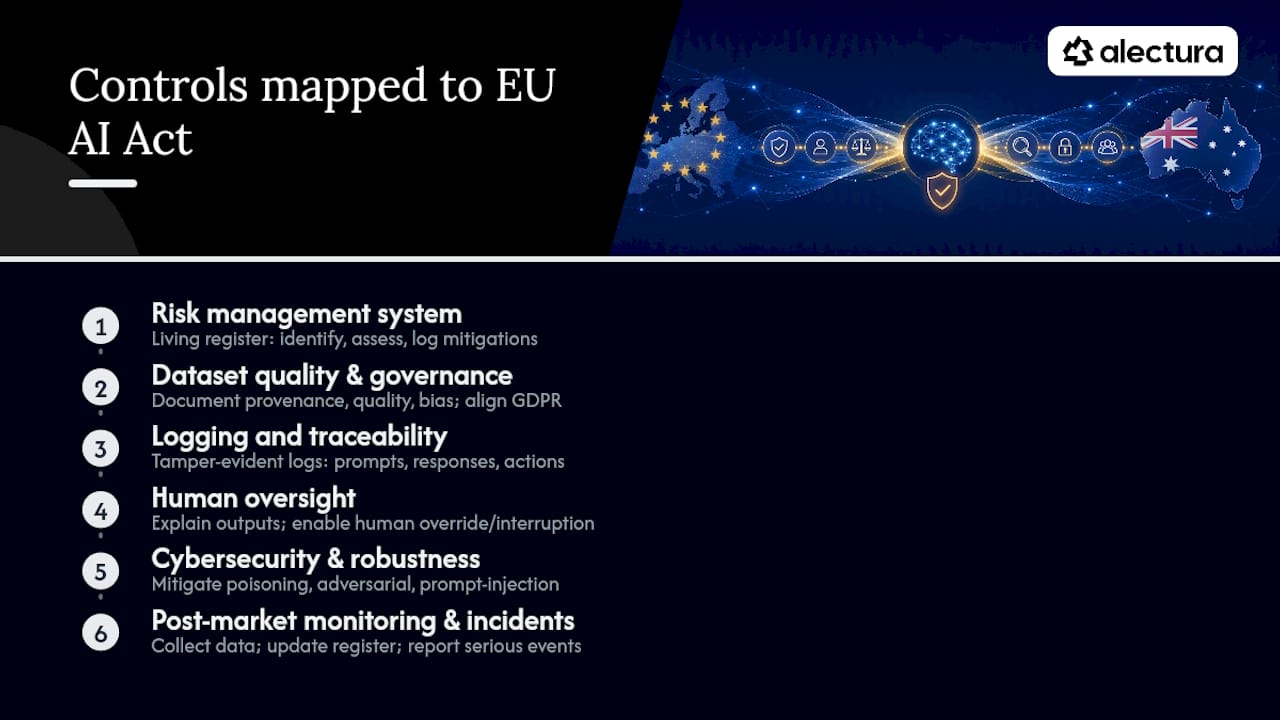
Risk management system (Article 9): Maintain a living document that identifies foreseeable risks, estimates their likelihood and severity, and records the mitigations applied. Review it whenever the system changes or new incident data arrives. This is not a one-time risk assessment; it is an ongoing process.
Dataset quality and data governance (Article 10): Document the provenance of training, validation, and testing data. Record quality criteria, bias assessments, and any data cleaning steps. For systems processing personal data, align data governance with GDPR obligations. The GDPR and AI compliance intersection is particularly relevant for Australian organisations with EU data subjects, since both frameworks apply simultaneously.
Logging and traceability (Article 12): High-risk systems must log events automatically to the extent necessary to identify risks and enable post-market monitoring. Logs must be tamper-evident and retained for a period appropriate to the system's lifecycle. For AI agent monitoring, this means capturing prompt-level interactions, model responses, and any actions taken by agentic systems.
Human oversight (Article 14): Build in mechanisms that allow a human to understand the system's outputs, override or interrupt operation, and prevent over-reliance on automated decisions. Document these mechanisms in the technical file and test them.
Cybersecurity and robustness (Article 15): Implement safeguards against data poisoning, adversarial inputs, and prompt injection. Article 15 requires demonstrable technical measures, not just policy statements. Offline AI security hardening techniques, including input validation, output filtering, and network segmentation, are directly relevant here.
Incident reporting: Serious incidents (those causing death, serious harm to health, significant property damage, or fundamental rights violations) must be reported to the relevant national market surveillance authority. Establish an internal pipeline that routes AI-related incidents from operations teams to the compliance function within a defined timeframe, and from there to the authority within the regulatory window.
Post-market monitoring (Article 72): Collect performance data from deployed systems, analyse it against the risk management system, and feed findings back into the technical file. The monitoring plan must be documented before the system goes live.
When does the EU AI Act apply to non-EU organisations?
The extraterritorial triggers are specific. An Australian organisation falls under the Act when it:
- Places an AI system on the EU market (makes it available to EU users, whether for payment or free of charge).
- Puts an AI system into service in the EU (deploys it for use in the Union, even internally within an EU subsidiary).
- Operates an AI system whose outputs are used in the EU, even if the system runs entirely on Australian infrastructure.
The provider versus deployer distinction carries different obligations. Providers bear the primary compliance burden: technical documentation, conformity assessment, CE marking, registration, and post-market monitoring. Deployers have lighter but still real obligations: using systems in accordance with instructions, monitoring for risks, reporting incidents, and not modifying systems in ways that change their risk classification.
When to appoint an EU authorised representative
Non-EU providers placing high-risk AI systems on the EU market must appoint an EU authorised representative before doing so. The representative must be established in an EU member state, hold a written mandate from the provider, and be able to cooperate with national authorities and the AI Office on the provider's behalf. This is a legal requirement, not optional. Engaging a representative early also gives you a point of contact for monitoring regulatory developments and receiving enforcement correspondence.
Contract clauses to include
When contracting with EU customers or EU-based AI suppliers, include clauses that:
- Allocate provider and deployer responsibilities explicitly.
- Require the supplier to maintain and provide access to technical documentation on request.
- Specify data handling obligations consistent with both the AI Act and GDPR.
- Establish incident notification timelines (supplier to customer, customer to authority).
- Include warranties that the system meets applicable AI Act requirements at the time of supply.
- Require cooperation with notified bodies and national authorities during conformity assessments or investigations.
Official tools and vendor controls to use right now
Official EU resources
The AI Act Service Desk and official Commission resources provide several tools that Australian teams should use from day one:
- EU AI Act Compliance Checker: A structured questionnaire that produces a preliminary scope determination. Use it for every system in your inventory. It does not replace legal advice but it does give you a documented starting point.
- AI Act Explorer: Full regulatory text with cross-references and search. Use it to verify the legal basis for classification decisions and to locate specific Articles and Annexes during gap analysis.
- AI Act Service Desk: The Commission's official support channel for implementation questions. Submit queries about ambiguous cases and retain the responses as part of your compliance record.
- Small Business Guide and FAQ pages: Practical plain-language guidance on obligations, timelines, and exemptions. Useful for briefing non-technical stakeholders.
- AI Pact: A voluntary commitment mechanism that allows organisations to signal early alignment with the Act's principles before mandatory dates apply. Participation is not a substitute for compliance but it demonstrates good faith to regulators.
Vendor control categories
Beyond official tools, compliance teams need operational controls. The categories to prioritise:
- Endpoint AI Detection & Response (AIDR): Discovers AI tools in use across your fleet, inventories their access and integrations, and generates audit logs that feed directly into the technical file and post-market monitoring reports.
- Model governance platforms: Track model versions, training data lineage, and performance metrics across the model lifecycle.
- Data management platforms: Enforce data quality standards, document provenance, and support bias assessments required under Article 10.
- Testing and validation tooling: Automate adversarial testing, performance benchmarking, and regression testing to generate evidence for the technical file.
- Third-party conformity services: Notified bodies and conformity assessment consultancies that can conduct independent reviews for systems requiring third-party assessment.
Alectura's AIDR platform maps directly to several of these needs. It discovers AI tools running across endpoints, inventories each one and the access it holds, tracks prompt timelines, detects sensitive data leaving the organisation, and enforces policy at the device level. The audit logs and policy enforcement records it generates are the kind of artefacts that go into the technical file and post-market monitoring reports. For AI agent governance specifically, Alectura provides the on-device visibility that most security stacks currently lack.
Key dates and enforcement posture you need to track
The Act's timeline is staggered, and the dates matter for prioritisation.
- February 2025: Prohibitions on unacceptable-risk AI practices became applicable.
- August 2025: Obligations for General Purpose AI (GPAI) model providers and governance provisions (AI Office, AI Board) became applicable.
- 2 August 2026: The main body of obligations, including Chapter III requirements for high-risk AI systems, applies from this date under the implementation guidance.
- 2027 and beyond: Transitional provisions for certain high-risk systems already on the market before August 2026, and for AI systems embedded in Annex I products, extend compliance windows in some cases. Check Article 111 for your specific situation.
Who enforces the Act
The AI Office sits within the European Commission and has primary responsibility for supervising GPAI models and coordinating enforcement across member states. National competent authorities in each EU member state conduct market surveillance for AI systems within their jurisdiction. Both can request technical documentation, conduct evaluations, and require corrective measures.
What to monitor
- The AI Office's official notices and guidance documents.
- Delegated acts specifying technical details for particular system categories.
- Harmonised standards developed by CEN/CENELEC that, once published, create a presumption of conformity.
- National authority guidance in the member states where your EU customers are located.
- The AI Pact's voluntary commitment updates and Commission communications.
How AIDR maps to the Act's technical requirements
The Act's evidence requirements are operational, not theoretical. Regulators want to see logs, not policies. This is where AIDR-style tooling earns its place in a compliance programme.
Inventory and classification evidence: Alectura discovers every AI tool running across your endpoint fleet, including browser copilots, IDE assistants, and AI embedded in SaaS applications. That inventory is the starting point for your AI Act scope assessment and feeds directly into the technical documentation's system description.
Prompt timeline and audit logs: The Act requires logging sufficient to enable traceability of high-risk system outputs. Alectura's prompt timeline tracking captures interactions at the device level, creating a tamper-evident record that can be produced to a notified body or national authority on request. These logs map to Article 12 (logging) and Annex IV (validation and testing procedures, post-market monitoring plan).

Data access and exfiltration detection: Article 10 requires documented data governance. Alectura's AI data loss prevention capabilities detect sensitive data leaving the organisation via AI tools, providing evidence that data governance controls are operational rather than aspirational.
Policy enforcement records: Alectura enforces guardrails at the device level and logs every enforcement action. Those records demonstrate that human oversight mechanisms are active, which maps to Article 14 and the human oversight section of the technical file.
Cybersecurity and robustness: Article 15 requires demonstrable safeguards against adversarial inputs and prompt injection. Alectura detects prompt injection attempts in real time and logs them, providing the kind of incident-level evidence that supports both the cybersecurity section of the technical file and the post-market monitoring report.
Integrating AIDR outputs into compliance evidence
Send Alectura logs to your SIEM or SOAR platform to create a unified compliance evidence stream. Map log event types to specific Annex IV elements in your documentation. For example:
- Policy enforcement events map to Article 14 (human oversight) and the technical file's human oversight section.
- Prompt injection detections map to Article 15 (cybersecurity) and the incident reporting pipeline.
- Data exfiltration alerts map to Article 10 (data governance) and the post-market monitoring report.
Operational considerations: Retain logs for at least the period specified in your post-market monitoring plan, and no less than the system's operational lifetime plus any regulatory retention requirement. Chain each log entry to a named responsible person where the system allows. For notified body reviews, produce signed test logs rather than raw exports.
Pro Tip: Structure your SIEM queries so that Annex IV evidence can be exported as a named report, not reconstructed manually each time. A notified body or national authority will not wait weeks for you to compile evidence from disparate sources.
The compliance posture that actually matters
Most compliance programmes for new regulations follow the same arc: initial panic, policy drafting, and then a long plateau where documented policies sit disconnected from what the systems actually do. The EU AI Act is specifically designed to break that pattern. Its evidence requirements are operational. An auditor asking for your Article 12 logs does not want a policy document; they want the logs.
The teams that will navigate this well are not the ones with the most polished compliance frameworks. They are the ones that started with an honest inventory, classified their systems without wishful thinking, and built evidence collection into their operational tooling from the start. Documentation and demonstrable processes matter more than perfection at first.
For Australian organisations, the 90-day priority list looks like this:
- Days 1–7: Complete the AI inventory. Run every system through the Compliance Checker. Assign a named owner to each system.
- Days 8–30: Classify each system. Run the gap analysis for any high-risk systems. Identify whether you need an EU authorised representative.
- Days 31–90: Begin producing technical documentation for high-risk systems. Implement logging and traceability controls. Engage legal counsel if you are definitely in scope for high-risk obligations or GPAI rules.
The instinct to wait for harmonised standards or further Commission guidance before starting is understandable but costly. The legal text is clear enough to begin classification and gap analysis now. Waiting means compressing the implementation timeline unnecessarily.
Alectura | AIDR: endpoint control that produces compliance evidence
The gap most Australian organisations discover mid-compliance programme is not in their policies. It is in their evidence. They have risk registers but no logs. They have data governance frameworks but no record of what AI tools actually touched sensitive data. They have human oversight procedures but no audit trail showing those procedures were followed.

Alectura's AIDR platform closes that gap at the endpoint level. It discovers every AI tool running across your fleet, inventories each one and the access it holds, tracks prompt timelines, detects sensitive data exfiltration, enforces policy guardrails, and integrates with your SIEM and SOAR stack. Every one of those capabilities produces an artefact that maps to a specific Annex IV element or Article requirement. The audit logs are on-device, tamper-evident, and exportable in formats that notified bodies and national authorities can work with directly.
For procurement and legal teams assessing vendor terms, Alectura's Master Subscription Agreement sets out the contractual obligations clearly. To see how the platform maps to your specific compliance gaps, request a demo at Alecturalabs.
Sources
The sources below are the primary references for validating requirements, timelines, and technical documentation expectations.
- Consolidated TEXT: 32024R1689 — EN — 27.07.2026
- Implementation Guidance for the EU AI Act
- AI Act | Shaping Europe's digital future - European Union
- Annex IV | AI Act Service Desk
Track delegated acts and harmonised standards through the AI Office's official notices and the CEN/CENELEC work programme. Once harmonised standards are published and referenced in the Official Journal, conforming to them creates a presumption of conformity with the corresponding Act requirements, which simplifies both internal assessment and notified body reviews.