
GDPR applies to AI the moment a system touches personal data, whether that's training data, prompts, or inference outputs, and it applies regardless of how the model was built or where it runs. There is no AI exemption. Organisations must identify a lawful basis, document processing, run a Data Protection Impact Assessment (DPIA) where risk is high, and build data protection by design into every deployment.
Before you go further, lock in these four moves:
- Decide your lawful basis (consent, legitimate interest, or contract/legal obligation) for each AI use case, not the whole program at once.
- Start DPIA scoping the moment a system touches special category data or profiles individuals at scale.
- Log records of processing (RoPA) for training, fine tuning, and inference separately.
- Turn on baseline technical controls: data minimisation, encryption, and prompt redaction.
The regulatory line to remember: the EDPB's Opinion 28/2024 treats anonymity as something you must prove, case by case, not something you can assume because data was "de-identified" once.
Key Takeaways
GDPR compliance for AI succeeds when lawful basis, documentation, and DPIAs are paired with continuous technical controls rather than a one-time assessment.
| Point | Details |
|---|---|
| Confirm lawful basis per use case | Document legitimate interest tests or consent separately for each AI system, not the whole program. |
| Treat anonymity as testable | Prove extraction and query-based re-identification risk is insignificant before calling data anonymous. |
| Trigger DPIAs on high-risk signals | Run a DPIA under Article 35 whenever profiling, special category data, or novel AI techniques are involved. |
| Stack AI Act obligations onto GDPR | High-risk systems need technical documentation and conformity assessment alongside existing GDPR duties. |
| Make compliance continuous with Alectura | Endpoint-level AI discovery, prompt timeline logging, and sensitive data detection turn policy into enforceable controls. |
Table of Contents
- How core GDPR principles apply to AI systems
- Key legal questions organisations face with AI and GDPR
- Practical compliance steps for building and deploying AI
- When is an AI model actually anonymous?
- How the EU AI Act interacts with GDPR obligations
- Technical controls that actually reduce GDPR exposure
- Where to find authoritative guidance on GDPR and AI
- What compliance leads consistently get wrong about AI and GDPR
- Turning GDPR obligations into endpoint-level visibility
- Frequently asked questions
- Sources
How core GDPR principles apply to AI systems
GDPR's principles don't bend for machine learning. They just get harder to apply cleanly.
Lawfulness gets complicated fast. Training data scraped from the open web rarely has clean consent attached, so most organisations lean on legitimate interest, which requires a documented three-step balancing test. Contractual or legal obligation bases work for narrower, purpose-built systems.
Purpose limitation and minimisation mean resisting the urge to hoover up every available dataset "in case it's useful later." Prefer synthetic or anonymised data wherever the model's performance allows it.
Transparency and automated decision-making trigger obligations under Articles 12 to 15: people have the right to know when an AI system makes or materially informs a decision about them, and to contest it.
Security and integrity under Article 32 means access controls, encryption, and model hardening against extraction attacks, not just a firewall around the training pipeline — see Security & Privacy — Configurato · Tekkr for operational governance and visibility controls details.
- Map each AI system against these five principles individually, not as a single compliance tick.
- Treat prompts and outputs as personal data whenever they reference identifiable individuals.
Pro Tip: Run a principle-by-principle audit on your highest-risk AI system first. It surfaces gaps faster than a broad, shallow review across every system at once.
Key legal questions organisations face with AI and GDPR
Three questions come up in almost every AI GDPR review, and they rarely have neat answers.
Is the model personal data or anonymous data? The EDPB's opinion says a model only counts as anonymous when the likelihood of extracting personal data directly, or reconstructing it through queries, is insignificant. That's a testable standard, not a guess.
Was the legitimate interest test done properly? Documentation matters as much as the outcome.
What happens if training data was processed unlawfully? The consequences flow downstream into the model itself.
The EDPB is explicit: controllers must document processing under Articles 5, 24, 25 and 30, and unlawful processing during development can taint everything built on top of it.
- Confirm whether your dataset or model meets the EDPB's anonymity bar before calling it "anonymised."
- Keep the legitimate interest balancing test on file, not just the conclusion.
- Build a process for handling objections to profiling and requests for explanation of automated decisions.
Practical compliance steps for building and deploying AI
Turning principles into practice means a sequence, not a checklist you tick once and forget.
- Scope the data flows. Map every AI project against your RoPA, separating training, fine tuning, and inference stages.
- Choose and document the lawful basis. Where legitimate interest applies, keep the three-step test on record, not just the conclusion.
- Run the DPIA trigger check. High-risk profiling, large-scale special category processing, or novel AI techniques generally require a full DPIA under Article 35.
- Lock down contracts and data provenance. Third-party AI vendors need clauses covering training data sourcing, retention limits, and deletion obligations.
- Implement technical controls. Access controls, prompt redaction, and centralised logging aren't optional extras once a DPIA flags residual risk.
- Revisit the DPIA whenever a model is retrained on a materially different dataset.
- Keep deletion and retention schedules for both raw data and model artefacts, not just the datasets you started with.
When is an AI model actually anonymous?
This is where most compliance teams overestimate their position. The EDPB's case by case test looks at two things: could someone extract training data directly from the model, and could someone reconstruct personal data through carefully designed queries? If either is more than insignificant, the model isn't anonymous.
Residual risk factors worth testing include membership inference (can an attacker tell if a specific record was in the training set), model inversion (can training examples be reconstructed from outputs), and how unique or rare specific data points are within the training corpus.
- Run adversarial testing for extraction and inference risk before declaring a model anonymised.
- Apply differential privacy, synthetic data generation, or controlled query interfaces where residual risk remains.
- Document every test and its result. Regulators expect evidence, not assurances.
How the EU AI Act interacts with GDPR obligations
The AI Act and GDPR aren't competing frameworks, they're stacked ones. GDPR governs how personal data gets used; the AI Act governs system safety, transparency, and risk classification.
High-risk AI systems carry extra obligations under the Act: technical documentation, conformity assessment, and human oversight requirements that sit on top of, not instead of, your GDPR duties.
- Align your AI Act technical documentation with your GDPR DPIA wherever the same system is in scope for both.
- Treat GDPR as your ongoing baseline; the AI Act adds product-level governance for higher-risk categories.
Technical controls that actually reduce GDPR exposure
Policy documents don't stop data leaking through a copilot's prompt window. Controls do.

At the endpoint, that means AI data loss prevention that catches sensitive data before it leaves the device, prompt redaction that strips personal identifiers automatically, and centralised policy enforcement so security teams know which AI tools are touching which corporate data.
At the model level, the EDPB's LLM privacy risk report recommends differential privacy, access gating, rate limiting, and query sanitisation to reduce inversion and poisoning risk. Stanford HAI treats model extraction as a realistic threat requiring both model and endpoint mitigations working together.
- Inventory every AI tool touching sensitive data across your fleet, including shadow AI that never went through procurement.
- Instrument prompt timelines and centralise logs so a security event is traceable end to end.
- Feed AI-specific alerts into your existing SIEM/SOAR stack instead of building a parallel monitoring system.
- GDPR compliance for AI is a continuous control loop, not a DPIA you file once and revisit next audit cycle.
Pro Tip: Instrument your highest-risk AI use case for full prompt-to-output visibility before rolling controls out fleet-wide. You'll catch the failure modes that matter before they scale.
Where to find authoritative guidance on GDPR and AI
Start with the EDPB's Opinion 28/2024 for anonymity and legitimate interest tests, the EDPS generative AI orientations for DPIA triggers, ICO's AI and data protection guidance for UK-specific application, the AI Act text for high-risk system obligations, and IAPP's AI Act mapping resources for cross-referencing both frameworks against your own risk register.
What compliance leads consistently get wrong about AI and GDPR
The biggest mistake isn't a missing DPIA. It's treating GDPR compliance for AI as something you finish, rather than something you run continuously.
Most organisations instrument their highest-risk AI system on day one, then never look at it again until an incident or audit forces the issue. Start with the use case that touches the most sensitive data or the largest number of people, and build monitoring in from the start rather than bolting it on afterwards.
Pro Tip: Pick one high-risk AI use case, wire it for full observability, and use what you learn to template the rollout across everything else.
Turning GDPR obligations into endpoint-level visibility
Most GDPR failures in AI don't start with a bad policy. They start with a security team that can't see which AI tools are running on their own endpoints, what data those tools touch, or where a prompt sent data it shouldn't have.

Alectura gives security and compliance teams that visibility directly at the endpoint: discovery of every AI tool in use across the fleet, an inventory of what each one can access, prompt timeline capture for auditability, and real-time detection of sensitive data leaving through a copilot or assistant. That's the operational layer GDPR's documentation and by-design requirements actually demand, built to work alongside the DPIAs and RoPA entries your legal team already maintains, referencing our own Master Subscription Agreement for procurement teams reviewing terms. If your GDPR compliance plan for AI still relies on policy documents and periodic reviews, evaluate Alectura's AI Detection & Response platform as the continuous control layer that closes the gap between what your policy says and what your endpoints are actually doing.
Frequently asked questions
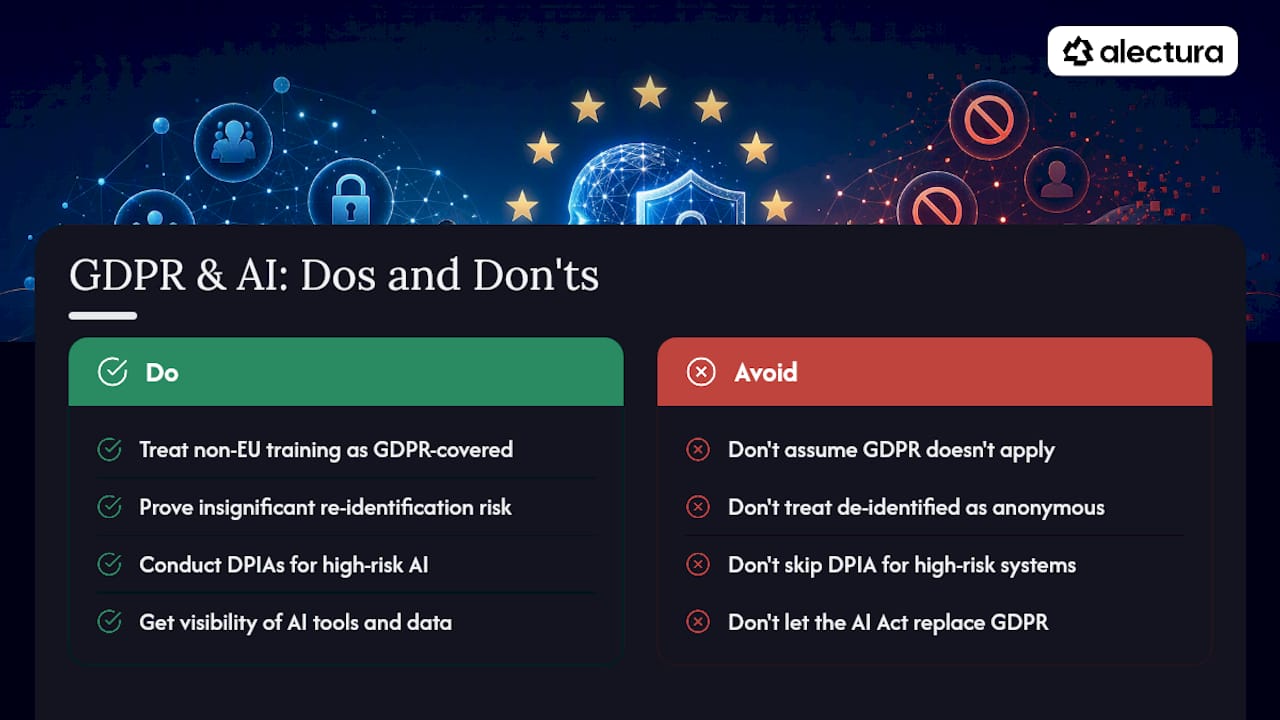
Does GDPR apply to AI models trained outside the EU? Yes, if the system processes personal data of individuals in the EU or is offered to them, GDPR's extraterritorial scope applies regardless of where training happened.
Is anonymised training data always exempt from GDPR? No. The EDPB requires proof that extraction and re-identification risk are insignificant before data or a model counts as genuinely anonymous, not just "de-identified."
Do we need a DPIA for every AI project? Not every project, but any system involving high-risk profiling, special category data, or novel large-scale processing should trigger a DPIA under Article 35.
How does the AI Act change our GDPR obligations? It doesn't replace GDPR. High-risk AI systems under the Act carry additional technical documentation and conformity assessment duties that sit alongside your existing GDPR responsibilities.
What's the fastest way to reduce GDPR risk from AI right now? Get visibility into which AI tools are running across your endpoints and what data they touch. You can't govern what you can't see.
This article is general information, not a substitute for advice from a qualified lawyer. Consult a qualified legal professional about your own circumstances before acting on anything here.
Sources
- Opinion 28/2024 on certain data protection aspects related to the processing of personal data in the context of AI models
- Regulation (EU) 2024/1689 laying down harmonised rules on artificial intelligence (Artificial Intelligence Act)
- Generative AI and the EUDPR. First EDPS Orientations for ensuring data protection compliance when using Generative AI systems
- Data privacy and foundation models: can we have both? | Stanford HAI