
Meeting GDPR evidence and control expectations for generative AI starts at the endpoint, not the network edge. Discover and log every AI interaction where it happens, on the device, before you worry about anything else. Deploy continuous discovery and tamper-evident logging first, then route AI traffic through a gateway with in-flight data loss prevention so sensitive data never leaves the device unmasked. Tools like Alectura exist for exactly this layer of enforcement.
TL;DR:
- Endpoint discovery tools are essential first steps, as they identify all active AI processes and embedded SaaS features many network monitoring tools overlook.
- Tamper-evident logging must include key details like masked prompts, model IDs, routing decisions, and timestamps to support effective audits and regulator compliance.
- Deploying a three-plane architecture with a central gateway, endpoint enforcement, and management layer ensures policies are enforced, logged, and scalable during phased rollouts.
- Technical controls such as in-flight DLP and real-time detection are critical for preventing data leaks and supporting GDPR evidence requirements.
- Continuous discovery and logging provide the evidence trail necessary for GDPR compliance, particularly regarding lawful basis, purpose limitation, and individual data rights.
Table of Contents
- What Are the Core Technical Controls for GDPR Generative AI Compliance?
- How Does the Reference Architecture Tie Together?
- What Does a 90-Day Rollout Actually Look Like?
- What Belongs in an Audit-Ready AI Interaction Log?
- How Do Technical Controls Map to GDPR Evidence Obligations?
- What Does GDPR Actually Cover When It Comes to Generative AI?
- What Makes Generative AI Uniquely Hard to Reconcile With GDPR?
- What Are the Real Risks of Personal Data Leaking Through AI Outputs?
- How Should Consent Work for AI-Generated Data Processing?
- How Do Individual Rights Apply to Generative AI Systems?
- When Does a Generative AI Deployment Need a DPIA?
- Why Endpoint Visibility Comes Before Everything Else
- How Alectura Maps to the Controls in This Guide
- Sources
- FAQ
What Are the Core Technical Controls for GDPR Generative AI Compliance?
Five controls do the heavy lifting for generative AI compliance, and they need to work together, not as isolated projects.
Continuous discovery comes first because you cannot govern what you cannot see. That means endpoint telemetry that flags new AI processes, browser extension analysis to catch copilots hiding inside Chrome or Edge, OAuth token auditing to spot AI tools that have quietly connected to Google Workspace or Microsoft 365, and MCP discovery to find agents wired into internal systems through Model Context Protocol servers. Continuous discovery surfaces embedded SaaS AI features and endpoint agents that network-only monitoring tools consistently miss.
PII detection and pre-egress redaction inspects prompts and outputs before they cross the device boundary. This is the control that actually stops a leak rather than just recording one happened.
Tamper-evident logging needs a defined schema: masked prompt content, model identifier, routing decision, and policy outcome, at minimum, so investigators and auditors get something usable without exposing raw personal data in the log store itself.
Endpoint enforcement routes traffic transparently to a gateway, blocks or allows based on policy, and applies local guardrails, all with minimal friction so people don't route around it.
Telemetry governance keeps audit logs separate from operational logs, masks sensitive fields in observability pipelines, and locks down who can access the log store. ENISA's guidance recommends treating telemetry with the same PII scanning rigour as primary data stores, because observability pipelines are often the least protected part of an AI stack.
- Discovery: endpoint telemetry, browser extensions, OAuth audits, MCP scanning
- DLP: prompt and output inspection before egress
- Logging: masked fields, tamper-evident storage
- Enforcement: transparent routing with local blocking
- Telemetry: separate, masked, access-controlled audit trails
Pro Tip: Build your redaction rules around field types, not keyword lists. A regex for "email address" catches far more than a list of banned words ever will, and it survives when someone rephrases a prompt to dodge a filter.
How Does the Reference Architecture Tie Together?
Three planes, each with a distinct job, is the model that actually holds up under procurement scrutiny and real deployment.
The control plane, usually an AI gateway, handles policy adjudication. It issues virtual keys instead of raw API credentials, inspects prompts and responses in real time, and produces the central tamper-evident log required for audit. This is where masking and blocking decisions get made centrally, rather than left to individual apps to interpret inconsistently.
The enforcement plane lives on the endpoint. It discovers AI activity as it happens, routes traffic transparently to the gateway, and applies local blocking or DLP hooks for cases where routing alone isn't fast enough, such as clipboard operations or file system access that agentic tools increasingly use to move data around outside conventional browser channels.
The management plane is your MDM or UEM layer, deploying the enforcement agent, pushing configuration updates, and tracking the health and lifecycle of every agent across the fleet.
- Control plane: gateway, policy decisions, virtual keys, central logging
- Enforcement plane: endpoint agent, transparent routing, local DLP hooks
- Management plane: MDM/UEM deployment, configuration, lifecycle tracking
The sequence runs discovery first, then routing and enforcement, then logging, then a feed into SIEM and GRC tooling for correlation and reporting. Skip a plane and you get either invisible AI use or unenforceable policy. A gateway paired with an endpoint agent preserves the user experience while keeping every interaction subject to policy and logged centrally, which is the balance most enterprise rollouts fail to strike on the first attempt.
What Does a 90-Day Rollout Actually Look Like?
A phased rollout beats a big-bang deployment because it gives security, privacy, and IT operations teams a chance to validate each layer before the next one goes live. Enterprise governance playbooks consistently structure this as discover, protect, prove, then monitor and scale.
- Days 0 to 30: Stand up discovery. Deploy endpoint telemetry and browser extension scanning across a pilot group. Identify your highest-risk data paths, think customer PII flowing into a chatbot, source code pasted into a coding assistant. Turn on PII scanning within your telemetry pipeline itself, not just at the application layer.
- Days 30 to 60: Route and redact. Push your highest-risk AI tools through an AI gateway. Enable in-flight DLP and redaction so sensitive fields get masked before they reach a third-party model. Begin tamper-evident logging for every routed interaction, even if enforcement agents aren't fleet-wide yet.
- Days 60 to 90: Scale enforcement. Deploy the endpoint enforcement agent across the full fleet through MDM. Integrate audit logs with your SIEM and GRC platforms. Baseline normal agent behaviour and tune anomaly alerts so you're not drowning compliance teams in false positives.
Assign clear owners at each stage: security engineering owns discovery and enforcement tooling, privacy owns the DPIA and evidence mapping, IT operations owns MDM deployment and agent health. Hand compliance teams a short validation test at each milestone, a sample redacted log, a blocked-prompt record, so they can confirm the evidence trail actually works before you scale it.
Pro Tip: Run your first redaction test on a deliberately messy prompt, one with a name, an email, and a customer ID all in the same sentence. If your masking catches all three on the first pass, you're ready to scale. If it misses one, fix the rule before fleet-wide rollout, not after.
What Belongs in an Audit-Ready AI Interaction Log?
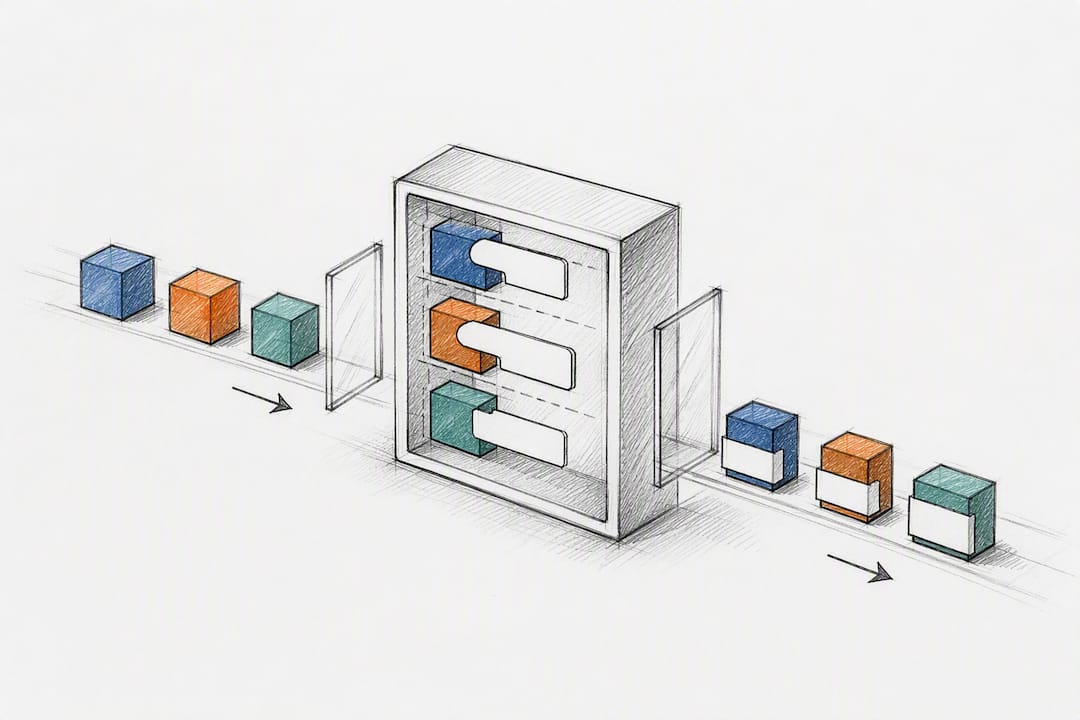
A usable log needs a defined minimum schema, or you end up with either too much raw personal data sitting in a log store or too little detail to reconstruct an incident. The fields that matter: the prompt or a masked version of it, the model identifier, the routing decision, user identity, PII detection flags, a timestamp, and the policy decision applied.
Tamper-evidence matters as much as content. Append-only log structures, cryptographic signing, and write-once storage all prevent a log from being edited after the fact, which is precisely the property an auditor or regulator will ask about. Access controls on the log store itself matter just as much. A tamper-evident log that anyone in IT can quietly edit isn't tamper-evident at all.
- Minimum fields: masked prompt, model ID, routing decision, user identity, PII flags, timestamp, policy decision
- Tamper-evidence: append-only structure, cryptographic signing, write-once storage
- Access control: restrict who can read or modify the log store
- Masking policy: record when redaction occurred, not just that it did
Masking policy needs a clear rule for when to redact fully versus mask partially, and both require a record that masking happened at all, otherwise your audit trail has a gap exactly where a regulator will look first. Retention and deletion controls should align to data classification, keeping high-risk logs long enough for investigation but not indefinitely, which is its own privacy exposure. ENISA's DMS and monitoring guidance frames tamper-protected records as a baseline expectation for GenAI asset governance, not an optional extra.
How Do Technical Controls Map to GDPR Evidence Obligations?
GDPR's records of processing obligation under Article 30 expects organisations to document what personal data gets processed, why, and by whom, a requirement that generative AI use makes considerably harder to satisfy manually. Every technical control described above produces a specific piece of that evidence.
Discovery inventories generate the "what AI processes personal data" answer. Tamper-evident logs generate the "when and how" answer, complete with timestamps and routing decisions. PII detection flags in your logs directly evidence data minimisation efforts, showing a regulator that sensitive fields get caught and masked rather than flowing unchecked into a model. Policy enforcement records demonstrate purpose limitation in action, showing that an AI tool used for one function was blocked from a different, unauthorised use.
Operational audit readiness means these records exist continuously, not assembled retroactively when a Data Protection Authority inquiry lands. A compliance team should be able to pull a report on any AI interaction from the past retention window without chasing down five different teams for screenshots and Slack threads. That continuous evidence trail is what separates a genuinely audit-ready posture from a paper policy that nobody can back up when it matters. Our guide to GDPR and AI walks through this evidence mapping in more operational detail.
What Does GDPR Actually Cover When It Comes to Generative AI?
GDPR applies to generative AI the same way it applies to any other processing activity: whenever personal data enters a prompt, gets stored in a model's context window, or appears in generated output, GDPR's rules on lawful basis, purpose limitation, and data subject rights are in play. The regulation itself doesn't mention "generative AI" by name, which is exactly why organisations struggle with scope. It regulates processing of personal data, and generative AI tools process personal data constantly, through user prompts, through retrieval-augmented context, and sometimes through training or fine-tuning pipelines.
Scope gets tricky at the boundary between the AI vendor and the deploying organisation. When an employee pastes customer data into a public chatbot, your organisation is the data controller for that processing event, regardless of which company built the underlying model. That distinction drives most of the compliance exposure enterprise security teams actually deal with day to day, and it's why endpoint-level visibility matters more than vendor-level assurances. You can read a vendor's data processing agreement cover to cover and still have no idea what your own employees are actually sending to that vendor's API.
The EU AI Act introduces a parallel but distinct layer of obligations around AI system risk classification, and the two regulations increasingly overlap in enterprise environments, particularly around documentation and monitoring requirements for high-risk AI use cases.
What Makes Generative AI Uniquely Hard to Reconcile With GDPR?
Three GDPR principles collide with generative AI's basic mechanics in ways that older data processing systems never triggered.
Data minimisation assumes you can define, in advance, exactly what personal data a process needs. Generative AI prompts are free text. An employee drafting a customer email might paste in a full support ticket, address and phone number included, when the task only needed the complaint summary.
Lawful basis gets murky because most organisations haven't updated their processing records to reflect AI-assisted workflows. The lawful basis that covered a human agent drafting a response doesn't automatically extend to an AI tool doing the drafting, particularly if that tool routes data to a third-party model host in a different jurisdiction.
Purpose limitation breaks down when the same AI tool gets used for a dozen different tasks across a dozen different teams, each with a different original justification for the data involved. A copilot approved for code review shouldn't also be the tool marketing uses to summarise customer feedback containing personal complaints, but without enforcement at the endpoint, nothing stops that drift in practice.
These aren't compliance checklist items you tick once. They require the kind of continuous, real-time enforcement that only endpoint-level and gateway-level controls can actually deliver, because policy documents don't stop a prompt from being typed.
What Are the Real Risks of Personal Data Leaking Through AI Outputs?
Leakage happens in more ways than the obvious "employee pastes sensitive data into a prompt" scenario, and the less obvious paths are usually the more dangerous ones.
Agentic AI tools that operate at the OS level can read clipboard contents, access the file system, and spawn processes as part of a multi-step task. That means a workflow can touch personal data across several steps without any single action looking suspicious on its own, and point-in-time DLP rules built for simpler tools often miss the pattern entirely. Output leakage is the other half of the problem: a model summarising internal documents can reproduce personal details verbatim in its response, even when the original prompt was carefully sanitised, because retrieved context or connected tools reintroduced the data downstream.
Mitigation has to happen at the point of use, not after the fact. In-flight inspection of both prompts and outputs, before either leaves the device or crosses the gateway, catches leakage that a monthly audit never will. Workflow-level monitoring, tracking the full sequence of an agent's actions rather than isolated events, closes the gap that multi-step exfiltration exploits. Redaction policies need to apply symmetrically to inputs and outputs, since a clean prompt doesn't guarantee a clean response.
How Should Consent Work for AI-Generated Data Processing?
Consent management for generative AI needs to answer a question most consent frameworks weren't built for: who consented, to what, when an AI tool is generating new data derived from personal information rather than simply storing it.
The practical answer starts with treating AI-assisted processing as its own documented activity in your consent and lawful basis records, rather than assuming existing consent for "customer service" covers "customer service assisted by a third-party language model." Where consent is the lawful basis, that consent needs to specifically cover AI processing, and withdrawal mechanisms need to actually reach the AI tool, not just the primary system of record.
Technical enforcement makes consent operational rather than theoretical. Policy enforcement at the endpoint can block AI tool access to a customer record flagged as consent-withdrawn, something a static consent database can't do on its own. Logging which consent status applied at the moment of each AI interaction gives you the evidence trail regulators expect, showing that consent state was actually checked, not just recorded somewhere and forgotten.
How Do Individual Rights Apply to Generative AI Systems?
The right of access, rectification, and erasure all get harder to fulfil once personal data has passed through a generative AI system, because "where is the data" stops having a single, simple answer.
Access requests need you to identify every AI interaction where a specific individual's data appeared, which is only possible if your logging captures user identity and content flags at the time of processing. Without that, you're reconstructing the answer manually from fragments, which doesn't scale past a handful of requests. Rectification is harder still: if incorrect personal data was used in a prompt that generated cached or stored output, correcting the source record doesn't automatically fix what the AI tool already produced elsewhere.
Erasure raises the hardest question of all. If a model was fine-tuned on data including a since-deleted personal record, full erasure from the model itself may not be technically achievable in the way deleting a database row is. Endpoint-level controls can't solve model-level erasure, but they can stop the ongoing problem: blocking future prompts that would reintroduce deleted personal data, and providing the audit trail showing exactly which AI interactions involved a given individual, which is often the practical deliverable a Data Protection Authority actually asks for during an inquiry.
When Does a Generative AI Deployment Need a DPIA?
A Data Protection Impact Assessment becomes necessary whenever generative AI processing is likely to result in high risk to individuals, which in practice covers most enterprise AI deployments that touch customer or employee personal data at any meaningful scale.
The assessment needs to look different for generative AI than for a traditional database system. Traditional DPIAs assume a defined, bounded data flow. Generative AI DPIAs need to account for variable inputs, since prompts are free text and unpredictable, third-party model hosting and cross-border data transfer, since most generative AI runs on infrastructure outside the deploying organisation's direct control, and output unpredictability, since the same prompt can generate different responses containing different levels of personal data exposure.
Technical controls feed directly into the DPIA as risk mitigations, and that link is what turns a DPIA from a paperwork exercise into something a regulator actually credits. Continuous discovery demonstrates you know where AI processing happens. In-flight DLP demonstrates a mitigation is actually operating, not just documented as a policy. Tamper-evident logging demonstrates you can produce evidence that the mitigation worked, on the specific interaction, on the specific date, if anyone ever asks.
Why Endpoint Visibility Comes Before Everything Else
Every control in this guide depends on one thing: knowing an AI interaction happened in the first place. Enforcement without discovery is a policy nobody can prove is being followed. Logging without discovery is a partial record that misses whatever your discovery tooling never found. Teams that get this backwards, buying a gateway before they've mapped what's actually running on their fleet, end up enforcing policy on the AI tools they happen to know about and leaving the shadow ones untouched.
The productivity argument matters just as much as the compliance one. An endpoint-first posture lets you route and redact selectively rather than block indiscriminately, which is the difference between a security programme people work around and one they actually tolerate. Start narrow, prove the model on your highest-risk data paths, then scale with clear owners at each stage. That's what actually earns budget for the next phase, not a slide deck.
— Nathan
How Alectura Maps to the Controls in This Guide
Every control described above, continuous discovery, endpoint enforcement, tamper-evident logging, in-flight DLP, exists as a specific capability inside Alectura's AI Detection and Response platform. Alectura discovers AI tools across your fleet, including browser copilots, desktop agents, and MCP connections, and builds a live inventory of what each one can access. The prompt timeline tracking feature produces exactly the kind of tamper-evident audit record this guide describes, with PII flags and policy decisions captured alongside routing metadata. Real-time detection catches secrets, PII, and prompt injection attempts before they leave the endpoint, and centralised policy governance lets you enforce that DLP consistently across the fleet rather than tool by tool.

For teams building the architecture described above, SIEM and GRC integrations mean the evidence you generate at the endpoint feeds straight into the systems your compliance team already uses. If you're still mapping out where AI tools sit relative to your existing security stack, the agentic endpoint security overview explains how endpoint agents fit into the broader category. For a deeper look at how policy, evidence, and audit come together for workforce AI use, the AI governance solution page walks through what a deployment actually looks like. Contact the vendor to see discovery and logging running against your own fleet before committing to a fleet-wide rollout.
Sources
- The visibility gap in autonomous AI agents — Cloud Security Alliance
- Governing AI on every company computer — reference architecture
- How AI gateways maintain data sovereignty — NeuralTrust
FAQ
Does GDPR Apply to Data Typed Into a Chatbot?
Yes. If the text contains personal data, GDPR applies the moment it's entered, and your organisation is generally the data controller for that processing event, regardless of which company built the AI tool.
What's the Minimum Logging Schema for GDPR Evidence?
At minimum, capture the masked prompt, model identifier, routing decision, user identity, PII detection flags, a timestamp, and the policy decision applied to that interaction.
Can Endpoint Controls Alone Satisfy GDPR for AI Use?
Endpoint controls handle discovery, enforcement, and logging, but full compliance also needs updated lawful basis documentation, consent management, and a DPIA. Some platforms cover the technical evidence layer that supports those broader compliance obligations.
How Long Should AI Interaction Logs Be Retained?
Retention should align to your organisation's data classification policy and investigation needs rather than a fixed universal period, since a high-risk interaction may need longer retention than a routine one.
Does a DPIA Need Updating Every Time You Add a New AI Tool?
Generally yes, particularly when the new tool changes the data flow, involves a new third-party host, or processes a different category of personal data than tools already assessed.