
For enterprise-scale sensitive data classification, the most practical approach is a hybrid pipeline: deterministic rules handle the routine, well-known cases, and LLM reasoning gets reserved for whatever is novel, ambiguous, or oddly labelled. Nobody should be pointing a large language model at every field in every table. That's slow, expensive, and unnecessary.
Here's what to build first:
- Ingest and metadata layer — pull schema, column names, and sample statistics before touching content.
- Evidence brief builder — assemble the context an LLM needs without exposing raw sensitive values.
- LLM reasoning path — reserved for the fraction of assets deterministic rules can't confidently resolve.
- Human review loop — adjudicates edge cases and feeds confirmed labels back into the rule engine.
- Enforcement hooks — wire confirmed labels into DLP, SIEM, and SOAR so classification actually does something.
Pro Tip: Run a metadata-only classification pass across a representative schema sample before you write a single prompt for content inspection. It tells you how much of the problem rules can already solve.
Key Takeaways
A hybrid pipeline that routes the majority of assets through deterministic rules and reserves LLM reasoning for ambiguous cases delivers accurate, auditable, cost-controlled sensitive data classification at enterprise scale.
| Point | Details |
|---|---|
| Use a dual-path funnel | Route routine assets to deterministic rules and reserve LLMs for novel or ambiguous cases to control cost. |
| Default to metadata-only | Classify from schema and sample metadata first; escalate to content inspection only when metadata is ambiguous. |
| Measure against the action | Set precision and recall thresholds based on whether the label feeds discovery or automated enforcement. |
| Distil confirmed patterns into rules | Promote stable LLM-resolved patterns into the deterministic engine to shrink expensive inference over time. |
| Document provenance for every label | Record which path, prompt version, confidence, and adjudicator produced each classification for audit trails. |
Table of Contents
- What is LLM data classification and why does it matter for enterprises?
- Core architecture and pipeline for LLM-driven classification
- How do you run a proof of concept for LLM data classification?
- What metrics actually prove a classifier is production ready?
- What are the biggest risks in LLM-based data classification?
- How do you control cost and latency at scale?
- From labels to action: integrating classification into security workflows
- How should you approach prompt engineering for classification tasks?
- What data labelling strategy actually supports an LLM classifier?
- How do you handle evolving data types and schema drift?
- How do you secure data in transit and at rest during classification?
- Open-source or commercial LLMs for classification tasks?
- What does a successful enterprise deployment actually look like?
- How do you document LLM classification outputs for audit and compliance?
- Nathan's take: stop treating classification as a research project
- What is LLM data classification and how does it differ from rule-based approaches?
- Is it safe to send sensitive data to an LLM for classification?
- How accurate are LLMs at data classification tasks?
- Should we build our LLM classification pipeline in-house or buy a platform?
- How often should classification rules and prompts be reviewed?
- Sources
What is LLM data classification and why does it matter for enterprises?
Regex and deterministic rules match patterns. LLMs interpret meaning. That's the entire difference, and it's a bigger deal than it sounds.
A regex can spot a string that looks like a credit card number. It cannot tell you that a column called usr_ref_9 actually stores a national identity number because the surrounding fields, sample values, and table name all point that way. LLMs infer intent from context: field names, adjacent columns, sample data, even the naming conventions of the engineering team that built the schema. That's contextual understanding versus pattern matching, and it's where nested fields, derived features, and cryptically named columns finally become classifiable.
Content inspection with an LLM is a big hammer, though. For most enterprise environments, metadata-only classification should be the default. You only escalate to content inspection when metadata is genuinely ambiguous, because every extra glance at raw values is extra exposure and extra cost.
Core architecture and pipeline for LLM-driven classification
The pipeline needs eight moving parts, and skipping any of them tends to show up later as either a security gap or an audit headache.
- Ingest — connectors pull schema and sample metadata from databases, object stores, SaaS apps, and endpoints.
- Metadata enrichment — attach table lineage, ownership, access patterns, and prior labels.
- Evidence brief builder — compress metadata and (only when necessary) masked samples into a compact prompt payload.
- Deterministic rule engine — resolves known patterns first: regex, dictionaries, known schema fingerprints.
- LLM classifier — the fallback path for assets the rule engine can't confidently score.
- Human review and label store — analysts adjudicate low-confidence or high-impact results.
- Rule distillation — patterns confirmed repeatedly by humans get promoted into the deterministic engine.
- Enforcement integrations — DLP, SIEM, and SOAR consume the final label.
The dual-path funnel is the part people get wrong. Deterministic rules run first, on everything. Whatever they can't resolve with sufficient confidence, and only that, gets routed to the LLM. Both paths converge on the same result schema (asset ID, label, confidence, source path, provenance) so downstream systems don't care which path produced the answer. Meta's engineering team runs exactly this pattern at scale, with rules resolving roughly 85% of assets and LLMs handling the remaining 15%.
Three design invariants matter regardless of scale: mask high-risk fields before they ever reach a prompt, treat reviewed labels as append-only (never silently overwritten), and attach provenance metadata to every label so you can answer "why was this classified this way" months later.
Pro Tip: Build your result schema before you build your prompts. If the deterministic engine and the LLM path can't write to the same schema, you'll end up with two incompatible classification systems instead of one.
How do you run a proof of concept for LLM data classification?
A POC that starts with "let's point GPT at our data lake" wastes weeks. Structure it instead as a tight, measurable loop.
- Select a representative sample. Pull schemas from your highest-value systems, plus deliberately weird edge cases: renamed columns, legacy tables, third-party integrations with inconsistent naming.
- Add adversarial examples. Include a handful of records designed to fool a naive classifier, columns that look sensitive but aren't, and ones that look benign but hold PII.
- Start metadata-only. Feed the model table names, column names, data types, and non-sensitive sample statistics rather than raw values. This minimises exposure and is enough to resolve most schema-level questions.
- Request one field at a time. Asking an LLM to classify fifty columns in one call invites "laziness", where it pattern-matches the first few and coasts on the rest. One-field or small-batch requests get sharper answers.
- Run a judgement panel. Send ambiguous cases through two or three prompt variants or models and treat disagreement as a signal for human review, not something to average away.
- Route to human adjudication. Anything below your confidence threshold, or anything touching a high-risk category, goes to a person before it's trusted.
- Hold out a validation set. Never let the same data inform both prompt tuning and your accuracy measurement.
- Run new rules in shadow mode first. Before a distilled rule enforces anything, let it run silently alongside the LLM path and compare outputs for a few weeks.
Before calling the POC done, check four things: what percentage of assets the deterministic baseline already covers, whether precision and recall on your held-out set clear the bar for your intended use case (discovery tolerates more error than automated enforcement), how the classifier performs against your adversarial set specifically, and whether you've got a regression gate stopping a prompt change from silently degrading accuracy on cases you'd already solved. ClassifAI's work on mapping free text to standard taxonomies is a useful reference for bootstrapping label coverage without needing a large hand-labelled corpus first.
What metrics actually prove a classifier is production ready?
Precision, recall, and F1 mean different things depending on what happens next. If the label only feeds a discovery dashboard, a missed case is annoying. If the label triggers automatic quarantine or access revocation, a missed case (a false negative) is a real exposure, and a false positive is an operational disruption someone has to explain. Set your precision and recall thresholds against the downstream action, not a generic target.
Sampling strategy matters more than most teams assume. Rare classes (a handful of health records buried in a mostly generic dataset) get swamped in a random sample. Build a stratified sample that deliberately over-represents rare and adversarial cases, because that's where hallucination and blind spots actually surface. Ethyca's engineering work on metadata-only classifiers found accuracy on adversarial benchmarks moved from around 50% to over 80%, and exceeded 95% on easier real-world datasets, once human-in-the-loop validation and ensemble evaluation were added.
Keep your evaluation set frozen and separate from whatever loop you use to tune prompts, and require a regression gate before any distilled rule goes live.
What are the biggest risks in LLM-based data classification?
Four failure modes recur across every enterprise deployment: hallucinated labels that look confident and are wrong, leakage of sensitive fields into a model's context window, over-classification that buries analysts in false alarms, and under-classification that quietly misses regulated data. Dataset drift compounds all four over time, as new systems and naming conventions shift what "normal" looks like.
The mitigations aren't exotic:
- Mask or tokenise high-risk fields before they ever reach a prompt.
- Default to metadata-only classification and reserve content inspection for genuinely ambiguous cases.
- Enforce tenant isolation so no classification pipeline can see across customer or business-unit boundaries.
- Check contracts and data processing agreements before sending any content to a third-party model provider.
- Require human sign-off before a high-risk classification change takes automated effect.
There's also a model-level obligation people skip. Pertama Partners argues that a model should be classified at least as highly as the most sensitive data used to train it, because model weights and outputs inherit the maximum sensitivity of their training inputs.
A model's weights carry the sensitivity of whatever trained them. Treat the model itself as a regulated asset, not just the data feeding it.
Regulatory exposure varies by jurisdiction and data category, so check what your local regime requires for regulated categories like health or financial records before finalising your handling rules.
How do you control cost and latency at scale?
Cost control starts with refusing to send everything to the LLM. Meta's dual-path pattern routes roughly 85% of traffic to deterministic rules and reserves the LLM path for around 15% of novel or ambiguous assets, because the LLM path can run substantially more expensive per request in compute terms than a rule match. That ratio is the whole economic argument for the hybrid model.
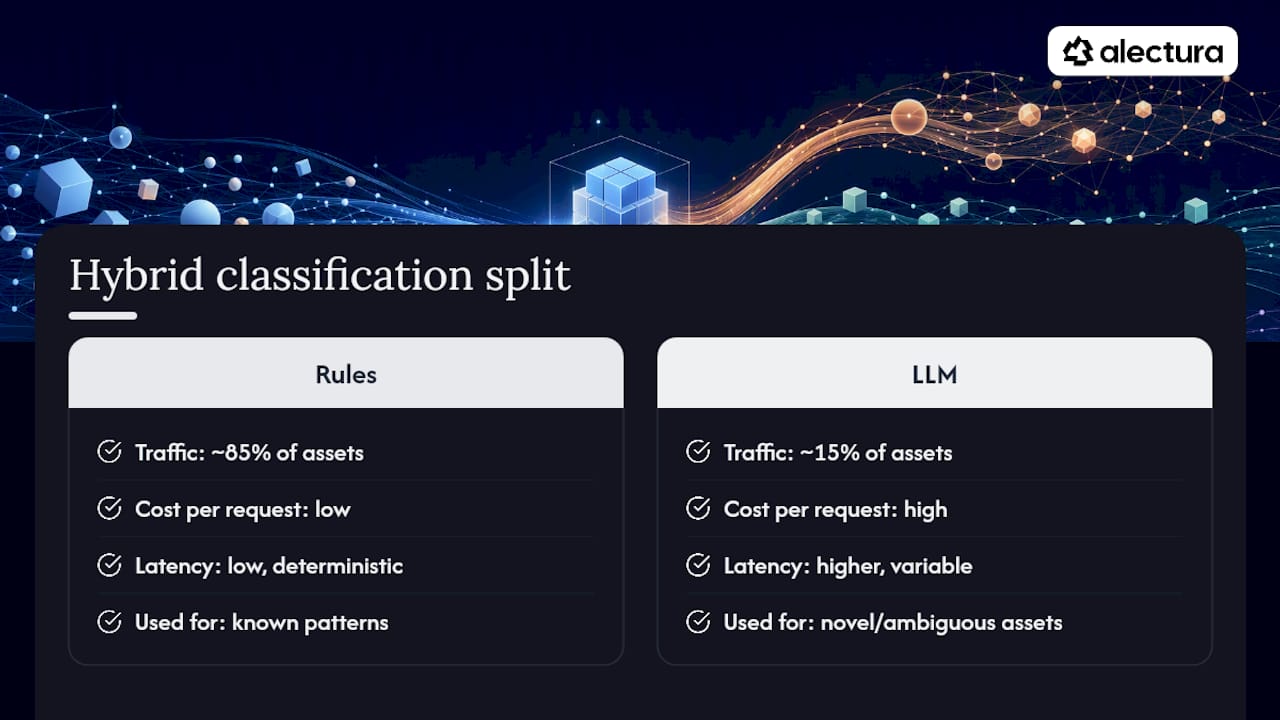
On the performance side: cache prompt templates and repeated context, batch similar requests where the model supports it, and keep single-field requests small enough to parallelise across workers rather than serialising one giant multi-column prompt.
For cost governance, give the LLM fallback path its own budget line separate from general model spend, so a spike in novel or messy assets doesn't silently blow out your bill. Track cost per classified asset, not just total spend. And treat rule distillation as an ongoing cost-reduction exercise: every pattern you confidently promote from the LLM path into the rule engine shrinks the surface area that needs expensive inference next quarter.
From labels to action: integrating classification into security workflows
A label sitting in a dashboard doesn't protect anything. Classification only earns its keep when it triggers a concrete downstream action, and that mapping needs to be explicit and tested, not assumed.
- Redact — automatically mask sensitive fields flowing through pipelines flagged as high sensitivity.
- Quarantine — isolate an asset or device pending review when confidence is high but adjudication hasn't happened yet.
- Escalate — route to a SOC analyst via SIEM when a classification event matches a high-risk pattern.
- Revoke access — trigger an automated access review when a previously low-sensitivity asset gets reclassified upward.
Your event schema should carry enough fields to reconstruct the decision later: asset ID, assigned label, confidence score, provenance (which path produced it, rule or LLM, and which prompt version), adjudication status, and a timestamp. Feed that schema into your SIEM for enterprise monitoring and into SOAR playbooks that map label plus confidence to a specific remediation action, with a defined SLA for how long a human has to review before automated action fires.
Set explicit human-review SLAs by risk tier. High-risk reclassifications (anything touching regulated categories) should hit a human within hours, not days. Lower-risk drift can queue for a weekly review cycle. Document every automated action the pipeline takes, because when a post-mortem asks "why did the system quarantine this asset", the answer needs to be in the log, not in someone's memory. This is also where DLP tooling built for AI-aware environments earns its place, translating a classification label directly into a blocking action at the point data tries to leave.
Pro Tip: Test your SOAR playbook against a deliberately wrong classification before going live. If a false positive quarantines a production system with no easy rollback, you've built an outage generator, not a security control.
How should you approach prompt engineering for classification tasks?
Treat prompts like code: version them, test them against a fixed evaluation set, and never ship a change without a regression check. A single-field classification prompt should specify the exact taxonomy you're using, ask for a confidence score alongside the label, and require the model to cite which piece of evidence (a column name, a sample value, a table relationship) drove its answer. That evidence trail is what makes an LLM's output auditable instead of a black box guess.
Microsoft's guidance on advanced prompt engineering covers chaining reasoning steps and structuring instructions to reduce brittleness, both of which matter more for classification than for open-ended generation, because a classification prompt has to behave the same way on the ten-thousandth call as it did on the first.
Run prompt variants against each other deliberately. Two or three phrasings of the same classification question, scored against your frozen evaluation set, will surface which wording actually holds up and which one only looked good in a handful of manual spot checks. Where variants disagree on a specific record, that disagreement is useful information: it flags a genuinely ambiguous case worth routing to human review rather than trusting a majority vote.
Continuous improvement means retiring prompts, not just adding to them. When a distilled rule takes over a pattern the LLM used to handle, remove that case from the LLM's responsibility and shrink the prompt accordingly. A prompt that keeps growing to cover cases already solved elsewhere is a maintenance liability, and it slows every future request down for no benefit.
What data labelling strategy actually supports an LLM classifier?
The labelled data you use to validate a classifier is arguably more valuable than the classifier itself, because it's the thing that lets you catch drift, benchmark new models, and justify decisions to an auditor. Building it well means combining a few approaches rather than picking one.
Start with expert-labelled seed sets: a security engineer or data governance analyst hand-labels a few hundred representative records across every class in your taxonomy, including the rare ones. Use that seed set to bootstrap a larger corpus with LLM-assisted pre-labelling, where the model proposes a label and a human confirms or corrects it, which is far faster than labelling from scratch and produces a natural disagreement signal wherever the model gets something wrong.
Active learning tightens the loop further: prioritise human review time on the records where your ensemble of prompts or models disagrees most, rather than reviewing a random sample. That's where labelling effort actually moves the needle on accuracy.
Keep three separate label pools: a training-adjacent set for prompt tuning, a frozen evaluation set nobody touches during development, and a rolling adversarial set you deliberately try to break the classifier with. Treat the label store itself as append-only and versioned, so you can always answer which taxonomy version was in effect when a given label was assigned.
How do you handle evolving data types and schema drift?
Enterprise schemas don't hold still. New SaaS integrations appear, columns get renamed, and entirely new sensitive categories emerge as regulation shifts (a jurisdiction adding a new protected data category, for instance). A classification system built for a fixed taxonomy breaks quietly the moment reality moves past it.
Version your taxonomy explicitly rather than editing it in place. Every label in your store should reference which taxonomy version produced it, so a schema change doesn't retroactively make historical labels ambiguous. When you add a new category, run it through the same POC discipline as the original build: a representative sample, a frozen evaluation set, and a shadow-mode period before any new rule gets enforcement authority.
Set up drift detection as an ongoing job, not a one-off audit. Track the rate at which the LLM fallback path is triggered over time. A sudden increase usually means new systems have entered your environment that the deterministic rule engine doesn't recognise yet, which is exactly the signal you want before those systems accumulate months of unclassified sensitive data. Feed that drift signal into your rule distillation cycle so the deterministic engine keeps absorbing new stable patterns rather than leaving everything permanently routed to the more expensive LLM path.
How do you secure data in transit and at rest during classification?
The classification pipeline itself becomes a target the moment it touches sensitive metadata or masked samples, so it needs the same controls as any other system handling regulated data, not a lighter version because "it's just metadata."
Encrypt everything in transit between ingest, the evidence brief builder, and the LLM inference endpoint, whether that endpoint is internal or a third-party API. Evidence briefs and prompt payloads should be treated as sensitive artefacts in their own right: encrypt them at rest, apply the same retention limits you'd apply to the underlying data, and purge them on a defined schedule rather than letting prompt logs accumulate indefinitely in a debugging bucket somewhere.
Tenant isolation deserves particular attention if you're running classification as a shared service across business units or customers. A single misconfigured queue or shared cache can leak one tenant's evidence brief into another tenant's classification request, and that's a breach regardless of how good your prompts are. Apply the same access controls to the label store as you would to the source systems it describes. A label store is, after all, a map of where your organisation's most sensitive data lives, which makes it a high-value target in its own right.
Open-source or commercial LLMs for classification tasks?
The choice comes down to data residency, cost profile, and how much control you need over the model's training data provenance, not raw accuracy alone. Commercial APIs from major providers generally offer stronger out-of-the-box reasoning on ambiguous, low-context classification tasks, and they update faster as vendors improve underlying models. That convenience comes with a trade-off: your evidence briefs leave your infrastructure, which means contract terms and data processing agreements matter as much as model quality.
Open-source models, self-hosted, keep data inside your perimeter entirely, which is often the deciding factor for regulated industries or for organisations with strict data residency requirements. The trade-off is operational: you own the serving infrastructure, the latency tuning, and the ongoing work of keeping the model current as better open-weight releases appear.
A sensible default for most enterprises is a split: run metadata-only classification on whichever model gives the best cost-to-accuracy ratio for your volume, and reserve the more expensive or more capable model, open-source or commercial, for the genuinely hard fallback cases that survive the deterministic and first-pass LLM filters. Whichever you choose, remember the model-classification principle from earlier: a model inherits the sensitivity of whatever trained it, so a fine-tuned open-source model trained on your regulated data becomes a regulated asset itself, with the handling requirements that implies.
What does a successful enterprise deployment actually look like?
Meta's public engineering write-up on asset classification is the clearest large-scale reference point available: a dual-path system resolving roughly 85% of assets through deterministic rules and 15% through LLM reasoning, with the LLM path running at a much higher compute cost per request but reserved for exactly the cases where it earns that cost. The lesson isn't the specific ratio, which will differ for every organisation's data estate. It's the architectural discipline: never let the expensive path handle traffic the cheap path could resolve.
Ethyca's engineering work on metadata-only classifiers offers a second, complementary pattern: instead of routing on a rules-first funnel, they focused entirely on minimising exposure by classifying from metadata alone and layering ensemble evaluation and human adjudication on top, pushing adversarial accuracy from a baseline level to a substantially higher level. That's a useful counterpoint for organisations where content inspection is off the table for privacy or contractual reasons, and it proves metadata-only isn't a compromise position. It can be the whole strategy.
Both examples share a structural trait worth copying regardless of scale: classification labels feed directly into downstream action rather than sitting in a dashboard. That's the distinction between a research project and a production security control.
How do you document LLM classification outputs for audit and compliance?
An auditor doesn't want to know that your classifier is "generally accurate." They want to reconstruct, for any given asset, exactly why it received the label it did, who reviewed it, and when. Build that trail into the pipeline from day one rather than trying to reconstruct it after an incident.
Every classification event needs a provenance record: which path produced it (rule or LLM), which prompt or rule version, the confidence score, the evidence cited, and the adjudication outcome if a human reviewed it. Keep taxonomy version history alongside the label store so a compliance reviewer can see which definition of "sensitive" was in effect at the time a given label was assigned, particularly important as regulatory definitions of protected categories shift across jurisdictions and over time.
Retain a record of every rule promoted from LLM output to the deterministic engine, including the shadow-mode evidence that justified the promotion. That record is your answer when someone asks why the system trusts a particular pattern without human review. Pair this with a governance framework aligned to recognised tiering models, so your internal documentation maps cleanly onto whatever external standard your auditors expect to see, rather than inventing bespoke terminology nobody outside your team recognises.
Nathan's take: stop treating classification as a research project
The gap in most enterprise LLM classification efforts isn't model quality. It's that teams build an impressive proof of concept and then never wire the output into anything that acts on it. A label that sits in a spreadsheet or a dashboard is a research artefact, not a security control.
The conventional advice, "use an LLM to classify your data," undersells the actual work. The hard part isn't getting a model to guess a label.
If you're starting from zero, prioritise the enforcement mapping before you prioritise prompt quality. A mediocre classifier wired into a fast human review loop and a working SOAR playbook beats a brilliant classifier whose output nobody acts on.
Alectura exists for exactly this handoff. It gives security teams endpoint-level visibility into which AI tools and copilots are running across the fleet, what data they're touching through MCP and other integrations, and it catches sensitive data heading out the door in real time. Classification labels become enforceable guardrails through SIEM and SOAR integrations, device isolation, and centralised policy controls, without slowing down the people using these tools every day. If you're building the case for a classification POC internally, see how Alectura Labs approaches AI discovery and enforcement as a reference architecture.
What is LLM data classification and how does it differ from rule-based approaches?
LLM data classification uses a language model's contextual reasoning to identify what a piece of data represents, rather than relying purely on pattern matches. Rule-based systems catch known formats reliably but miss ambiguous or novel fields; LLMs infer meaning from context, column names, and surrounding structure, which is why most enterprises run both together.
Is it safe to send sensitive data to an LLM for classification?
Sending raw sensitive values to a model, especially a third-party API, increases exposure risk. Metadata-only classification, working from schema, column names, and non-sensitive sample statistics, resolves most classification questions without that exposure and should be the default pattern.
How accurate are LLMs at data classification tasks?
Accuracy depends heavily on approach and evaluation method. Metadata-only classifiers have moved from roughly 50% to over 80% accuracy on adversarial benchmarks, and above 95% on easier real-world datasets, when paired with human adjudication and ensemble evaluation, according to Ethyca's engineering work.
Should we build our LLM classification pipeline in-house or buy a platform?
That depends on your existing security stack and endpoint visibility. Building in-house gives full control over prompts and rule distillation but demands ongoing engineering investment. Platforms that already provide endpoint-level AI discovery and enforcement integrations can shorten the path from classification label to actual remediation, which is where most in-house projects stall.
How often should classification rules and prompts be reviewed?
Review distilled rules whenever drift detection shows a rising LLM fallback rate, and review prompts on a fixed cadence (monthly is common) against your frozen evaluation set. Any taxonomy change, new regulation, or new data source should trigger an out-of-cycle review immediately.
Sources
- Privacy-Aware Infrastructure in the AI-Native Era: An Asset Classification Case Study - Engineering at Meta
- AI data classification | Pertama Partners
- Data classification for AI | AISApedia | AISA