
LLM traceability at the endpoint means three things working together: per-endpoint discovery of every copilot and AI tool in use, a per-prompt timeline with immutable audit logs on the device, and on-device DLP that can block a risky prompt before it leaves the machine. Microsoft Purview and Microsoft 365 Copilot sit at the centre of most enterprise AI estates, but they only cover one location. Alectura (AIDR) exists to cover the rest, at the device.
This has to be endpoint-first for three reasons:
- Server-side DLP has no visibility into what happens on the device before a prompt is even submitted.
- Users have dozens of egress channels, clipboard, file upload, browser extensions, that never touch a server-side control point.
- Adversarial prompts and jailbreak attempts are often crafted locally, tested, and refined before they ever reach a logged API call.
Key Takeaways
Endpoint LLM traceability requires discovery, per-prompt audit logs, and on-device DLP working together, because server-side controls alone cannot see what happens before a prompt leaves the device.
| Point | Details |
|---|---|
| Discovery comes first | Inventory every copilot, local LLM, and browser-based AI tool running on endpoints before writing policy. |
| Output-path enforcement wins | Place the authoritative policy enforcement point after inference, not just before it, to catch reworded prompts. |
| Purview alone isn't enough | Microsoft Purview covers Copilot locations specifically; pair it with endpoint DLP for full coverage. |
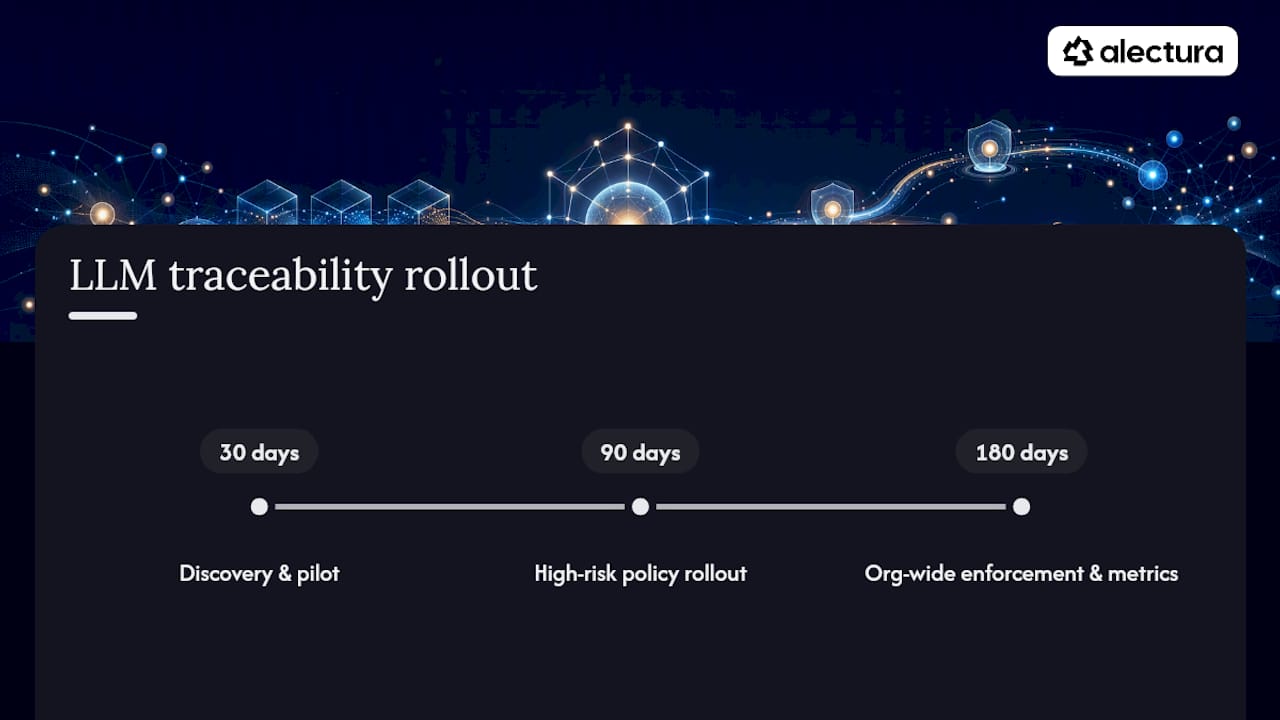
| Roll out in phases | Use a 30/90/180-day plan: pilot and baseline, then high-risk policy rollout, then org-wide enforcement. |
| Alectura fills the endpoint gap | Alectura (AIDR) delivers per-endpoint discovery, audit-grade prompt logs, and on-device DLP integrated with SIEM/SOAR. |
Table of Contents
- What must a llm traceability solution actually deliver?
- How should the enforcement architecture be structured?
- How does this connect with Microsoft Purview and SIEM/SOAR?
- What does a realistic 30/90/180-day rollout look like?
- How do you triage and contain an AI-driven incident?
- Should you build this in-house or buy an endpoint AIDR platform?
- Why endpoint-first traceability is the control most CISOs still get backwards
- Get endpoint AI visibility running with Alectura
- Where to go next for implementation detail
- Frequently asked questions
- Sources
What must a llm traceability solution actually deliver?
A checklist sounds bureaucratic until you're the one explaining to a regulator why nobody saw a prompt containing customer health records leave a laptop. Here's what actually needs to be in place.
- Discovery and inventory: real-time detection of every copilot, local LLM, and browser-based AI tool running on a device, not just the sanctioned ones.
- Per-prompt timeline and audit logging: request IDs, timestamps, policy version, and a tamper-evident signature (HMAC or equivalent) so logs hold up under audit and can't be quietly edited after the fact.
- On-device DLP: real-time inspection of copy/paste, file uploads, clipboard activity, and IDE or copilot integrations, with the power to redact or block, not just log after the damage is done.
- Adversarial prompt detection: a mix of pattern matching, ML classifiers, and rule-based checks to catch jailbreak attempts and prompt injection before they succeed. Research into enterprise secure AI execution engines shows a layered Zero Trust gateway approach, RBAC, DLP, adversarial detection, and deterministic tokenisation together, can catch these attempts with limited effect on processing speed.
- Integration: exportable structured logs in CEF or JSON, SIEM and SOAR hooks, and role-based access control for centralised policy management.
- Scalability and compliance: policy versioning, configurable retention, and proper encryption and key management baked in from day one.
Endpoint DLP products that inspect PII, PCI data, and national identifiers locally, before anything reaches an AI tool, are the difference between a policy that exists on paper and one that actually stops a leak in the moment it happens.
How should the enforcement architecture be structured?
Picture four components: an agent on the device, browser-level DLP, a central LLM enforcement gateway, and an audit log store feeding your SIEM or SOAR. None of these work in isolation. The device agent and browser DLP catch what happens before a prompt leaves the machine; the gateway enforces policy centrally for anything that reaches a shared model endpoint.
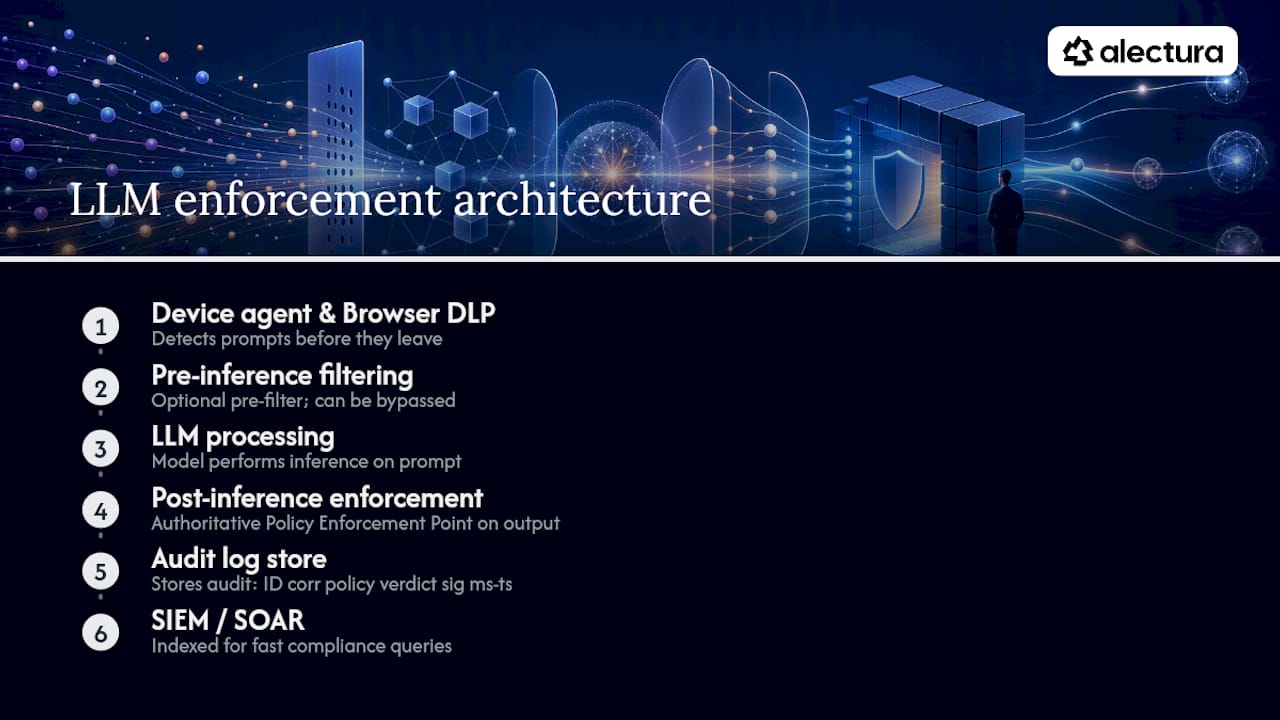
The data flow matters more than the diagram. A prompt gets detected, optionally filtered pre-inference, sent to the LLM, then checked again on the way back out. That second check, the post-inference enforcement point, is where the real authority sits. Architecture guidance from EVE Core is blunt about this: the Policy Enforcement Point belongs on the output path, because pre-inference filtering alone can be bypassed with clever phrasing, but a well-placed output gate catches the result regardless of how the prompt was worded.
Your choice between an in-process SDK, a sidecar process, or an API gateway comes down to a trade-off between latency and central policy ownership. SDKs are fast but harder to update centrally. Gateways centralise control but add a hop.
Every audit log needs a few non-negotiable fields: a unique decision ID, request correlation data, the policy version applied, the verdict, a signature, and a millisecond-precision timestamp. Index these properly and compliance queries that once took a week take minutes.
Streaming responses (SSE) complicate output enforcement because you're inspecting a stream, not a single payload. Batch where you can, and set a p95 latency budget upfront so security controls don't visibly slow down the tools people actually rely on to do their jobs.
Pro Tip: Treat pre-inference filtering as a secondary control, not your main defence. If your only enforcement happens before the model runs, a rephrased prompt sails straight through. Put your authoritative gate on the output.
How does this connect with Microsoft Purview and SIEM/SOAR?
Endpoint traceability doesn't replace your existing Microsoft 365 governance, it closes the gap around it. Purview DLP can already block Copilot from using external web search when a prompt contains configured sensitive information types, and it can stop Copilot from processing a sensitive prompt altogether. That's real coverage, but it's scoped to Copilot and Copilot Chat locations specifically.
Getting the roles right matters more than most teams expect:
- Confirm which admin roles are required for DLP and Purview policy authoring, then apply least privilege rather than handing broad access to your whole security team.
- Check licence requirements before assuming a control is available, some Copilot DLP features are still rolling out and gated by tier.
- Coordinate policy versioning between Purview and your endpoint agent so a rule change in one doesn't silently conflict with the other.
For integration, structured logging is the foundation. Export in CEF or JSON, build SIEM parsers around consistent field names, and wire high-severity events into SOAR playbooks with proper API key rotation.
A practical policy might scope a rule to Microsoft 365 Copilot and Copilot Chat locations, trigger on detected SITs, and take the action of blocking web search or halting processing entirely, illustrative logic, not something you copy verbatim, since your sensitive information types and risk appetite will differ.
The operational note that trips teams up: server-side Copilot controls reduce risk, they don't eliminate the need for endpoint DLP. Microsoft's own Zero Trust guidance is explicit that server-side DLP creates a false sense of security on its own, because it can't see what happens on the client before submission. Run both layers, aligned, or you've only solved half the problem. For teams weighing endpoint DLP alternatives against traditional tooling, this endpoint gap is usually the deciding factor.
What does a realistic 30/90/180-day rollout look like?
Nobody achieves full coverage in a sprint, and pretending otherwise sets teams up to fail their own audit.
- Days 1 to 30: run discovery and inventory across endpoints to find every AI tool actually in use, deploy a pilot agent on a representative device set, and stand up baseline logging with KQL or SPL queries in your SIEM.
- Days 31 to 90: roll out endpoint DLP policies fully for your highest-risk data classes, wire audit logs into SOAR playbooks, and define policy versioning and rollback procedures before you need them under pressure.
- Days 91 to 180: move to organisation-wide enforcement, build user coaching and exemption workflows for legitimate edge cases, and start tracking maturity metrics as compliance evidence.
Acceptance criteria worth setting from day one:
- The proportion of endpoints successfully onboarded compared to the total fleet.
- Mean time to detect (MTTD) for AI-driven exfiltration attempts.
- Audit log completeness tests and retention verification, run these regularly, not just once at launch.
Start with low-friction policies on your most sensitive data classes. A pilot that blocks obvious PII leaks without disrupting daily work builds trust fast, and trust is what gets you to full rollout without a user revolt. Our AI detection and response pilot checklist covers this staging in more detail.
How do you triage and contain an AI-driven incident?
An alert without a deterministic next step is just noise. Here's the sequence that actually resolves an AI-driven incident instead of leaving it half investigated.
- Detect: watch for prompt-injection patterns, mass PII or PHI paste events, outbound model requests that spike beyond baseline, and statistical anomalies in prompt volume per user.
- Triage: map the decision ID back to the specific user session and endpoint, pull related process and network artefacts, and check the policy version and risk score that applied at the time.
- Contain: isolate the device, revoke any API keys the flagged app was using, rotate affected credentials, and apply temporary policy tightening while you investigate further.
- Remediate: export the decision certificate for forensics, coach the user involved, tune the policy that missed or over-triggered, and file regulatory reports where the incident requires it.
Track mean time to detect, mean time to respond, your false positive rate, the number of blocked uploads, and policy coverage as a percentage of your fleet. These five numbers tell you more about program health than any dashboard vanity metric. Continuous data-at-rest scanning feeding your classification cache speeds up every one of these steps, because you're not classifying sensitive content for the first time in the middle of an incident.
Should you build this in-house or buy an endpoint AIDR platform?
Buy when you need coverage fast: mature adversarial prompt detection, audit-grade per-prompt certificates, working SIEM and SOAR integration, and the ability to scale per endpoint without a multi-quarter engineering project.
Build when you already control the platform layer, have deep in-house LLM engineering capacity, and can commit to maintaining policy versioning, HSM-backed signing keys, and continuous tuning as attack patterns shift.
- Time to deploy: buying wins decisively here, weeks versus quarters.
- Maintenance cost: building means you own detection tuning forever, not just at launch.
- Feature parity: adversarial detection and compliance evidence generation are non-trivial to build correctly the first time.
For most enterprises, a specialised, endpoint-first AIDR platform delivers faster and lower-risk traceability than an internal build. That's precisely the gap Alectura (AIDR) was built to close.
Why endpoint-first traceability is the control most CISOs still get backwards
Most security teams still think about AI risk the way they thought about shadow IT a decade ago: find the unsanctioned tool, block it, move on. That mindset fails against LLMs because the risk isn't the tool, it's the prompt. A sanctioned copilot with a badly worded prompt leaks just as much data as an unsanctioned one.
What gets underestimated is how much of this risk lives in ordinary, well-intentioned behaviour, someone pasting a customer record into a chat window to get a faster summary. Traceability isn't about catching malicious insiders. It's about seeing the thousand small, careless moments before one of them becomes a breach report.
Get endpoint AI visibility running with Alectura
Alectura closes the gap that Microsoft Purview and server-side controls can't reach on their own, real-time visibility and enforcement on the device itself, not just at the platform boundary. It maps directly onto the capability checklist covered above: per-endpoint discovery and inventory of every AI tool in use, per-prompt audit logs with tamper-evident signatures, on-device DLP that blocks risky prompts before they're submitted, and native SIEM/SOAR integration with centralised policy governance.

The outcome for security teams running Alectura is straightforward: faster detection of AI-driven data loss, audit-grade decision certificates ready for compliance review, and a measurable drop in the blind spots that server-side tools alone leave open. If you're responsible for AI risk across an endpoint fleet, see how Alectura's AIDR platform discovers, logs, and enforces policy at the device, and book a walkthrough to see your own environment's AI footprint mapped in real time.
Where to go next for implementation detail
For the policy mechanics behind Copilot-specific DLP, Microsoft Purview's documentation covers role requirements and licensing directly. For architecture and audit log schema design, EVE Core's enforcement guide and the IEEE paper on secure AI execution engines are worth a technical read. For a broader Zero Trust framing that applies well beyond LLMs, Blue Team Academy's practical guide is a solid reference, and Alectura's own writing on shadow AI detection and LLM observability tooling covers adjacent ground in more depth.
Frequently asked questions
Is LLM traceability the same as LLM observability? No. Traceability, in the endpoint security sense used here, focuses on discovering AI tools, logging prompts, and enforcing DLP policy on the device. Observability in application engineering typically means tracing model calls, latency, and cost inside a software pipeline, a related but separate discipline.
Does Microsoft Purview cover endpoint LLM traceability on its own? Not fully. Purview DLP can block Copilot from processing sensitive prompts or using external web search, but that coverage is scoped to Microsoft 365 Copilot and Copilot Chat locations. Other AI tools on the endpoint, browser-based assistants, local models, third-party copilots, sit outside that scope and need endpoint-level DLP to close the gap.
What's the biggest mistake teams make when deploying endpoint AI monitoring? Treating pre-inference filtering as sufficient. Prompts can be reworded to bypass input-side filters, so the authoritative enforcement point needs to sit on the output path, checking what the model actually returns before it reaches the user.
How long does it typically take to get full LLM traceability coverage across an enterprise fleet? A realistic timeline runs across 30, 90, and 180 days, from discovery and pilot deployment through to high-risk policy rollout and finally organisation-wide enforcement with maturity metrics in place.
Can adversarial prompts really be detected automatically? Yes, with layered detection. Combining pattern matching, ML classifiers, and rule-based checks in a Zero Trust AI gateway has shown it can identify adversarial and jailbreak attempts with limited impact on processing performance.
Sources
- Deploy Endpoint and Browser DLP Policies for AI Data Locations | Microsoft Zero Trust
- Learn about Microsoft Purview DLP for Microsoft 365 Copilot and Copilot Chat
- AI Policy Enforcement Architecture Guide | EVE Core