
Prompt timeline tracking is the tamper-evident, timestamped sequence of prompts and related events captured at the endpoint where AI use actually happens. Its value is simple: reproducible investigations and audit evidence, built at execution time rather than pieced together afterwards from disparate logs. Endpoint-native capture is what prevents shadow AI from becoming a blind spot in your incident response.
TL;DR:
- Accurate prompt timeline tracking must include agent identifiers, prompt details, model versions, inputs and outputs, and precise timestamps to establish true causality.
- Instrumenting endpoints requires placing sensors at prompt entry points, capturing data atomically, and ensuring the format integrates with existing security workflows like SIEM or SOAR.
- For effective detection and forensics, timelines must provide full causal sequences with verifiable integrity and enough context to identify responsible agents and model versions.
- Auditors will demand tamper-evidence, clear identity provenance, rapid retrieval, and evidence that records are authentic and unaltered during audits.
- Starting pilot implementations on high-risk autonomous agents and measuring completeness, replay fidelity, and latency ensures scalable, trustworthy audit readiness.
Table of Contents
- What fields does a usable prompt timeline need?
- How do you instrument endpoints for this?
- How do timelines improve detection and forensics?
- What will auditors expect from your timelines?
- A practitioner's view on where to start
- See how Alectura builds this into every endpoint
- Sources
What fields does a usable prompt timeline need?
A prompt log is not an audit trail. A logs page shows you what happened somewhere; an audit trail lets you prove exactly what happened, in what order, and who or what caused it. That distinction is the whole point of prompt timeline tracking, and it comes down to what you record and how you protect it.
At minimum, a defensible record needs:
- Agent identifier and the upstream human or service principal that triggered it
- The prompt itself (or a cryptographic hash where storing raw content is restricted), plus prompt version
- Model name and model version, since behaviour shifts between releases
- Full inputs, outputs, and any tool calls or MCP connections invoked
- An action classification (read, write, send, execute) and its outcome
Timestamps need to be precise enough to establish causal order between events, and the record itself needs integrity guarantees. An admissible audit trail is contemporaneous, causally ordered, and tamper-evident, typically through hash chaining or a cryptographic signature applied at the moment of capture. Recording has to be synchronous or atomic with the action itself. If there's a gap between the event and the write, that gap is a tamper window, and any auditor worth their fee will ask you to account for it.
How do you instrument endpoints for this?
Discovery comes first. You can't build a timeline for AI activity you don't know exists, and most organisations are running far more of it than IT has approved.
- Place sensors where prompts actually get typed — browsers, IDEs, native desktop apps, and clipboard activity are the common entry points for shadow AI usage that never touches a sanctioned gateway.
- Capture at the point of entry, not after the fact. Record the prompt, any retrieval context pulled in, tool invocations, and a data classification tag alongside the action, all in one write.
- Record atomically wherever the architecture allows it. If asynchronous capture is unavoidable, document the buffering window explicitly and treat it as a known limitation, not a silent gap.
- Map your export format to your existing stack. Structured records exportable as Syslog or JSONL for SIEM and SOAR ingestion let you fold prompt data into workflows your analysts already use, and retention plus role-based access control keeps the audit trail itself from becoming the next data exposure.
- Run a pilot before you scale it. Validate completeness of capture, whether the timeline actually replays cleanly, and the performance hit on the endpoint before rolling it fleet-wide.
Pro Tip: During a pilot, deliberately trigger a multi-step agent action, like a copilot pulling data then sending it somewhere, and try to reconstruct the full sequence from the timeline alone. If you can't, the gap you find is exactly where an attacker or auditor will look first.
How do timelines improve detection and forensics?
An alert tells you something happened. A timeline tells you why, and that difference decides how fast you close an incident.
Causal chains expose the patterns a single alert misses entirely. Prompt injection often looks benign at the point of entry and only reveals itself two or three steps later, when the model acts on manipulated instructions. Data exfiltration through an AI tool frequently shows up as a legitimate-looking read followed by an unexpected external send. Reconstructing the reasoning behind an agent's action, not just its outcome, is what separates a false positive from a genuine breach.
In triage, the flow runs from detection to timeline replay, then scope, containment, and remediation. Analysts should be able to pivot on agent ID, model version, or destination endpoint to pull every related event across the fleet.
For forensics, a defensible reconstruction means:
- The full causal sequence, not isolated snapshots
- Verifiable integrity, so nobody can claim the record was altered after capture
- Enough context (data classification, principal, action outcome) to answer a regulator's specific question without guesswork
What will auditors expect from your timelines?
Governance frameworks are converging on the same core demands. Whether you're mapping to GDPR, SOC 2, ISO 27001, or NIST-aligned guidance, auditors want completeness, tamper evidence, clear identity provenance, and a defined retention policy. Auditors increasingly treat decision provenance as a requirement rather than a nice-to-have as agentic AI deployments scale, and an inability to explain why an AI system did something is fast becoming a documented finding rather than a footnote.
Operationally, that means:
- Restrict access to the audit trail itself with role-based controls, separate from general log access
- Run reconstruction exercises on a schedule, not just when an incident forces one
- Document where CASB and DLP tools can't see inside prompts and fold that gap explicitly into your AI risk register
| What auditors ask | What your timeline needs to show |
|---|---|
| Can you prove the record wasn't altered? | Evidence of tamper-evidence such as hash chaining or signatures at capture time |
| Can you identify who or what triggered the action? | Agent identifier and upstream principal information |
| Can you reconstruct the full event, not just the log line? | Causal ordering of inputs, outputs, and related calls |
| Can you retrieve it fast under audit pressure? | Records that are searchable, retained properly, and have role-based access control |
At audit time, the strongest position is a live reconstruction demo, not a policy document describing one.
A practitioner's view on where to start
Pilot prompt timeline tracking on your highest-risk agentic workflows first, anything touching regulated data or acting autonomously without a human approval step. Everything else can follow once you've proven the model works.
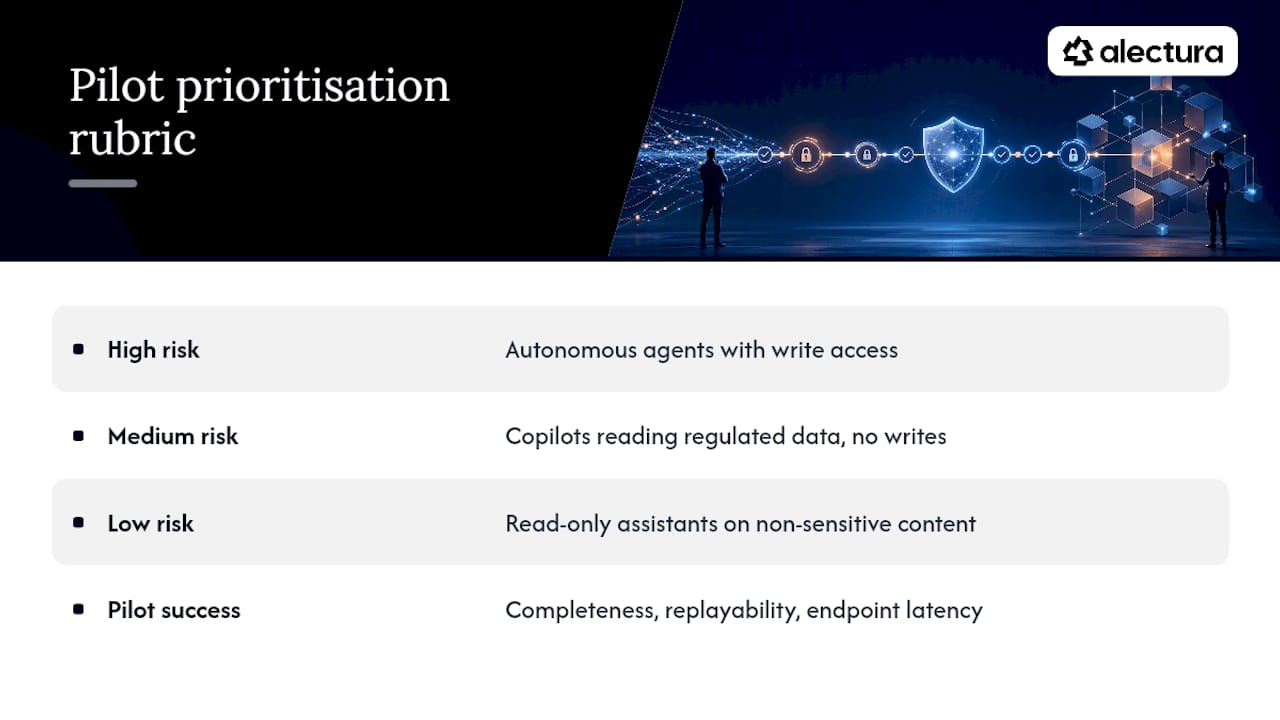
A rough prioritisation rubric: high risk is autonomous agents with write access to sensitive systems; medium is copilots reading regulated data with no write action; low is read-only assistants on non-sensitive content. Measure pilot success on three things: completeness of capture, whether the timeline replays cleanly for a real investigator, and the latency hit on the endpoint.
Auditability isn't a compliance chore bolted onto AI deployment. It's the control that actually lets you extend autonomy safely, because you can't approve what you can't reconstruct.
— Nathan
See how Alectura builds this into every endpoint
The platform is built around the exact requirements this article lays out, because they're the ones security teams actually need in production. It discovers AI tools across a fleet, including the shadow copilots and browser extensions nobody signed off on, then builds prompt audit trails that are tamper-evident and replayable for investigation, not just logged and hoped for. Records stay searchable and complete, with SIEM and SOAR integrations so they slot into analysts' existing workflows.

If you're evaluating a proof of concept, test three things: how much of your real AI usage it actually discovers, whether recording holds up atomically under load, and whether an analyst can replay a full incident end to end without gaps. Start by reading what agentic endpoint security covers, then request a demo to see the discovery and replay working against your own endpoints.
Sources
For teams building or auditing prompt timeline capability, the clearest technical grounding comes from Covia Labs' argument that audit trails are not logs, which sets out the causal ordering and tamper-evidence requirements referenced throughout this piece. TechTarget's overview of what CISOs need to know about AI audit logs covers the regulator-facing expectations in more depth, and Kitecyber's compliance logging guide for AI agents breaks down field-level detail for teams building their own schema. For broader audit logging practice across AI systems, AI Syndicate is a useful further read.