
AI event logging is the practice of recording what AI tools actually do on an endpoint, capturing prompts, model calls, agent actions and policy violations in a tamper-evident audit trail. A SOC needs this for three reasons: detecting misuse, proving compliance and speeding up incident response. The essentials are non-negotiable: hash-chained records that resist tampering, direct export into SIEM and SOAR, defined retention tiers, and strict access controls, which is exactly what platforms like Alectura are built to deliver.
TL;DR:
- Proper AI event logging captures prompts, agent actions, and policy violations with tamper-evident hashes to ensure trustworthiness during audits and investigations.
- Collecting detailed endpoint activity requires in-agent logging, OS hooks, or buffered batching to minimize system impact while maintaining high fidelity.
- Hash chaining and append-only storage are essential for tamper-proof logs that can be reliably used as compliance evidence by regulators and insurers.
- Mapping logs into existing SIEM or SOAR schemas with appropriate retention tiers enables rapid detection and automated incident response.
- A phased rollout prioritizes high-risk groups and continuous tuning to control costs, false positives, and privacy concerns effectively.
Table of Contents
- What AI activity actually needs to be logged
- How do you collect these logs without slowing endpoints down?
- Why tamper-evidence decides whether logs hold up
- Getting AI logs into SIEM, SOAR and long-term compliance stores
- How SOCs turn AI logs into fast incident response
- Rolling AI logging out without breaking the budget or the team
- Why endpoint AI logging is the piece most SOCs are missing
- Where Alectura fits into your AI logging stack
- Useful sources and further reading
- FAQ
What AI activity actually needs to be logged
Most security teams logging network traffic still miss what happens on the device itself, where the prompt gets typed and the agent takes action. The events worth capturing fall into a small, specific set:
- Prompts submitted to any AI tool, plus the model and version identifier that processed them
- Agent actions, including file reads, file writes, and any command or API call an agent triggers on its own
- Policy violations, such as a user pasting a customer record into an unsanctioned chatbot
- Outbound connections initiated by an AI tool or agent, especially to unfamiliar domains
- File operations tied to an AI session, including uploads, downloads and temporary artefact creation
Each event needs supporting fields, not just a headline description. Timestamp, device ID and user identifier are the baseline. Process context (which application spawned the AI call) tells you whether this was a browser copilot or an IDE assistant. A salted hash of the prompt text lets analysts verify content later without storing the raw string everywhere. Risk tags, flagging PII or secrets detected inline, turn a plain log entry into something a detection rule can act on.
None of this works in isolation. AI events need to sit next to existing endpoint telemetry, because a prompt event with no device or network correlation is just a data point, not evidence.
How do you collect these logs without slowing endpoints down?
Network monitoring alone cannot see what happens inside a prompt window or an agent's local reasoning loop. Capturing that detail requires an agent running on the endpoint itself, watching the process rather than guessing from packets.
Three collection patterns work in practice:
- In-agent instrumentation — the AI tool or its wrapper logs events directly as they happen, giving the highest fidelity.
- Kernel or userland hooks — lightweight interception at the OS level catches activity that in-agent logging misses, particularly for agents built outside a monitored wrapper.
- Buffered batching — events queue locally and ship on an interval rather than streaming individually, which keeps CPU and bandwidth overhead low on laptops running dozens of background processes already.
Privacy has to be engineered in from the start, not bolted on. On-device redaction strips obvious sensitive literals before anything leaves the machine, and hashing preserves the ability to verify content without exposing it broadly, an approach that pairs raw content protection with forensic usefulness. Sampling matters too: full-fidelity capture for high-risk groups, lighter sampling for low-risk ones, keeps storage costs sane.
Pro Tip: Test your buffering interval under real network conditions before rollout. A five-second batch window looks fine on a corporate LAN and falls apart on a hotel Wi-Fi connection, right when a travelling executive's laptop is most worth watching.
Why tamper-evidence decides whether logs hold up
A log an attacker or a rogue insider can quietly edit is worthless as evidence. Hash chaining solves this by linking each record cryptographically to the one before it, so altering any entry breaks the chain and immediately signals tampering. This single design choice is what separates an audit trail a regulator will accept from a log file nobody trusts.
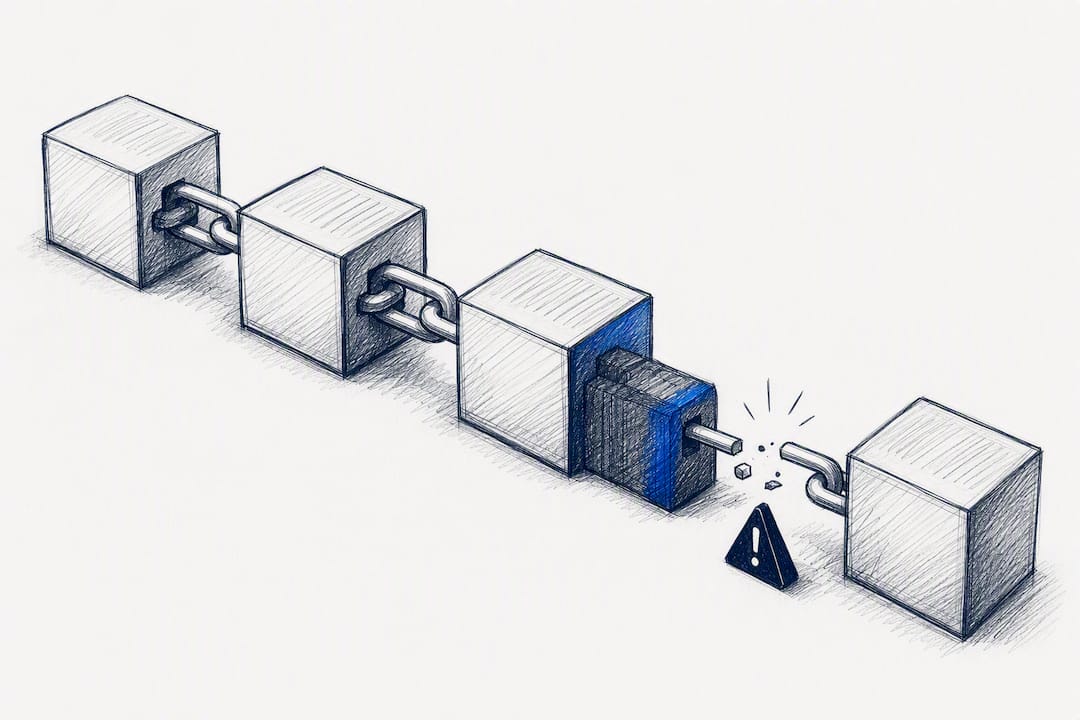
Insurers and auditors increasingly treat verifiable chain-of-custody as the baseline for AI activity evidence, not an optional extra, because hash chaining and append-only archives materially increase auditor trust compared with mutable log files.
Build the storage layer to match:
- Append-only or WORM (write once, read many) stores for anything that might become compliance evidence
- Segregated write paths so the live detection index and the long-term archive never share a single point of failure
- Signed records or remote attestation to prove the logging agent itself hasn't been tampered with
The end goal is a prompt trail that's fully replayable, where investigators can reconstruct exactly what a user typed, what the model returned, and what the agent did next, with linked artefacts like screenshots or output files attached to each event. Tamper-evident logging shows what this looks like operationally: hash-chained records that hold up under forensic review rather than falling apart the moment someone asks how the log was produced.
Getting AI logs into SIEM, SOAR and long-term compliance stores
Raw endpoint events are useless until they're mapped to a schema your SIEM already understands. Map AI-specific fields, model ID, prompt hash, agent action type, onto existing asset and user context fields, then enrich with risk labels so a detection rule doesn't need to parse free text to find a PII flag.
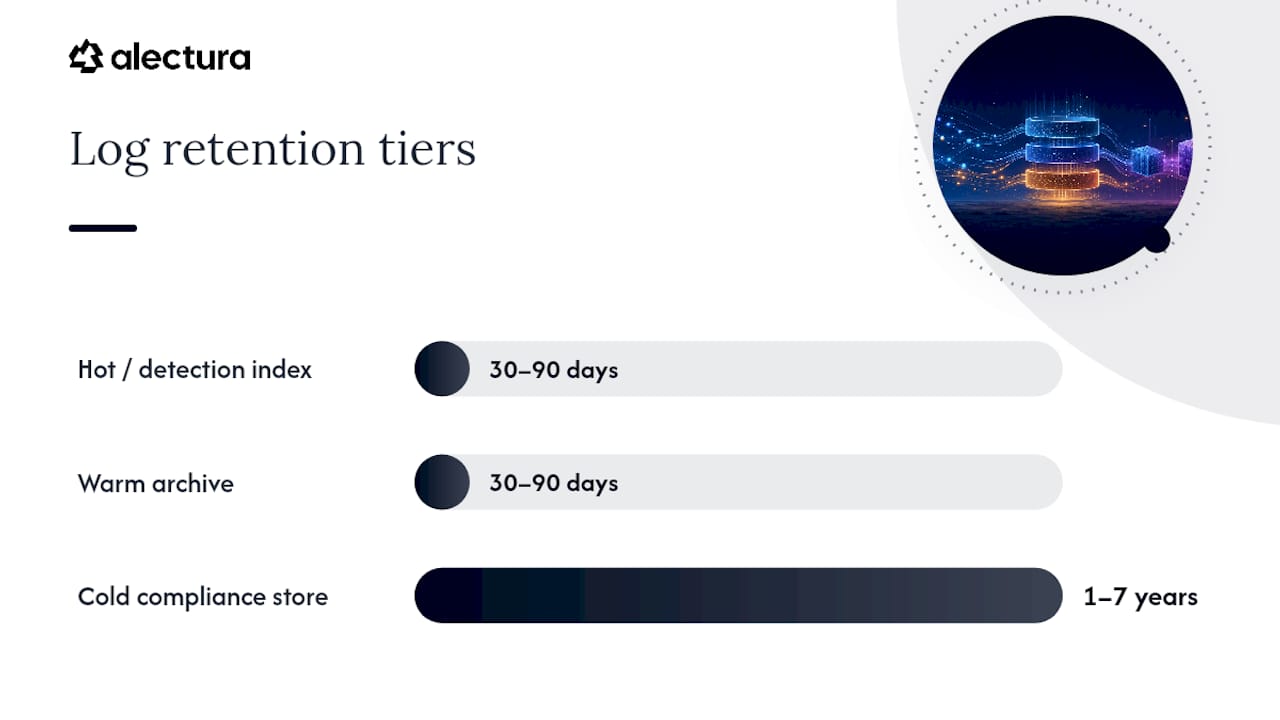
Retention should split by purpose, not run on one blanket policy:
- Short-term, fast-indexed storage (roughly 30 to 90 days) for active detection and triage
- Long-term immutable archives (commonly one to seven years, depending on your regulatory obligations) for compliance evidence
- A separate export path for auditors that packages chain-of-custody metadata alongside the raw events
| Log tier | Typical retention | Primary use |
|---|---|---|
| Hot/detection index | 30 to 90 days | Real-time alerting, SOC triage |
| Warm archive | 30 to 90 days | Investigation follow-up, trend analysis |
| Cold compliance store | commonly one to seven years | Regulatory evidence, legal hold |
SOAR playbooks should trigger directly off specific AI event types: a detected secret in a prompt fires a containment playbook, an agent connecting to an unlisted domain fires an isolation step. That mapping is what turns a log entry into an automated response rather than a ticket sitting in a queue.
How SOCs turn AI logs into fast incident response
The value of AI event logging shows up the moment something goes wrong, when a triage analyst needs answers in minutes, not after a week of chasing logs across three systems.
A few detection rules do most of the work:
- Flag prompts matching known exfiltration patterns (large pastes of structured data, credential-shaped strings)
- Alert on agent-initiated outbound connections to domains outside an approved allowlist
- Flag unexpected model selection, especially a local or unmanaged model handling data usually restricted to an approved enterprise tool
A documented case shows enterprise SOCs correlating AI events across device, log and network traces in around 30 minutes, pulling together evidence that used to take analysts most of a shift to assemble manually.
For triage, build a fixed evidence package every time: the hash-chained prompt record, the device telemetry for the same window, and any network trace showing where data went. Runbook templates that standardise this packaging save real time when a regulator or legal team asks for proof after the fact.
Pro Tip: Pre-build your evidence package template before you need it. Analysts under incident pressure will skip steps that aren't already a checklist.
Rolling AI logging out without breaking the budget or the team
A phased rollout beats a big-bang deployment every time. Start with discovery, identify which AI tools are already running and which user groups carry the highest risk, before committing to full-fidelity capture everywhere.
- Discovery first: inventory shadow AI tools and access before deciding what to log
- Pilot on high-risk groups: finance, legal and engineering teams handling sensitive data get full logging first
- Expand incrementally: widen coverage as storage and alerting tuning prove out
- Tune continuously: adjust sampling rates and enrichment rules as false positives surface
This staged approach, discover, then capture, then expand, controls both cost and noise far better than logging everything from day one.
Governance decisions matter just as much as the technical rollout. Someone owns the logs, someone owns the playbooks, and legal holds need a defined process before an incident forces the question. The most common pitfall isn't under-logging, it's overcapturing noise while missing the context that makes an event actionable, or ignoring privacy constraints until a works council or legal team raises them mid-deployment.
Why endpoint AI logging is the piece most SOCs are missing
Most detection stacks were built for processes and network flows, not for a copilot quietly reading a spreadsheet and summarising it into a chat window. That gap is why endpoint-level AI event logging matters now rather than in a future roadmap cycle.
The 30-minute correlation case study matters less for the specific number than for what it demonstrates: when AI logs, device telemetry and network traces share a common event structure, investigation stops being archaeology. Endpoint AI logs don't replace EDR or network monitoring, they fill the blind spot those tools were never designed to see. For teams wanting the deeper mechanics, the technical breakdown of endpoint telemetry and the hash-chaining implementation notes are worth the read before you write your first detection rule.
— Nathan
Where Alectura fits into your AI logging stack
Some platforms map directly onto the checklist covered above: shadow AI discovery, per-request prompt tracing, hash-chained tamper-evident records, and native export into SIEM and SOAR, all captured at the device level before a request ever leaves the endpoint. That's a meaningful contrast with tools that only see AI activity after it's already crossed the network, which is too late for prevention and often too thin for a compliance file.

A sensible pilot starts small: pick one high-risk team, turn on full-fidelity logging, and see how the evidence package looks after two weeks of real activity. If you're weighing this against a network-only monitoring approach, it's worth reading how agentic endpoint security differs as a category before you commit budget either way. Pricing for Alectura's full agentic endpoint security plan is available directly on request, and the product team can walk you through a technical integration guide before you deploy a single endpoint agent.
Useful sources and further reading
For implementation detail beyond what fits in a single article, these technical posts go deeper on specific pieces of the stack:
- AI incident runbooks for ready-to-use triage templates
- The AI stack running in production today for broader architecture context on where AI tooling sits in production environments
FAQ
What is AI event logging?
AI event logging is the practice of recording AI activity on an endpoint, prompts, model calls, agent actions and policy violations, in a structured, auditable format. It differs from standard system logging because it needs prompt-level detail and tamper-evident storage to hold up as compliance evidence.
How is AI event logging different from feeding logs into a SIEM?
AI event logging is the collection layer; getting those logs into a SIEM is the integration step that makes them useful for correlation and alerting. Both matter, but the endpoint capture has to exist first, or there's nothing to feed the SIEM in the first place.
How long should AI event logs be retained?
Retention typically splits into a short-term detection index of 30 to 90 days and a long-term compliance archive that can run from one to seven years depending on regulatory obligations. Compliance archives should be immutable, while detection indexes prioritise fast search over long retention.
Does AI event logging slow down endpoints?
Well-designed collection uses buffered batching and risk-based sampling, so overhead stays low even on standard business laptops. Well-designed approaches capture activity at the device level without materially impacting performance, since events queue and ship on an interval rather than streaming individually.
What does Alectura cost for AI event logging?
Alectura's full agentic endpoint security plan doesn't carry a published price, and pricing is available on request directly through the site. It covers the full logging, detection and export stack described in this article rather than logging as a standalone add-on.