
AI threat detection uses machine learning models to spot AI-specific attacks, data poisoning, prompt injection and model exfiltration, alongside the anomalies traditional tools miss. For SOCs, the practical payoff is visibility: it surfaces what AI tools and agents are actually doing across endpoints, networks and cloud, referencing frameworks like NIST and OWASP, and platforms such as Alectura, to close a blind spot most security stacks weren't built to see.
TL;DR:
- AI threat detection focuses on identifying data poisoning, prompt injection, model exfiltration, and adversarial evasion, which traditional tools often miss.
- Deployments rely on telemetry from endpoints, networks, identities, cloud logs, and prompt activity, with models needing regular retraining to adapt to shifting patterns.
- Controls such as data provenance, input validation, runtime containment, and continuous red teaming are essential to reduce specific AI-related risks.
- Integration with SIEM and SOAR platforms must prioritize telemetry mapping, automated triage, and phased rollouts to ensure effective response.
- Building visibility of AI tools and activity is the foundation for effective detection, with commercial platforms easing operational complexity for most security teams.
Table of Contents
- How AI threat detection works in enterprise environments
- What AI-specific threats look like in your telemetry
- Controls that actually reduce AI-specific risk
- Getting AI threat detection into your SOC workflow
- Metrics that tell you if it's actually working
- How Alectura's AIDR approach maps to the detection lifecycle
- Real-world signals: where AI threat detection earns its place
- Regulation and ethics are catching up to AI threat detection
- Commercial platforms vs open-source tools for AI threat detection
- Author perspective: what security leaders should prioritise this year
- A practical next step for teams building AI detection and response
- Sources
How AI threat detection works in enterprise environments
An AI threat detection pipeline runs on the same basic logic as any modern security analytics system, but the inputs and models differ enough that it deserves its own mental model. It starts with data, moves through feature engineering, gets scored by one or more models, and ends with a human making a call.
Most enterprise deployments pull from five telemetry sources: endpoint activity (process execution, API calls made by AI copilots and assistants), network traffic (destinations, payload size, protocol anomalies), identity signals (who's authenticating to which AI service), cloud logs (API gateway records, LLM provider logs), and increasingly, prompt-level telemetry, the actual text going into and out of AI tools, which is critical for revolutionizing SaaS security with cutting-edge bot attack defense. Red Canary's research points out that AI is particularly strong at behavioural analytics and natural language processing for phishing detection, precisely because those two data types (behaviour sequences and text) are where traditional signature-based tools fall over.
The pipeline generally runs through these stages:
- Ingestion — collecting raw telemetry from endpoints, SaaS APIs, MCP connectors and network taps into a unified store.
- Preprocessing — normalising formats, deduplicating events and tagging metadata (user, device, application, timestamp).
- Feature engineering — extracting security-relevant signals: query frequency per API key, prompt length distribution, entropy in outbound payloads, sequence patterns in tool calls.
- Model training — building anomaly detection baselines (unsupervised), supervised classifiers trained on labelled attack samples, or behavioural models that learn "normal" per user or per agent.
- Scoring and prioritisation — assigning a risk score, often blending multiple model outputs, then ranking alerts by severity and confidence.
- Alerting and human review — routing high-confidence, high-severity events to analysts, with lower-confidence signals feeding a watchlist rather than triggering a page.
Anomaly detection models handle the "we've never seen this before" case well but tend to generate noise in environments with high natural variance. Supervised classifiers are more precise but need labelled data on attacks that, by definition, are still rare and evolving. Behavioural models sit in between, learning what normal looks like for a specific user, device or agent, and flagging deviation. NLP models add a fourth layer specifically for parsing prompt content, catching injection attempts and policy violations in natural language rather than structured logs.
None of this runs itself indefinitely. Models drift as usage patterns shift, new AI tools get adopted, and attackers adapt. Retraining cadence matters as much as initial model quality, and teams that skip drift monitoring tend to find their false positive rate creeping up quietly until someone notices analysts are ignoring the queue.
What AI-specific threats look like in your telemetry
Traditional threat detection was built for malware signatures and network intrusion patterns. AI systems introduce attack surfaces that don't map cleanly onto those categories, and the OWASP Machine Learning Security Top 10 treats several of them as primary risks in their own right.
Data poisoning happens when an attacker corrupts training data, or a fine-tuning dataset, so the model learns a backdoor behaviour. It's hard to catch after the fact because the model performs normally on everything except the trigger condition. Indicators include: sudden shifts in model confidence distributions, training data from unverified or newly added sources, and performance regressions that only appear on specific input subsets.
Prompt injection covers both direct attacks (a user typing malicious instructions) and indirect ones (malicious instructions embedded in a document, email or web page that an AI agent later reads and acts on). The prompt injection detection techniques that work best watch for instruction-like patterns appearing inside content the model treats as data, not commands.
Model exfiltration and model-stealing show up as unusual API query patterns: repeated near-identical queries designed to reconstruct decision boundaries, sudden spikes in query volume from a single credential, or systematic probing across parameter ranges.
Adversarial evasion involves inputs deliberately crafted to fool a classifier, small perturbations invisible to a human that flip a model's output. In production, this often looks like a spike of borderline-confidence classifications clustered around a decision threshold, rather than one obvious anomaly.
Agentic and MCP-based misuse is the newest category. When an AI agent has tool access, connectors to file systems, ticketing platforms or internal APIs through the Model Context Protocol, a compromised or manipulated agent can chain permitted actions into an unauthorised outcome. Watch for agents invoking tools outside their normal task pattern, or connector calls that don't match the user's stated intent.
Statistic callout: NIST's adversarial machine learning taxonomy documents poisoning, evasion and model-stealing as the three attack families that recur across virtually every deployed ML system category, spanning classifiers, generative models and agentic systems alike.
Controls that actually reduce AI-specific risk
Every threat above maps to a specific, testable control. Bolting on a detection layer without fixing the underlying exposure just delays the inevitable.
Training data governance starts with provenance tracking, knowing where every training and fine-tuning dataset came from, and verifying it hasn't been tampered with before it enters a pipeline. Microsoft's threat modelling guidance for AI/ML systems recommends treating data lineage as seriously as code provenance, with automated checks that flag unverified sources before training begins.
Input validation and out-of-distribution (OoD) detection catch anomalous prompts and inputs before they reach a model. Semantic filtering, checking not just for banned keywords but for instruction-like structure inside untrusted content, catches a meaningful share of indirect prompt injection attempts that keyword blocklists miss entirely.
Runtime containment matters even when detection fails. Sandboxing agent execution, restricting egress from AI-enabled processes, and gating which tools an agent can invoke without human approval all limit blast radius. The RAND controls reference for high-risk AI systems frames this as layered containment: assume any single control will eventually fail, and design so failure doesn't cascade.
Monitoring and observability need to cover AI-specific telemetry, not just infrastructure metrics. That means logging prompts, model outputs, tool invocations and confidence scores in a searchable, retained format, not just uptime and latency.
Adversarial testing and red teaming should run continuously, not just before release. The NCSC's machine-learning principles call for a red-teaming mindset baked into the development lifecycle, using automated adversarial testing and OoD detection to surface weaknesses before attackers find them.
Supply chain controls round it out: signed model artifacts, version pinning, and a software bill of materials (SBOM) equivalent for models and datasets, so a compromised third-party model or dependency doesn't slip into production unnoticed.
Priority order for teams starting from scratch:
- Establish data provenance and lineage tracking first, everything downstream depends on trustworthy inputs.
- Add input validation and OoD detection at the model boundary.
- Layer runtime containment (sandboxing, egress limits, tool gating) around agentic systems specifically.
- Build observability and logging before scaling deployment, not after an incident forces the issue.
- Schedule recurring red-team exercises rather than one-off pre-launch tests.
Pro Tip: Run your first adversarial test against your own agent's tool permissions, not its model outputs. Most agentic security failures come from over-permissioned tool access, not from a model saying something it shouldn't.
Getting AI threat detection into your SOC workflow
AI threat detection only earns its keep once it's wired into existing SOC muscle memory. That means feeding SIEM and SOAR platforms the right telemetry, not adding a parallel dashboard nobody checks.
Prioritise these integration points:
- Telemetry mapping — route endpoint AI activity, prompt logs and MCP connector events into your SIEM using the same event schema as existing EDR data, so analysts query one place, not five.
- Triage automation — use scoring output to auto-close low-confidence, low-severity alerts and escalate only what needs eyes, cutting analyst fatigue without silencing genuine signals.
- SOAR playbook integration — build automated response actions (isolate device, revoke API key, block egress) triggered by high-confidence AI threat alerts, mirroring how you already handle malware containment.
- Phased rollout — pilot on a subset of endpoints or one business unit, track false positive rate and analyst time saved before expanding fleet-wide.
- Rollback readiness — keep a documented path to disable automated blocking actions quickly if a new model version starts misfiring.
Common pitfalls: deploying detection without a clear owner for tuning it, treating pilot metrics as production-ready without a scale test, and skipping the AI incident response playbook work until after the first real incident forces it.
Metrics that tell you if it's actually working
Mean time to detect (MTTD), false positive and false negative rates, precision and recall, and analyst hours saved per week are the core metrics worth tracking from week one. None of them mean much in isolation, a low false positive rate paired with high false negatives just means the system is quiet and wrong.
Validation should combine red-team exercises, synthetic testbeds (deliberately injected attack scenarios) and holdout evaluation on data the model never trained on. Model drift and data drift need separate monitoring: drift in the underlying model's performance versus drift in the nature of incoming traffic itself.
| Metric | What it tells you | Typical trade-off |
|---|---|---|
| MTTD | Speed of detection after an attack begins | Faster detection often raises false positives |
| Precision/recall | Accuracy of flagged alerts vs missed threats | Higher precision usually lowers recall |
| False positive rate | Analyst fatigue and alert trust | Aggressive tuning risks missed real threats |
| Analyst time saved | Operational ROI of automation | Requires baseline measurement pre-deployment |
Explainability determines when a model's output needs human escalation rather than automated action, particularly for high-stakes containment decisions like device isolation.
How Alectura's AIDR approach maps to the detection lifecycle
Alectura operationalises this lifecycle at the endpoint. It discovers every AI tool, copilot and MCP connector running across your fleet, then inventories the access each one holds, filling the visibility gap most detection pipelines start without. Prompt timeline tracking and egress monitoring catch data leaving through AI channels or injection attempts arriving through them. Alectura integrates with existing SIEM and SOAR platforms, and supports device isolation and centralised policy enforcement, so detection connects directly to response.
Real-world signals: where AI threat detection earns its place
Security teams adopting behavioural AI models for phishing detection consistently report the same pattern: NLP-based classifiers catch a category of socially engineered messages that signature-based filters miss, because the attack lives in phrasing and intent rather than known-bad indicators. That strength, per Red Canary's analysis, extends to anomaly detection at scale, spotting the unusual sequence across millions of events that no analyst could manually correlate.
The harder cases are the ones that make headlines less often: agentic misuse where an AI assistant with legitimate tool access gets manipulated into taking an action nobody intended. These incidents rarely look like a classic breach. They look like a workflow that technically followed every permission it was granted, right up until the outcome was wrong. Teams that have caught these early typically had one thing in common: they were logging prompt content and tool invocations, not just infrastructure metrics, before the incident happened.

The consistent challenge across real deployments is tuning. Organisations that skip a pilot phase and go straight to fleet-wide rollout tend to drown analysts in low-confidence alerts within the first month, then quietly disable the system rather than tune it. The ones that succeed treat the first 90 days as calibration, not production, adjusting thresholds against real traffic before trusting automated response actions. Effectiveness here isn't a fixed property of the tooling. It's a function of how deliberately a team rolls it out.
Regulation and ethics are catching up to AI threat detection
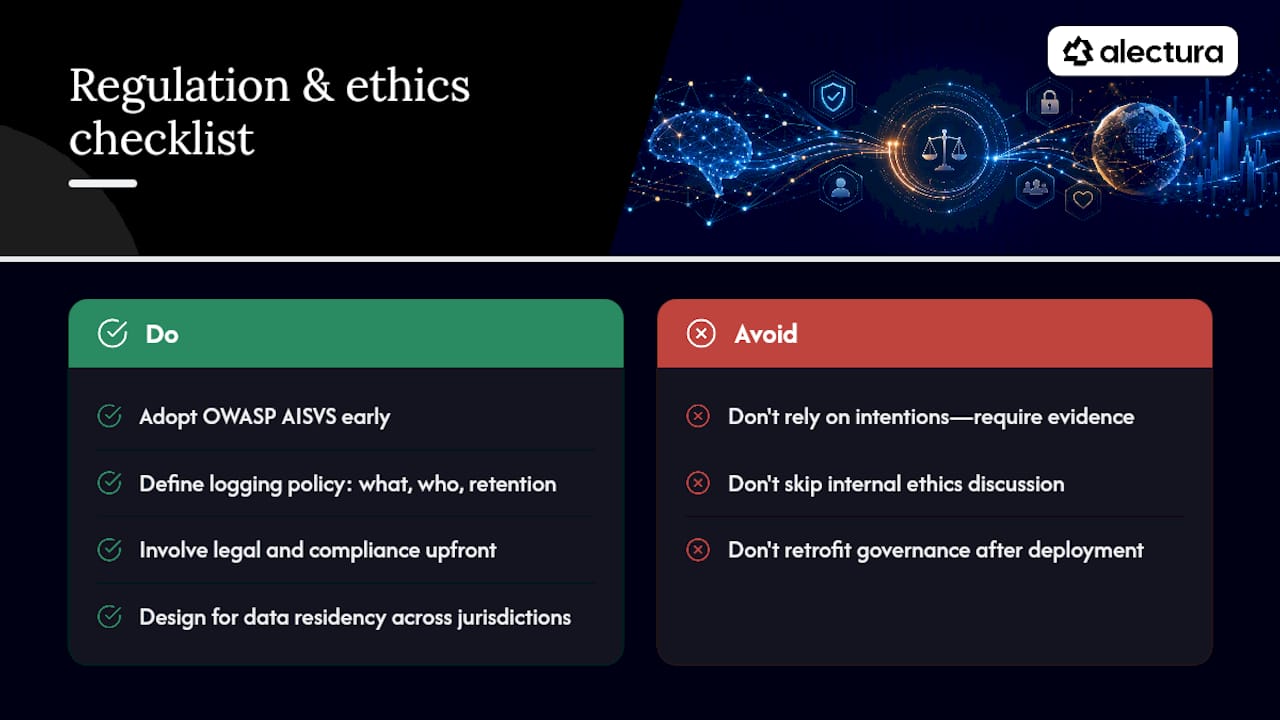
Regulatory frameworks for AI security are still forming, and that creates real ambiguity for security teams trying to build defensible programs. The OWASP AISVS gives teams testable, pass/fail requirements across training data governance and monitoring, which matters because auditors and regulators increasingly want evidence, not intentions.
Ethical questions sit alongside the compliance ones. Monitoring prompt content for security purposes means your detection system is reading what employees type into AI tools, potentially including sensitive personal or business information. That's defensible as a security control, but only with clear policy boundaries: what gets logged, who can access those logs, and how long they're retained. Teams that skip this conversation internally tend to have it externally instead, during an incident, in front of legal.
Data residency and cross-border processing add another layer, particularly for organisations running AI models or logging infrastructure across multiple jurisdictions with different privacy regimes. There's no single global standard yet, which means security leaders need to treat their AI monitoring architecture as something legal and compliance teams review alongside security, not after it's already in production. Building on frameworks like AISVS from the start makes that conversation considerably easier than retrofitting governance onto an existing deployment.
Commercial platforms vs open-source tools for AI threat detection
Open-source options, model-scanning libraries, adversarial testing frameworks, and OoD detection research code, give teams flexibility and no licensing cost, but they demand serious in-house ML engineering capacity to operate, tune and maintain. For a well-resourced team building a bespoke detection stack around specific models, that trade-off can work.
Commercial platforms trade some of that flexibility for faster deployment, vendor-maintained model updates, and integrated workflows that plug directly into existing SIEM and SOAR tooling without months of custom engineering. For most mid-size and enterprise security teams, the calculus comes down to a straightforward question: does your team have the bandwidth to build and maintain a detection pipeline from open-source components, or is that time better spent on tuning and response?
The honest answer for most organisations is a blend. Open-source libraries often handle specific research-grade tasks well, adversarial example generation for testing, for instance, while commercial platforms handle the operational backbone: discovery, inventory, continuous monitoring and integration with the rest of the security stack. Treating this as an either/or choice usually costs teams more engineering time than the licensing fee they were trying to avoid.
Author perspective: what security leaders should prioritise this year
If you're a CISO evaluating this space, prioritise telemetry coverage before governance policy, and governance before red teaming cadence. Get visibility first. Everything else is easier once you can see what your AI tools are actually doing, and productivity doesn't have to be the trade-off.
— Nathan
A practical next step for teams building AI detection and response
Most of the controls covered here, provenance tracking, egress monitoring, tool gating, depend on one thing you can't skip: knowing which AI tools are actually running across your fleet right now. Alectura gives security teams that starting point directly at the endpoint, discovering copilots, assistants and MCP connectors, inventorying what access each one holds, and tracking prompt activity and data egress in real time, then feeding it straight into your existing SIEM and SOAR workflows with device isolation and centralised policy enforcement built in.

If you're mapping out where shadow AI tools might already be exposing sensitive data, the AI security glossary is a useful starting reference for terms like MCP, prompt injection and AIDR. For teams ready to see what's actually running across their environment, Alectura's AIDR platform is built to answer exactly that question, with a rollout designed around the phased, pilot-first approach this article recommends.
Sources
- OWASP Machine Learning Security Top 10
- NIST AI report: taxonomy of adversarial machine learning
- NCSC machine-learning principles