
AI browsers and browser-embedded copilots are a live enterprise risk today, not a future one: agentic sessions inherit your users' authenticated cookies, and attackers can hijack that trust through indirect prompt injection. The immediate action is to inventory which agents touch which sessions, then restrict agent access to anything authenticated until you've scoped it. Everything below explains why, with the CVEs and research to back it.
TL;DR:
- Limiting agent access to sensitive, authenticated sessions and instruments that scoping or inventory are crucial before deploying AI copilots.
- Content-based prompt injection and session hijacks can occur without exploiting system bugs, relying solely on malicious content embedded in web pages, emails, or PDFs.
- Traditional security tools like EDR and web filters cannot detect these attacks because they appear as normal user activity within legitimate sessions.
- A layered architecture including destination scoping, dual-LLMs, and per-action confirmation is essential to prevent prompt injection and session hijacks effectively.
- Conducting phased on-device discovery, strict permission controls, and red-team testing forms the backbone of a defensible, monitorable browser AI security strategy.
Table of Contents
- What is browser AI security and why does it matter now?
- How does prompt injection actually hijack an AI browser?
- Why your EDR and web filters don't see this
- Building a browser AI defence that actually holds
- Your 30 to 90 day action plan
- Where endpoint AIDR fits in this picture
- Where does agent data actually go?
- Does locking down AI browsers wreck productivity?
- Building browser AI features without repeating vendor mistakes
- What's coming next in agentic browser threats
- Perspective: stop treating this as block or allow
- Evaluate agentic endpoint security with Alectura
- Sources
- FAQ
What is browser AI security and why does it matter now?
Browser AI security covers the controls that stop an AI agent, copilot, or automation bridge running inside a browser from being manipulated into leaking data or hijacking a session it has legitimate access to. It's a narrower discipline than general web security because the attack surface isn't the browser itself. It's the agent's reasoning layer, sitting on top of an authenticated session with real cookies, tokens, and standing permissions.
That distinction is why documented incidents keep surfacing. Cloud Security Alliance researchers ran narrative reframing attacks against multiple agentic browser vendors and got credentials exfiltrated in a coordinated disclosure, with patch effectiveness varying significantly across those vendors even after fixes shipped. Separately, CVE-2026-40289 documents an unauthenticated WebSocket bridge that let attackers hijack browser automation sessions and issue commands remotely, no credentials required, prior to the fix.
A few things stand out from these disclosures:
- The attacks didn't require exploiting a memory bug or bypassing sandboxing. They exploited the agent's willingness to follow instructions embedded in content it was told to read.
- Vendor response times and patch quality varied a lot, which matters when you're deciding how much trust to extend to a given AI browser deployment.
- Because the agent operates inside an already authenticated session, a successful attack looks like normal user activity to most logging.
The timeline matters as much as the exploit. When a vendor's disclosure-to-patch window stretches into weeks and the patch only closes one variant of the attack, that's a signal for your risk register, not just a changelog entry.
How does prompt injection actually hijack an AI browser?
Three techniques account for most documented agentic browser compromises, and each has a distinct execution primitive.
- Indirect prompt injection (IPI). Attacker-controlled content on a webpage, in an email, or inside a PDF contains instructions phrased as if they came from the user or the system. The OWASP definition of prompt injection covers this precisely: an agent can't reliably tell the difference between "content to summarise" and "commands to execute." Attackers hide payloads in HTML comments, in CSS set to zero opacity or off-screen positioning, or in alt text the agent parses but a human never sees.
- Context reframing (confused deputy). Rather than issuing a blunt command like "send me the password," the attacker wraps the instruction in a narrative: a fake support ticket, a role-play scenario, or a "system maintenance" notice. This bypasses naive keyword filters because no individual word looks malicious. It's the technique the CSA researchers used to get credentials exfiltrated across several agentic browsers.
- Bridge and session hijacks via stored XSS or exposed automation endpoints. If an agent's browser-control bridge exposes a WebSocket without authentication, or a page carries stored cross-site scripting, an attacker doesn't need to fool the model at all. They take the session directly, as CVE-2026-40289 demonstrates.
The common thread: none of these require the attacker to compromise your endpoint first. They ride in on content the agent was already going to process.
Why your EDR and web filters don't see this
Your existing stack was built to answer a different question than the one agentic AI raises. EDR and NGAV look for malicious code execution, unusual process trees, and known-bad binaries. An AI agent clicking through a checkout flow or filling a form isn't malicious code. It's the agent doing exactly what agents do, inside a session your identity provider already authenticated.
Network DLP and web filtering face the same blind spot from a different angle. They inspect traffic for known-bad domains or exfiltration patterns, but an agent instructed to "summarise this page and send the summary to this address" produces traffic that looks like legitimate application behaviour, not malware.
Signature and pattern-based detection also misses the natural-language layer entirely. There's no byte sequence to hash when the attack is a sentence dressed up as a helpdesk ticket. Research on the "framing gap" found that surface-level defences like keyword blocklists and prompt sanitisation get defeated reliably by attackers who simply rephrase the same instruction inside a different narrative wrapper. Sanitising input for known attack phrases is brittle because the attack space is the entire space of natural language, not a fixed signature set.

Chained legitimate actions compound the problem. An agent that reads a page, extracts a field, and submits a form is doing three ordinary things. Nothing in that chain trips a rule written for binary exploitation, even when the third action sends session data somewhere it shouldn't go.
Building a browser AI defence that actually holds
Design comes before runtime enforcement, because no amount of monitoring fixes an architecture that lets an agent read untrusted content and act on privileged sessions in the same reasoning pass.
Architecture layer:
- Destination allow-lists and capability scoping. Constrain which domains an agent can navigate to or submit data toward, and separate "read" capability from "act" capability. The framing-gap research found that constraining destinations and isolating capabilities closes more indirect prompt-injection attacks than prompt sanitisation alone.
- Dual-LLM or quarantine pattern. Split the model that reads untrusted web content from the model that plans actions. The reader passes only a structured summary to the planner, never raw content, which is the most robust known defence against instruction and data confusion.
- Split-compute with an origin guard. A lightweight on-device sentinel filters obvious anomalies immediately, a cloud-based planner handles complex reasoning, and a deterministic origin guard enforces hard constraints on which origins can trigger which actions. This keeps latency low while reducing IPI success rates, because only genuinely ambiguous cases get escalated to the slower cloud check.
Runtime layer:
- Action screening and per-action confirmation. Before an agent submits a form, sends data externally, or changes account settings, require synchronous confirmation for sensitive domains, mirroring the input, output, and action screening pattern OWASP recommends.
- Latent-state detection. Representation Engineering probes can flag a hijacked agent state before the action fires, acting as a circuit breaker inside the tool-calling pipeline rather than a post-incident log entry.
- Telemetry into SIEM/SOAR. Agent actions, destination changes, and confirmation overrides need to land in the same alerting pipeline as everything else your SOC triages, not a separate dashboard nobody checks.
Pro Tip: Start the origin guard with a strict allow-list for finance, HR, and identity-provider domains only. Expand it gradually as you build confidence in the telemetry, rather than trying to scope every domain your organisation touches on day one.
The trade-offs are real. Per-action confirmation adds friction; dual-LLM patterns add latency; cloud-based planners add cost and raise data residency questions. Stage the rollout. Lock down authenticated, high-value sessions first, and expand scope only once monitoring proves the controls aren't generating so many false positives that users start disabling them.
Your 30 to 90 day action plan
Treat this as a sequence, not a wish list. Each step depends on the one before it.
- Inventory every agentic feature touching your fleet and map exactly which authenticated sessions each one can reach. You can't scope what you haven't found, and discovery has to come before any blocking decision.
- Apply least-privilege scoping to sensitive domains and require explicit per-action confirmation anywhere an agent touches finance, HR, or identity systems. Practical playbooks for locking down agent permissions at runtime exist for exactly this step.
- Deploy runtime monitoring for anomalous agent behaviour, particularly unexpected destination changes or actions outside an agent's normal pattern, and route that telemetry into existing SOC workflows.
- Run red-team tests using frameworks built for this, such as IPI-proxy or Muzzle-style toolkits, which rewrite live responses against your actual whitelisted domains rather than mock attacker sites, giving you a realistic read on whether your allow-lists hold.
Map each step back to recognised guidance, including the UK's Code of Practice for the cyber security of AI, which sets lifecycle expectations for secure design, deployment, and ongoing monitoring that translate directly onto agentic browser rollouts.
Where endpoint AIDR fits in this picture
Every mitigation above assumes you can see the agent in the first place. That's the gap Alectura's AI Detection and Response approach targets: on-device discovery that finds copilots, assistants, and MCP-connected agents running across your fleet, inventories exactly what access each one holds, and enforces guardrails before a risky action leaves the endpoint. Real-time detection flags secrets, personal data, and prompt injection attempts as they happen, with policy events exportable into your existing SIEM or SOAR pipeline.
None of this replaces the architectural work described above. Origin guards, dual-LLM patterns, and destination allow-lists still have to be designed into the agents themselves. Endpoint enforcement is one layer in a defence-in-depth stack, not a substitute for it, but it's the layer that tells you whether the other layers are actually holding.
Where does agent data actually go?
The privacy risk in browser AI isn't hypothetical: agents routinely read page content, form fields, and clipboard data to complete tasks, and a meaningful share of that data ends up transmitted to a cloud model provider for processing. That's a different data flow than a browser sending a page request to a server. It's an agent extracting structured meaning from everything on screen, including fields the user never intended to share.
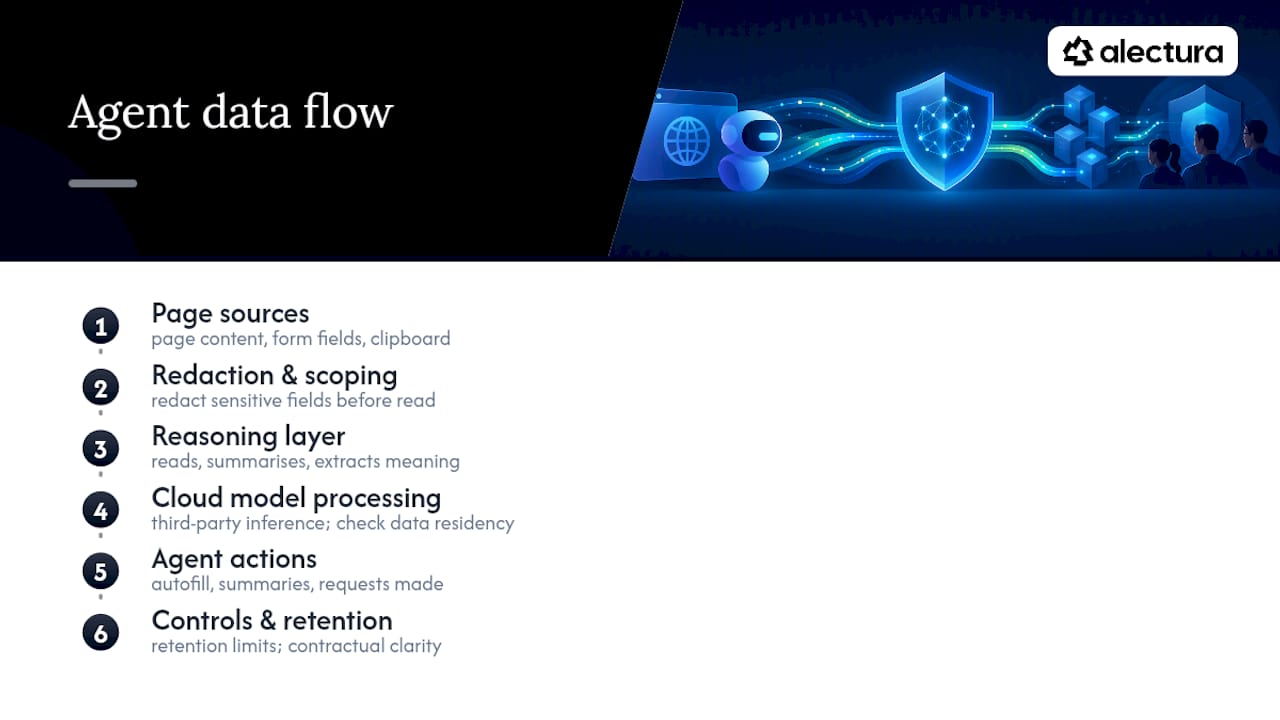
The exposure compounds in a few specific ways. Session cookies and auth tokens can be summarised or referenced by an agent even when the agent isn't supposed to act on them directly, because the reasoning layer doesn't always distinguish between "context I'm reading" and "context I should ignore." Form autofill data, saved payment details, and internal documents opened in adjacent tabs are all fair game for an agent with broad page-reading permissions.
Data residency adds another layer. If your agent's planning happens on a third-party cloud model, sensitive content from an internal HR system or a client contract may be leaving your jurisdiction entirely, something most data protection officers haven't been asked to sign off on yet because nobody flagged the agent as a data processor.
The practical response is scoping what an agent can read, not just what it can act on. Redaction before content reaches the reasoning layer, strict retention limits on any logs the agent or its provider keeps, and contractual clarity on where inference actually runs all belong in a browser AI privacy review, alongside the access controls covered earlier.
Does locking down AI browsers wreck productivity?
Security teams routinely assume tight agent controls will trigger user pushback, and that fear is often what delays rollout. The honest answer is that friction depends entirely on where you place it, not whether you have it at all.
Per-action confirmation on a handful of sensitive domains, finance portals, HR systems, identity providers, adds a few seconds to genuinely high-risk actions. Users barely notice it because those actions were already infrequent and already deserved a second look. Blanket confirmation on every agent action, by contrast, trains users to click through prompts without reading them, which defeats the control entirely.
Destination allow-lists work the same way. Scoped tightly to a handful of sensitive systems, they're invisible to daily workflow. Applied broadly across every site an agent might touch, they turn into a constant stream of "this action was blocked" tickets that erodes trust in the tool and pushes people toward unmanaged workarounds, exactly the shadow AI problem security teams are trying to avoid.
The usability lesson from the disclosures covered earlier is that attackers exploit friction gaps, not friction itself. An agent that pauses for confirmation before submitting a form on an unfamiliar domain isn't slowing anyone down in any way that matters. An agent that never pauses is the one that got exploited in the CSA research. Staged, risk-weighted friction protects both security posture and user goodwill better than either extreme.
Building browser AI features without repeating vendor mistakes
Teams building or extending browser AI features internally, whether that's a custom copilot for an internal tool or an MCP integration for a specific workflow, keep making the same mistakes the vendor disclosures already exposed. A few practices consistently separate the deployments that hold up from the ones that don't.
Treat every piece of external content an agent reads as untrusted input, full stop, even content from domains your organisation controls. The framing-gap research is explicit that narrative rewrapping defeats keyword-based filtering, so any development process that relies on a blocklist of "suspicious phrases" is building on ground that's already been shown to fail.
Separate reading from acting at the architecture level, not just the policy level. If your internal agent's code lets the same model instance both parse a webpage and call a privileged API, you've built the exact instruction/data confusion the dual-LLM pattern exists to prevent. Refactoring that split after launch is far more expensive than designing it in from the start.
Test against your own whitelisted domains before shipping, using a red-team methodology that rewrites live responses rather than testing only against obviously malicious mock sites. Log every agent action with enough context to reconstruct intent later, because the incident response teams investigating the CVE-2026-40289 hijacks needed exactly that kind of trail and often didn't have it. Finally, build a disclosure and patch process before you need one. The CSA research found remediation quality varied significantly across vendors facing the same class of attack, and the difference wasn't luck. It was whether the team had a repeatable process ready.
What's coming next in agentic browser threats
Expect attackers to keep moving toward multi-step, low-signal chains rather than single obvious payloads. The narrative reframing techniques documented against agentic browsers are getting more sophisticated, layering legitimate-looking context across several pages or several turns of interaction so no single step looks malicious in isolation.
Multi-agent systems raise the stakes further. As organisations connect multiple specialised agents through protocols like MCP, a compromise doesn't need to succeed against the most hardened agent in the chain. It just needs to succeed against the weakest one, then propagate through whatever trust relationship connects them. That's a fundamentally different threat model than a single browser copilot with a fixed permission set.
Detection is shifting to meet this. Latent-state probing techniques like Representation Engineering are moving from research into production tooling, aiming to catch a hijacked reasoning state before the harmful action executes rather than relying purely on logging what already happened. Expect vendors to compete on how early in the pipeline they can catch a manipulated agent state, not just on how comprehensive their action logs are after the fact.
Regulatory pressure is also catching up. Lifecycle guidance like the UK's Code of Practice signals that "we didn't know our agent could do that" is becoming a weaker defence every year, which means inventory and documented scoping decisions will matter as much for compliance as for security.
Perspective: stop treating this as block or allow
The instinct to blanket-block AI browsers is understandable and wrong. It buys a false sense of control while pushing usage into unmanaged shadow tools you can't see at all, which is a worse outcome than the risk you were trying to avoid.
Staged scoping beats wholesale blocking because it's testable. You can measure whether a destination allow-list holds against a real red-team run; you can't measure the security value of a ban nobody's actually following. Vendor transparency matters more than marketing claims here: ask for disclosure timelines and patch evidence, not assurances. The CSA research showed remediation quality varies a lot across vendors facing the identical attack class, so verify, don't assume.
Build red-teaming into your regular cadence, not a one-off before signing a contract. The threat surface moves every time a vendor ships a new agent capability, and your runbook needs to move with it.
— Nathan
Evaluate agentic endpoint security with Alectura
Alectura is built specifically for the gap this article keeps circling back to: the moment an agent acts inside a session your existing stack can't see into. Rather than watching network traffic after the fact, there are technologies that inspect and enforce AI activity at the device level, before a risky request ever leaves the endpoint. This includes shadow AI discovery, an inventory of agents and their access, and enforceable guardrails that can be tested against red-team runs.
A sensible pilot starts small: pick your highest-value authenticated systems, finance, HR, identity, and scope agent access there first using Alectura's discovery and policy enforcement before expanding fleet-wide. You can review Alectura's agentic endpoint security approach or check pricing for full agentic endpoint security to plan a staged rollout that fits your environment. Reach out to start a pilot on the systems that matter most.
Sources
- Prompt injection | OWASP Foundation
- 2608.27092 The Framing Gap: Indirect Prompt-Injection Exfiltration Defeats Surface-Level Defenses in Tool-Using Agents
- CVE-2026-40289 | NVD
- BioShocking / CSA research note
- LLM prompt injection prevention - OWASP Cheat Sheet Series
FAQ
What browser should I use to avoid AI risk entirely?
There's no mainstream browser that guarantees zero AI exposure, since many now ship built-in assistants or support extensions that add agentic features. The safer approach is inventorying which AI features are active in your fleet's browsers and restricting agent access to sensitive sessions, rather than assuming any single browser is inherently safe.
Is there an AI that can control my browser?
Yes. Agentic browser features and browser automation bridges are designed to let an AI navigate pages, fill forms, and take actions on a user's behalf, which is exactly the capability CVE-2026-40289 showed could be hijacked when the automation bridge lacked authentication.
Which is the world's safest browser?
No browser is provably the safest against agentic AI risks specifically, because the vulnerability class sits in the AI layer, not the browser's rendering engine. Security depends more on how tightly an organisation scopes agent permissions and monitors sessions than on which browser brand is installed.
How can I check if my browser is hacked or has a hijacked AI session?
Look for unexplained account activity, agent actions you didn't authorise, or destination changes in browsing history that don't match user intent. Enterprise teams get far better visibility from endpoint-level monitoring tools, like Alectura's agent discovery and detection, than from manual checks alone, since manipulated agent behaviour often looks like normal activity in standard logs.
How much does Alectura's agentic endpoint security cost?
Alectura's Full Agentic Endpoint Security plan pricing is available directly on the Alectura pricing page rather than published as a flat figure here, since deployment scope varies by fleet size and requirements.