
The safest posture for AI agent permissions is deterministic, least-privilege enforcement: deny rules always win, ask rules pause for human confirmation, and every tool call is scoped and logged at runtime, not decided by the model's own judgement. Pair that with delegated identity where possible and endpoint-level visibility everywhere else, and you have a system that fails safe instead of failing open.
TL;DR:
- Deterministic, least-privilege enforcement with deny rules and scoped logging prevents safety failures by stopping malicious or accidental agent actions.
- Runtime permission hierarchies prioritize deny over allow, with modes like ask or always_allow, requiring careful configuration to limit risks effectively.
- Delegated identity ensures accountability by tying agent actions directly to individual users, whereas application-wide permissions increase risk and reduce audit clarity.
- Tools connecting via MCP servers should default to ask mode, with strict whitelisting and restrictions on destructive actions to mitigate export and injection threats.
- Enforcing permissions requires endpoint visibility and real-time monitoring, including inventory, session logs, and alerts, to verify actual activity against policies.
Table of Contents
- Why AI agents need a distinct permission model
- Runtime permission models: deny, allow, and ask
- Delegated identity vs application-wide access
- Controlling tool execution through MCP servers
- Hooks, callbacks, and when to bring in a human
- A configuration checklist for enterprise rollout
- Monitoring, detection, and response
- How Alectura enforces and monitors agent permissions
- Where to go deeper on agent permissions
- The permission model most teams get backwards
- Sources
Why AI agents need a distinct permission model
Human access control assumes a person clicks a button and takes responsibility for the outcome. Agents don't work that way. They chain tool calls, generate their own next steps, and can be manipulated by content they read, not just instructions they're given. That non-determinism is the whole problem: an agent that summarises a support ticket one minute might, because of a crafted string buried in that ticket, try to email a customer list the next.
Three risks dominate:
- Data exfiltration — an agent with broad read access pulls sensitive records into a context window it shouldn't touch, then surfaces them somewhere unintended.
- Prompt injection — malicious instructions hidden in a document, webpage, or ticket hijack the agent's next action.
- Privilege escalation — an agent inherits a service account's full permission set instead of the narrow slice it actually needs.
An arXiv survey on agent permissions found commercial agents frequently lean on LLM guardrails instead of deterministic enforcement, which is exactly backwards for a security-critical decision.
Runtime permission models: deny, allow, and ask
The evaluation order matters more than any individual rule. Permissions are typically checked in the sequence deny, then allow, then ask, and a deny rule always overrides an allow, even one configured at the agent level against a global block. That hierarchy is what stops a well-meaning local override from quietly reopening a hole someone closed for a reason.
On top of that hierarchy sit permission modes, which set the default posture for a whole toolset or session:
| Mode | Behaviour | Typical use |
|---|---|---|
| always_allow | Executes automatically without prompting | Typically used for low-risk or read-only tools |
| always_ask | Requires confirmation before executing each call | Usually employed for new or unverified MCP servers |
| dont_ask | Suppresses prompts when within an allowed scope | Suitable for high-trust, repetitive internal tools |
| bypassPermissions | Bypasses permission checks entirely | Intended for sandboxed or test environments only |
| plan / auto | Model suggests actions requiring human batch approval | Used in multi-step workflows with review gates |
Managed agent platforms document always_allow and always_ask as the baseline policy types, with defaults varying by toolset. Pattern matching and argument constraints let you scope a rule tightly. "Allow file reads under /reports/* but deny anything under /finance/" is a very different risk profile to a blanket file-read permission, and it's the difference between a rule that actually holds and one that looks good in a policy document.
Delegated identity vs application-wide access
Two broad models exist for how an agent authenticates against your systems, and the choice shapes your entire audit trail.
- Delegated (user-mirroring) access — the agent acts under the permissions of the human who invoked it. If Sarah can't see payroll data, neither can an agent acting on her behalf. Every action ties back to a real identity, which makes audit logs meaningful and revocation trivial: disable Sarah's account, and the agent's access disappears with it.
- Application-wide or service-account access — the agent runs under a shared identity with its own, often broader, permission set. This is common where delegation isn't technically feasible, but it flattens accountability. Every action looks the same in the logs regardless of who triggered it, and a compromised agent inherits the full blast radius of that service account.
The practical guidance is to default to delegated access. If that is not feasible, use short-lived, narrowly-scoped credentials and enforce access via a policy engine instead of relying on the agent's self-limitation. Azure Machine Learning's role structure is a working example: built-in roles plus custom roles let you scope AI resource access tightly, and effective permissions are calculated as the union of everything assigned, which means audit reviews need to check combinations, not just individual role grants.
Controlling tool execution through MCP servers
Model Context Protocol servers are where agent permissions get genuinely dangerous, because they're the bridge between a model's reasoning and real external systems: databases, ticketing tools, cloud consoles, email. An agent with an MCP connection to your CRM isn't theoretically risky. It's one bad instruction away from exporting a customer table.
That's why MCP toolsets commonly default to always_ask rather than always_allow. It's a defensive default that stops a newly connected tool from executing before anyone has reviewed what it can actually do.
- Override the default only per tool, and only after reviewing exactly what that tool's calls can touch, never at the server level as a blanket exception.
- Restrict destructive or irreversible actions (deletes, sends, transfers) to ask or deny regardless of how trusted the server otherwise is.
- Maintain a whitelist of vetted MCP servers with always_allow reserved for that list, and force always_ask for anything unrecognised. This is covered in more depth in a practical MCP server security guide.
Hooks, callbacks, and when to bring in a human
Permission modes set the default. Hooks are what enforce it at the moment a tool actually tries to run. A pre-tool hook, or a canUseTool callback, sits between the model's decision and the tool's execution, checking the call against policy before anything happens. That precedence matters: the hook runs regardless of what the model "thinks" it's allowed to do.
- Use hooks for anything that must be checked on every call: destructive actions, anything touching regulated data, anything crossing a network boundary.
- Model-classified auto-approvals (letting the LLM decide a call is "probably fine") work for low-stakes filtering, but they're a guess, not a guardrail, and the arXiv survey's finding on guardrail reliance is exactly this failure mode.
- Escalate to a human reviewer for anything irreversible, high-value, or outside a well-tested pattern.
Pro Tip: Treat hooks as your actual security boundary and permission modes as the policy layer above it. If you can't point to the hook that would have stopped a given action, the enforcement doesn't exist yet, no matter what the config file says.
A configuration checklist for enterprise rollout
Most rollouts fail not on the policy itself but on the sequencing. Work through this order:
- Inventory every toolset and MCP endpoint in use, and map each one against the sensitivity of the data it can touch.
- Build RBAC roles around least privilege, using custom roles (Azure's model and OpenAI's project-scoped roles are both workable templates) rather than reusing broad, pre-existing human roles.
- Set explicit deny patterns for destructive operations first, before you configure anything else.
- Configure ask for sensitive but reversible actions, and document every permission mode decision so a reviewer six months later can see why it was made.
- Enable telemetry from day one, then run negative tests, deliberately trying to trigger denied actions, to confirm enforcement is actually deterministic rather than theoretical.
An AI agent governance playbook walks through this sequencing in more operational detail, and a data classification framework helps with step one specifically.
Monitoring, detection, and response
Policy without visibility is a false sense of security. You need to know what's actually running on your endpoints before you can claim to be enforcing anything against it, which is the core argument for endpoint-level discovery and inventory of every AI tool in the fleet, not just the ones IT approved.
Capture, at minimum:
- Every tool invocation event, including which permission mode allowed or blocked it.
- Session pauses and confirmations, tied to the human or service identity that approved them.
- MCP connection events and any data leaving the endpoint through them.
Feed this into SIEM and SOAR so high-risk tool use triggers an alert, not a log line nobody reads. Client-side permission checks are useful for stopping accidents, but Docker's own permissions documentation is blunt about their limits: they're not a security boundary on their own, which is precisely why endpoint visibility has to sit alongside them rather than instead of them. A best-practice observability stack covers what to wire into your existing SOC tooling.
How Alectura enforces and monitors agent permissions
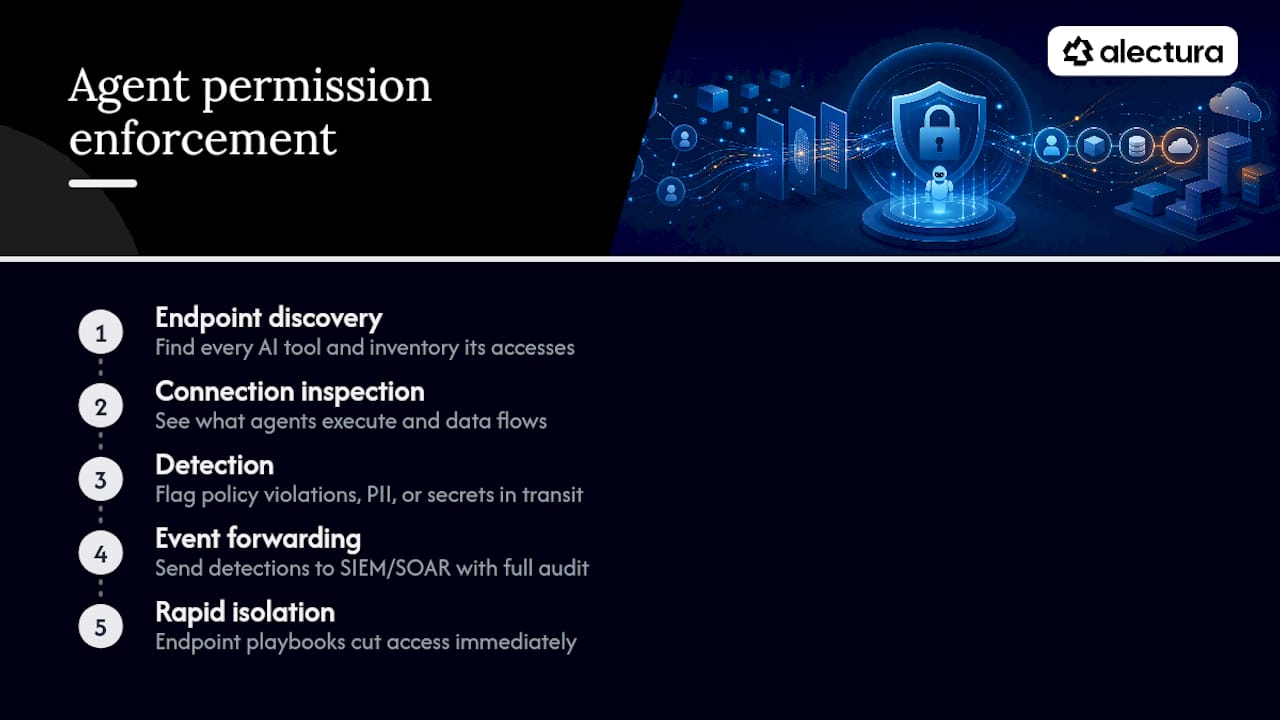
Alectura runs AI Detection and Response at the endpoint, which is the layer most permission conversations skip. It discovers every AI tool actually in use, copilots, assistants, agents, and inventories the access each one holds, rather than relying on a list of what was officially approved.
For MCP specifically, Alectura inspects connections to see what an agent is executing and whether sensitive data is moving through that channel toward an exit point. Detected policy violations, secrets, or PII in transit trigger events that ship straight into existing SIEM and SOAR workflows, with full audit logging retained for investigation. Where something needs to stop immediately, endpoint isolation playbooks give security teams a way to cut access without waiting on a broader incident process. Start with the AI security glossary if any of the terminology here, MCP, shadow AI, AIDR, needs unpacking for your team.
Where to go deeper on agent permissions
For implementation detail beyond this article, go to the primary sources. Docker's permissions documentation covers evaluation order and merge behaviour in full. Claude's managed-agent permission policies document defaults per toolset. The arXiv survey on agent permissions is the most rigorous look at where commercial implementations still fall short of deterministic control, and a governance-first blueprint for agent swarms is worth reading if you're scaling beyond single agents. Always check your specific platform's RBAC docs for exact role names and scopes before you build policy around assumed defaults.
The permission model most teams get backwards
Most organisations treat agent permissions as a configuration problem: pick the right modes, write the right rules, ship it. That's necessary but it's not where the real exposure sits. The gap is in the assumption that a well-written policy is the same thing as an enforced one.
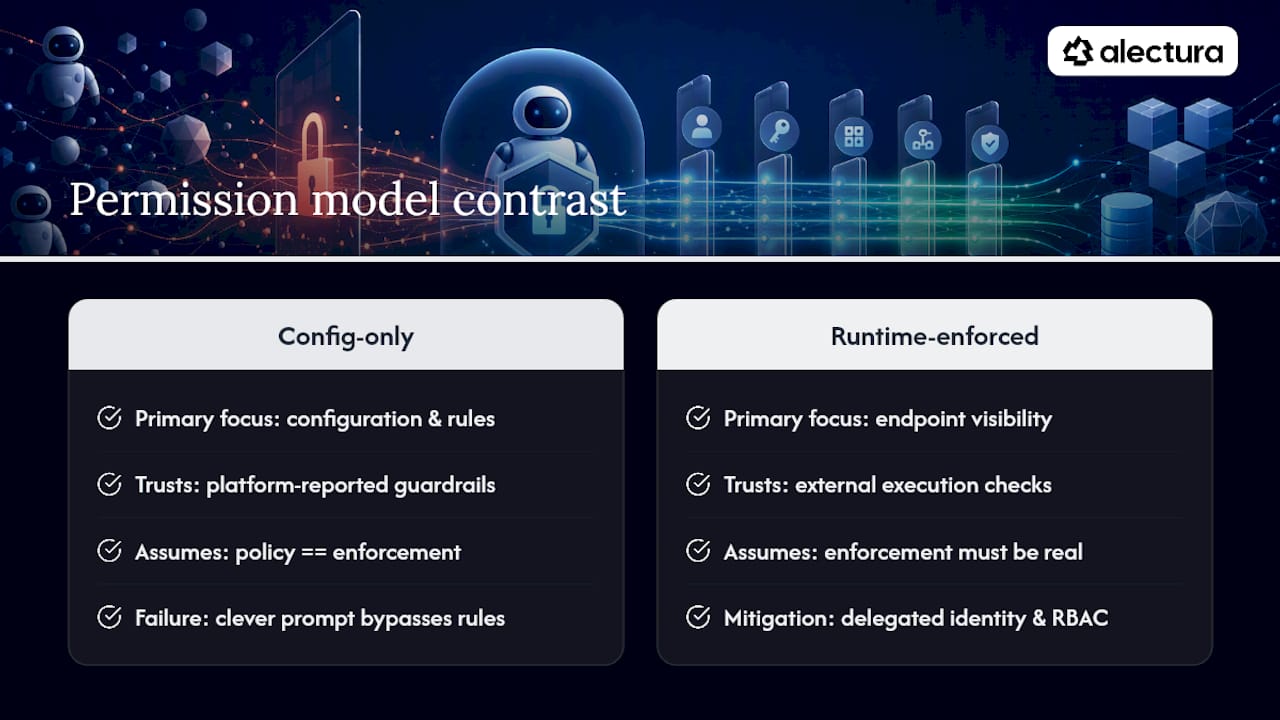
It isn't. A deny-allow-ask hierarchy configured inside an agent platform only holds if something outside the model actually checks it at execution time. The arXiv research on this is unambiguous: commercial agents lean on the model's own guardrails far more than the deterministic enforcement the architecture assumes. That's a design choice, not an edge case, and it means a sufficiently clever prompt can talk its way around a rule that was never truly a rule to begin with.
What I'd prioritise first isn't more granular policy. It's visibility into what's actually running and what it's actually touching, at the endpoint, independent of whatever the agent platform reports about itself. Delegated identity, tight RBAC, and hooks that fire on every call matter enormously. None of it means much if you can't see the agent in the first place.
— Nathan
Sources
- Control which tools can execute automatically, require confirmation, or are blocked entirely — Docker Docs
- Permission policies for managed agents — Claude docs
- How Agents Ask for Permission: User Permissions for AI Agents, from Interfaces to Enforcement — arXiv
- Assign roles for Azure Machine Learning — Microsoft Docs