
Enterprise "llm redaction" means on-device, per-call reversible redaction: sensitive spans get swapped for deterministic placeholders before a prompt ever leaves the endpoint, and the mapping restores originals only on the returning response. The right architecture chains three layers: local redaction, a per-process egress proxy enforcing policy, and a per-call verdict log for audit. Get this right and you stop payloads reaching external LLM vendors without wrecking answer quality or losing the evidence trail your auditors will ask for.
TL;DR:
- Reversible token-map redaction is essential for preserving answer quality while preventing sensitive data from leaving the device during prompt processing.
- Deploying local edge LLMs or per-process egress proxies allows organizations to enforce policies effectively without relying solely on network-based controls.
- Multi-signal detection methods, including regex, entity recognition, and behavioral signals, are necessary to identify potential data exfiltration attempts early.
- A focused two-week pilot with inventory, honeytokens, and a single egress channel provides a clear way to measure redaction effectiveness and user impact before wider deployment.
- Starting with comprehensive visibility through shadow AI discovery reduces the risk of blind spots, ensuring policies target only the AI tools that could expose sensitive data.
Table of Contents
- What "LLM redaction" means for enterprise security teams
- Core technical patterns and controls you must deploy or evaluate
- Policy and data classification for per-call enforcement
- Operationalising redaction: telemetry, detections and SOC integration
- Deployment trade-offs and attacker considerations
- A compact two-week pilot: inventory, honeytokens, and a proxy
- What Alectura Labs sees in the field
- Start with visibility before you build controls
- Primary sources and further reading
- Sources
What "LLM redaction" means for enterprise security teams
This article uses "llm redaction" in one specific sense: endpoint and on-device controls that intercept sensitive data before it reaches a cloud LLM, not the practice of asking an LLM to redact a document for you. That second use case is a different problem for a different audience. Security teams governing AI risk care about the first.
The scope matters because copilots in the browser, assistants baked into your IDE, and AI features quietly shipped inside everyday apps rarely register on a traditional security stack. They read clipboard content, local files, and screen context, often without a visible network log entry your existing DLP tooling would flag. Endpoint-first redaction closes that gap. The goals are threefold: cut data residency risk, keep the user experience close to unchanged, and produce audit-grade evidence that survives a compliance review.
Core technical patterns and controls you must deploy or evaluate
Four architectural patterns dominate real deployments, and they're not mutually exclusive.
- Reversible token-map redaction. Sensitive spans get replaced with deterministic placeholders (think
<SSN_001>) before the call, then restored on the response. PromptDLP's real-time DLP approach shows this preserves the model's semantic structure, so answer quality holds up even though the original data never left the device. - Edge LLM obfuscation. A small local model parses the prompt, generates plausible replacements, and keeps a local mapping database to reconstruct the real response. The GPTWall research demonstrates this using a lightweight Llama3-8B instance running on-device, processing input in chunks to keep latency manageable.
- Per-process egress proxies with policy gateways. TLS interception tied to process identity lets you apply Open Policy Agent style rules per application, not just per network flow, which matters when three different apps on one machine all talk to the same LLM API.
- Sandboxing for plugin vetting. Virtual filesystem redaction, microVMs for high-risk personas, and WASM plugin isolation limit what a compromised or careless integration can actually reach.
Detection underneath all of this should be multi-signal: regex for structured data like card numbers, machine learning named-entity recognition for unstructured PII, and behavioural signals (unusual read volume, rapid sequential file access) layered on top.
Pro Tip: Don't rely on regex alone for PII detection. Structured patterns catch account numbers and tax IDs reliably, but names, addresses, and contextual secrets need NER models tuned to your document types, and behavioural signals catch what pattern matching misses entirely.
Policy and data classification for per-call enforcement
Redaction is only as good as the policy deciding what happens to each data class, and that decision needs to vary by channel. The same customer record that gets blocked outright heading to a public chatbot might be fine flowing into an internal retrieval system with full audit logging attached.
Three actions cover most cases:
- Block — for regulated data classes heading to unapproved external destinations, no exceptions negotiated at runtime.
- Redact and allow — the default for most sensitive-but-necessary contexts, where the token-map approach lets work continue with placeholders standing in.
- Allow with audit — for lower-risk internal tools where visibility matters more than prevention.
PromptDLP's documentation makes a point worth taking seriously: forcing one global policy across every channel pushes users to route around it. Per-channel configurability is what keeps redaction adopted rather than bypassed.
For genuinely high-risk classes, irreversible redaction beats reversible every time, even at the cost of the model losing some context. Health records tied to identifiable patients, government ID numbers, and active credentials are candidates for permanent stripping rather than a placeholder round trip. Whatever approach you choose, set retention rules for the verdict logs themselves, and decide who can access the token map before you need it in an incident.
Operationalising redaction: telemetry, detections and SOC integration
Your SIEM can't act on a redaction event it never sees, so the log schema matters as much as the redaction logic itself. A workable event captures the verdict (blocked, redacted, allowed), the entity types detected, a token-map reference ID, a request ID for correlation, the action taken, and a hash of the payload, never the raw sensitive content. Microsoft's guidance on endpoint DLP diagnostic logs is explicit on this point: centralising raw sensitive content in a log just builds a second breach target.
Four detection recipes catch most agent-driven exfiltration attempts early:
- Rapid sequential file reads across a short window, which suggests bulk scraping rather than normal use.
- Unusually high read volume from a single process compared to that user's baseline.
- Clipboard content dumped repeatedly into a single destination app.
- Unexpected child process spawning from an AI client, which often signals a plugin doing something it shouldn't.
Wire these into your existing EDR to SIEM to SOAR chain and give each one a defined escalation path, not just an alert that sits in a queue. Run a tabletop exercise before you trust the pipeline: simulate an exfiltration attempt and time how long it takes from event to analyst action. That time-to-alert number, not raw detection coverage, is the metric that tells you whether the system will hold up under real load.
Deployment trade-offs and attacker considerations
Every architecture choice here trades something for something else. Chunking prompts to reduce latency, as the GPTWall prototype does, keeps response times workable, but you're still adding processing overhead to every call, and that adds up at scale.
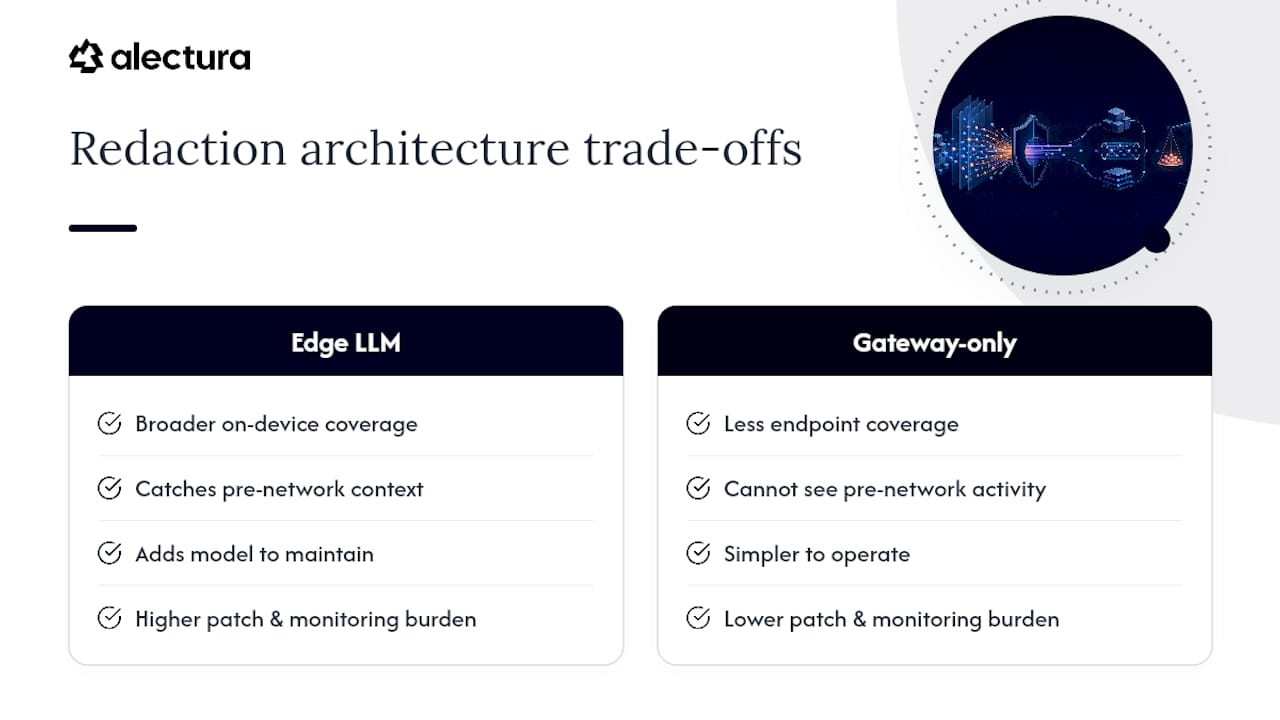
Edge LLMs give broader on-device coverage than a gateway-only setup, catching context a network proxy would miss entirely, but they add a model to patch, monitor, and occasionally retrain. A gateway-only approach is simpler to operate and audit, though it can't see what happens before a request hits the network layer.
The sharper risk is statistical inference across sessions. If your token map assigns the same placeholder to the same value every time, a sophisticated attacker with enough session data could start correlating patterns back to real identities. Rotate mappings sensibly, and treat prompt injection targeting the redaction layer itself as a live threat, not a theoretical one. And don't forget the paradox sitting inside your own audit trail: a verdict log built to prove you're protecting data becomes a liability if it stores that data. Metadata and hashes only, always.
A compact two-week pilot: inventory, honeytokens, and a proxy
You don't need a six-month rollout to know whether this works. Run this instead:
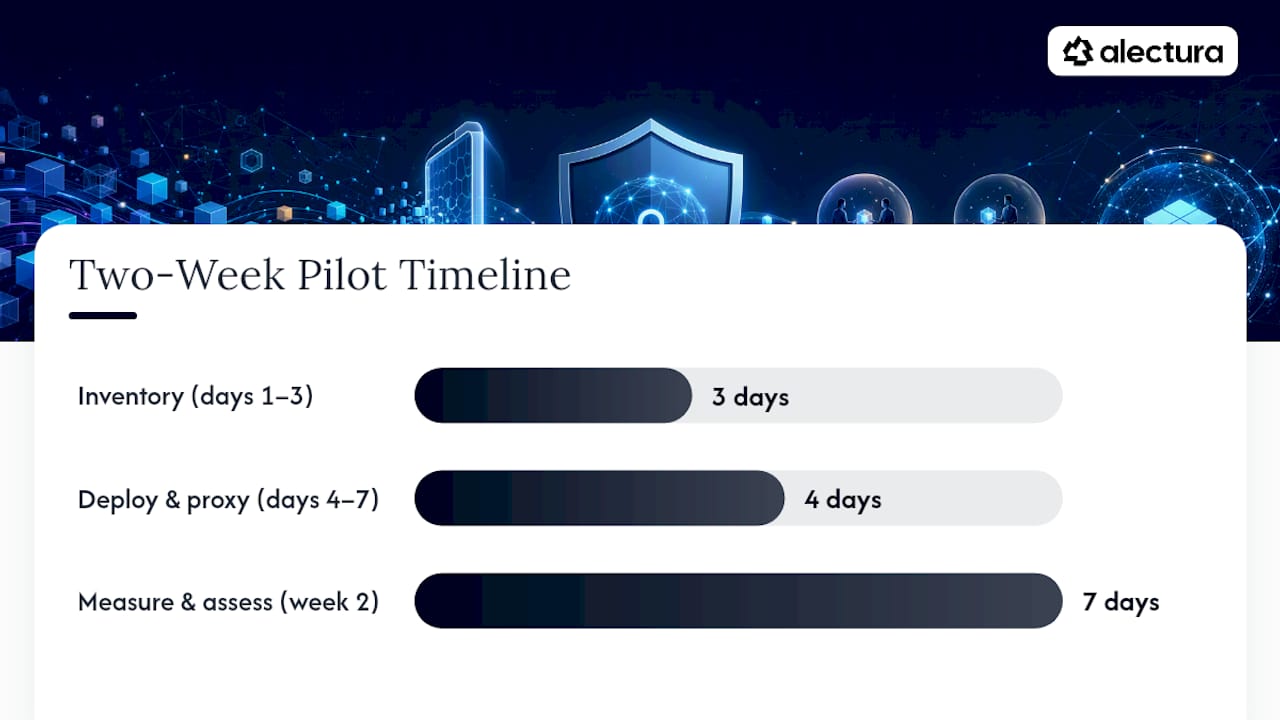
- Week one, days one to three. Inventory every AI binary and browser extension across a sample of endpoints, and flag high-risk personas (finance, legal, engineering with source access).
- Days four to seven. Deploy honeytokens into a handful of documents and instrument a per-process proxy with token-map redaction on one egress channel only, not everything at once.
- Week two. Measure detection time-to-alert, count blocked versus allowed-with-audit events, track latency impact users actually notice, and collect direct feedback from the pilot group.
Judge success on whether time-to-alert beats your current baseline and whether users report the redaction as invisible rather than intrusive. If both hold, you have a gating case for wider rollout.
Pro Tip: Keep the pilot's scope to one channel and one user group. A pilot that tries to cover every app and every team at once produces noisy data that tells you nothing useful about whether the controls actually work.
What Alectura Labs sees in the field
AI Detection & Response solutions address this problem: discovering the AI tools running across a fleet, inventorying what they can access, and enforcing per-call redaction with verdict logs usable for auditors. The reusable piece is not the redaction logic alone, but the operational scaffolding around it: policy templates, playbook checklists, and telemetry built to satisfy compliance reviewers without storing raw sensitive payloads. That combination is where most in-house builds stall.
— Nathan
Start with visibility before you build controls
Most security teams trying to design llm redaction from scratch hit the same wall first: they don't actually know which AI tools are running across their fleet, let alone what those tools can read. Alectura's shadow AI discovery solves that starting problem directly, mapping every copilot, assistant, and embedded AI feature across your endpoints before you write a single policy rule.

From there, the platform layers in the pieces this article walks through: per-call reversible redaction, per-process enforcement, and verdict logs built for SOC 2, GDPR, and PCI evidence flows, not just internal dashboards. If you're weighing an in-house build against a platform that already ships with the token-map and audit logging worked out, start with the discovery scan. It'll show you exactly what's touching sensitive data on your endpoints right now, which is the fact every redaction policy needs before it can be written properly. Request a demo of the shadow AI discovery tool to see your own fleet's exposure first.
Primary sources and further reading
For the technical mechanics behind edge LLM obfuscation, see the GPTWall paper on governing open vocabulary data leaks. For reversible token-map implementation details, PromptDLP's documentation is a useful reference, alongside Microsoft's endpoint DLP diagnostic log guidance for audit design, and ShieldIQ's breakdown of the EU AI Act's cybersecurity implications for retention and governance obligations.
Sources
- Governing Open Vocabulary Data Leaks Using an Edge LLM through Programming by Example
- PromptDLP — real-time DLP for LLM applications