
Redact before sending. Use a layered detector stack plus reversible placeholders, and test the whole pipeline end to end before it touches production traffic. The two non-negotiables are pre-boundary redaction (nothing leaves your infrastructure unmasked) and a test corpus built from your own domain-specific identifiers, not generic name lists. Everything else, from NER thresholds to vault design, is a trade-off between recall, precision, and latency you tune after those two are locked in.
TL;DR:
- Layered detection combining regex, domain parsers, NER, and local LLM review provides the most reliable PII redaction coverage with minimal false positives.
- Using typed placeholders that are session-specific and reversible ensures the model maintains context without exposing redacted PII, especially in multi-turn conversations.
- Redaction policies must be versioned, explicitly documented, and enforced at every outbound communication point, including chat, retrieval, and tool integration, for effective compliance.
- Monitoring detection metrics like recall and precision at the entity level, along with real-world and synthetic testing, is crucial to evaluating and improving redaction effectiveness.
- Establishing a central enforcement gateway for redaction, with audit logs and controlled vaults for re-identification, minimizes operational risk and supports regulatory compliance.
Table of Contents
- What does pii redaction llm actually mean in practice?
- Layered detection: what catches what?
- Detect, anonymise, rehydrate: how do you keep placeholders reversible?
- Where in the pipeline does the guardrail actually sit?
- How do you prove a redaction pipeline actually works?
- What does running this at scale actually cost you?
- How do you turn redaction rules into an auditable system?
- What does this look like in a real rollout?
- The mistakes I keep seeing in redaction pipelines
- Where Alectura fits if you're building this today
- Sources
What does pii redaction llm actually mean in practice?
PII redaction for LLMs is the practice of stripping, masking, or tokenising personally identifiable information before a prompt, retrieved document, or tool output reaches a language model, whether that model runs in your data centre or behind a third-party API. The standard industry term for the deeper discipline is de-identification, and it covers three distinct actions people often lump together: masking (blacking out a value), pseudonymisation (swapping a value for a consistent fake), and anonymisation (removing it so thoroughly it can't be traced back). Most production LLM pipelines actually want pseudonymisation, because you need the model to reason about "the customer" consistently across a conversation without ever seeing their real name.
The trust boundary is the entire point. Once a name, a Medicare number, or a customer record crosses from your systems into a third-party model provider's inference stack, you've lost control of it. It might get logged. It might get used for training, depending on the provider's terms. It might get exposed in an incident on their side, not yours. Model-side redaction, where you ask the LLM itself to "not mention" or "forget" PII it just read, doesn't reverse this. The disclosure already happened the moment the token stream left your boundary.
- User turn: raw customer input, support tickets, free text fields.
- System prompt and injected context: internal documents, prior conversation history, business rules that reference real customers.
- Retrieved chunks (RAG): vector search results pulled from a knowledge base that may contain unredacted records.
- Tool outputs: an agent calling a CRM or ticketing system and pasting the raw response into context.
- Metadata and logs: request headers, session IDs, and observability traces that quietly capture the same PII you just redacted from the prompt.
Regulators don't care which of these five paths leaked the data. The GDPR is technology-neutral by design. It defines personal data as anything relating to an identified or identifiable person and requires data minimisation and confidentiality regardless of whether a human or a model processed it. HIPAA works on a similar logic for protected health information in US healthcare contexts. Neither framework has a clause for "the AI promised not to repeat it." If PII crossed the boundary, the disclosure occurred, and your controls need to prove it didn't.
That's the case for treating pre-LLM redaction as a hard gate rather than a nice-to-have. A gate you can test, log, and version. A prompt instruction you hope the model honours is not a control; it's a suggestion, and auditors know the difference.
Layered detection: what catches what?
No single detection technique catches everything, and academic work on LLM-based PII redaction backs this up directly. The PRvL evaluation found that redaction performance varies materially depending on model architecture and training choices, which is a polite way of saying you cannot trust one model, one prompt, or one technique to consistently find every identifier in a document. The fix is layering, where each detector handles what it's structurally good at and none of them is a single point of failure.
Layer 1: regex and checksum validators. This is your fastest, cheapest, zero-dependency layer, and it should run first on everything. Credit card numbers validate against the Luhn algorithm. Tax file numbers, ABNs, IBANs, and passport numbers all follow fixed structural patterns with check digits. A well-written regex plus a checksum pass catches these with near-perfect precision and negligible latency, because you're pattern-matching, not inferring.
Layer 2: domain parsers and allow-lists. Generic detectors miss what's specific to your business. Internal project codenames, employee ID formats, locale-specific identifiers like UK National Insurance numbers or Australian Medicare numbers, none of these are covered by off-the-shelf PII libraries trained on US-centric data. This layer is where you encode "what PII looks like in our systems," and it's the layer most teams skip, which is exactly why it's the layer that causes the most embarrassing leaks.
Layer 3: named entity recognition and gazetteers. Names, addresses, and organisations don't follow a checksum. You need statistical models here, typically spaCy-style NER pipelines or purpose-built gazetteers. The trade-off is real and worth naming plainly.
Statistic callout: Enabling NER on top of deterministic detectors substantially lifts recall for names and locations, according to the preserve-pii project, but that gain tends to come with a small drop in precision. Report recall and precision separately per entity category rather than a single blended score, because a category like "medical record number" failing silently is a very different risk to "person name" catching a few false positives.
Run NER lazily rather than eagerly. Route text to NER only when Layer 1 and Layer 2 haven't already exhausted the content, and set a confidence threshold below which spans get flagged for review rather than auto-redacted.
Layer 4: optional local LLM review for ambiguous spans. For the residual cases, an address embedded mid-sentence, a name that's also a common word, a genuinely context-dependent reference, a locally-hosted LLM can adjudicate. The privacy model matters here: this review has to happen inside your boundary, on infrastructure you control, never as a call out to the same third-party provider you're trying to protect data from. The preserve-pii architecture documents exactly this pattern, deterministic detection first, contextual NER second, local LLM adjudication last, reserved for the small percentage of spans the earlier layers can't resolve with confidence.
- Regex/checksums: structured IDs, near-instant, highest precision.
- Domain parsers: business-specific and locale-specific identifiers.
- NER/gazetteers: names, addresses, higher recall, needs threshold tuning.
- Local LLM review: ambiguous spans only, run inside your boundary.
Detect, anonymise, rehydrate: how do you keep placeholders reversible?
The pattern that makes redaction usable rather than just safe is detect, anonymise, rehydrate. You find the PII, replace it with a typed placeholder, send the sanitised text to the model, and swap the placeholder back for the real value once the model's response returns to your side of the boundary. Done well, the model never loses the thread of the conversation because it's reasoning consistently about [PERSON_1] and [EMAIL_2] throughout, and your customer never sees a token that looks like a redaction artefact.
Typed placeholders matter more than generic ones. [REDACTED] everywhere tells the model nothing about whether two redacted spans are the same entity. A session-scoped deterministic mapping, where "John Smith" always becomes [PERSON_1] within that session and stays that way, preserves the model's ability to track "he," "the customer," and follow-up references correctly. The llm-pii-firewall project documents this stateful mapping approach directly, and it's the difference between a redaction layer the model can work with and one that breaks every multi-turn conversation.
Vault design is where most of the operational risk actually sits, because the vault is now a second copy of your sensitive data.
- Ephemeral session vaults hold the mapping only for the life of a conversation and discard it afterwards. Lowest long-term exposure, but you lose the ability to re-identify anything later for support or audit purposes.
- Persistent vaults with a TTL keep mappings for a defined window, useful when a support ticket might need to be reopened days later. Every hour of TTL is an hour of exposure if the vault is compromised, so the TTL should match a genuine business need, not a default setting.
- Encrypted at rest, access-controlled, and key-managed separately from the redaction service itself. If the same process holds both the mapping and the decryption key, you haven't built a vault, you've built a filing cabinet with a sticky note on it.
Operational teams generally find that session-scoped pseudonyms with a short, deliberate TTL strike the best balance, according to patterns documented in the Rehydra SDK. Persistent mappings should require a specific, justified business reason and their own access review, not just a "might need it later" default.
Streaming responses complicate rehydration because tokens arrive one chunk at a time and a placeholder can split across chunk boundaries. The practical fix is a hold-back buffer: don't emit the last few tokens of a stream until you've confirmed they don't contain a partial placeholder pattern, then rehydrate the completed buffer before flushing it to the client.
Pro Tip: Test your rehydration logic against placeholders that land exactly on a streaming chunk boundary. This is the single most common production bug in redaction pipelines, and it almost never shows up in non-streaming tests.
Where in the pipeline does the guardrail actually sit?
The guardrail has to sit at every point where text leaves your control and heads toward a model, which in a modern LLM application is more places than most teams initially map.
In a simple chat application, redact the user's turn and any appended conversation history before the SDK call goes out, and enforce this server-side. Client-side redaction alone is defence in depth at best, because a modified client or a direct API call bypasses it entirely.
In a retrieval-augmented generation pipeline, the risk shifts. Your vector database can hold unredacted source documents, which is often fine since it's inside your boundary, but the moment chunks are retrieved and assembled into a prompt, they need to pass through redaction before assembly, not after. Provenance fields (document IDs, source URLs, author metadata) need the same scrutiny as the chunk text itself, because metadata leaks PII just as readily as body text.
Agent workflows are the hardest case and the one teams most often get wrong. An agent that calls a CRM, then a ticketing system, then drafts an email, has three separate outbound hops, and each one needs the guardrail applied independently. Philterd's engineering guidance is blunt about this: redaction has to be a hard dependency routed through a central gateway, not a step individual tool integrations remember to call. The moment a new tool gets added by a developer who didn't know about the redaction requirement, an unguarded hop opens up.
- Chat: redact user turn plus context before the SDK call; enforce server-side, never trust client-only scrubbing.
- RAG: redact retrieved chunks after retrieval, before prompt assembly; check provenance metadata too.
- Agents: gate every tool call through the same redaction stage; no exceptions for "just this one integration."
- Client-side scrubbing: useful as a second layer, never sufficient alone.
- Central gateway or proxy: the enforcement point that guarantees the rule actually holds across every service that calls the model.
A privacy proxy pattern, where every outbound LLM call routes through a single enforcement point rather than being scattered across a dozen microservices, is exactly the architecture Microsoft's PII Shield concept describes. Centralising the gate is also what makes your audit story defensible: one enforcement point to inspect, rather than trusting that every team implemented the same discipline independently.
How do you prove a redaction pipeline actually works?
Recall and precision, measured at the span level and rolled up by entity category, are the two numbers that matter, and they trade off against each other in ways that should shape your review process, not just your dashboard.
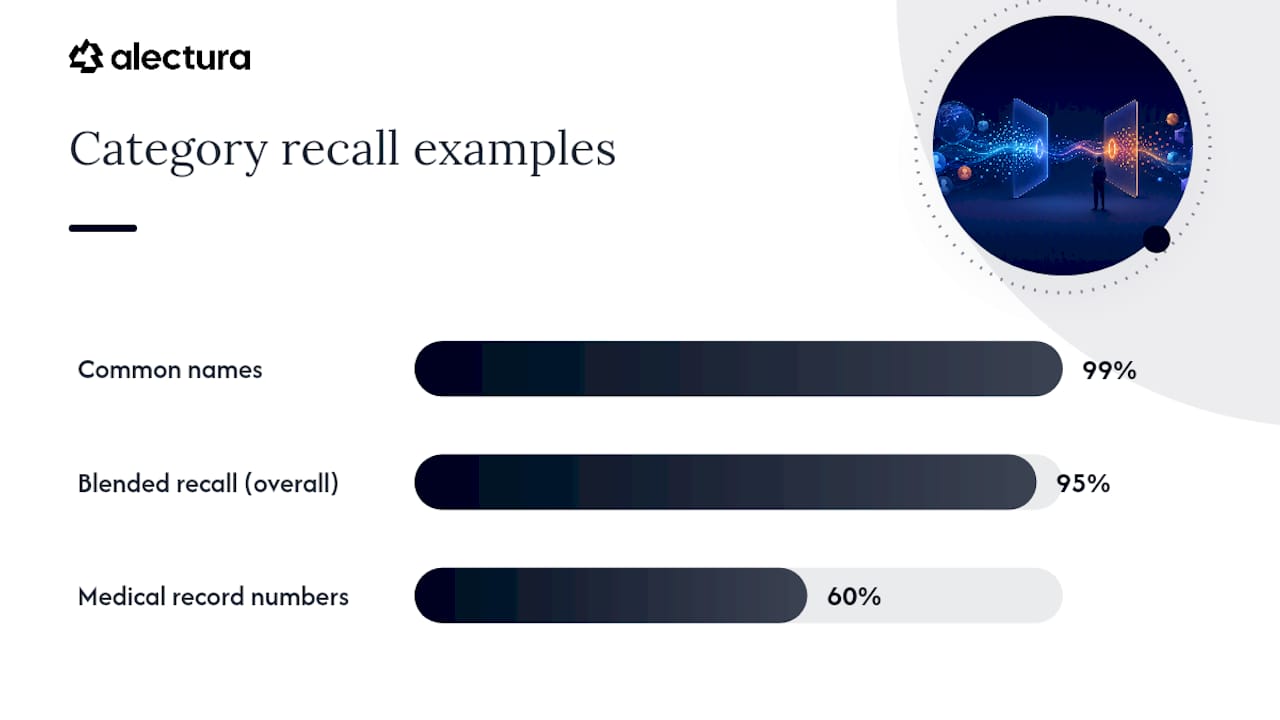
Span-level recall asks: of every actual PII instance in the test set, what fraction did the detector find? Span-level precision asks: of everything the detector flagged, what fraction was genuinely PII? A detector tuned for maximum recall will over-flag and annoy users with excessive redaction; one tuned for precision will miss edge cases and leak. Category-level recall matters because a 95% blended recall score can hide a category, say, medical record numbers, sitting at 60% while common names sit at 99% and drag the average up.
- Recall: did you catch it? Prioritise this for high-consequence categories (health data, financial identifiers).
- Precision: did you over-flag? Prioritise this where false positives break user experience or corrupt useful context.
- F1: a single balanced number, useful for tracking trend over time, not for deciding where to focus engineering effort.
- Weighted error score: not all misses cost the same; a missed name is a minor annoyance, a missed Medicare number is a regulatory incident.
Weight your errors by consequence rather than treating every miss equally. A practical scoring approach assigns a severity multiplier per category, so a single missed government ID number counts far more heavily in your acceptance metric than ten missed instances of a first name appearing mid-sentence. Set review bands from this score: anything above a defined severity threshold blocks a release; anything in a middle band gets flagged for manual review before shipping; low-severity misses get logged and batched into the next model update.
Statistic callout: Context Wire's engineering guidance recommends building labelled test fixtures from both synthetic data and curated real-world samples specific to your jurisdiction, because generic PII test sets built for US English miss the identifier formats, name conventions, and address structures your actual traffic contains.
Build your fixtures in two tranches. Synthetic data lets you generate volume cheaply and cover edge cases you can construct deliberately, like a name embedded inside a URL or an ID number split across a line break. Curated real samples, properly consented and stripped of anything you can't legally hold, catch the messy, unpredictable formatting real users actually produce. UCL's guidance on GDPR-aligned testing reinforces the same point from the compliance side: domain-specific tests matter because identifiers and naming conventions vary meaningfully by country and context, and a test suite built on assumptions from one jurisdiction will systematically under-perform in another.
Reconstruction tests are the final check, and they catch what entity-level metrics structurally cannot. Give a reviewer only the transformed, redacted prompt and ask them to re-identify the subject. If they can, correlation across several partially-redacted fields (a suburb plus a job title plus a date) has recreated the disclosure your detectors individually missed. Context Wire's own testing framework treats this as a distinct pass from category-level scoring, because combination attacks don't show up when you're only checking whether each span was individually caught. Run an independent secondary scan on the final serialised request too, the exact JSON payload leaving your boundary, not just the prompt text you think you sent, because serialisation bugs have a habit of reintroducing fields you'd already redacted upstream.
What does running this at scale actually cost you?
Latency is the practical objection every security team hears from engineering, and it's a fair one if you architect the pipeline naively. The fix is ordering your layers by speed, not by thoroughness. Regex and checksum validation run in single-digit milliseconds and should always execute first, catching the bulk of structured identifiers before anything heavier runs. NER, which is genuinely expensive, gets invoked lazily, only on spans the earlier layers didn't already resolve. Caching helps too: if the same document chunk gets retrieved repeatedly in a RAG pipeline, cache its redacted version rather than re-running detection on every retrieval.
Streaming responses need buffering logic that holds back the tail end of a token stream long enough to confirm no placeholder pattern is mid-flush, then rehydrates the completed buffer before releasing it to the client. This adds a small, usually sub-100-millisecond delay at the very end of a stream, which is a reasonable trade for guaranteeing you never emit a broken placeholder or a partially-rehydrated value.
Telemetry is where a lot of teams accidentally recreate the exact leak they built the pipeline to prevent. The instinct to log everything for debugging purposes is exactly how raw PII ends up sitting in an observability platform with weaker access controls than your production database.
- Record detection counts per category and per request, never the raw matched text.
- Log policy version diffs, so you can prove which ruleset was active at the time of any given request.
- Capture non-PII audit metadata: timestamp, request ID, entity type, action taken.
- Never persist the raw PII value itself in logs, traces, or debugging dumps, not even temporarily.
- Alert on anomalous detection volume spikes, which often signal a new PII type your detectors haven't been trained on yet.
On architecture, a central gateway or proxy centralises enforcement and gives you one place to update policy, but it introduces a network hop and a potential bottleneck under load. In-process libraries embedded in each service avoid that hop and scale horizontally with your application, but they demand that every team correctly integrates and keeps the library current, which is a governance burden, not a technical one. Most mature setups end up hybrid: a gateway enforces the policy for anything touching third-party model providers, while in-process libraries handle lower-risk internal calls where the latency budget is tighter.
How do you turn redaction rules into an auditable system?
A redaction policy that lives in a config file nobody reviews is a policy that drifts silently until an incident forces a review. Treat policy the way you treat infrastructure: as code, in version control, with diffs a human signs off on before they ship.
Map each entity category to a default action, mask, generalise, pseudonymise, tokenise, or fully redact, and document every exception explicitly rather than letting them accumulate as undocumented special cases in someone's memory. A generalisation action (turning an exact date of birth into an age bracket) preserves more analytical value than a full redaction, but it's the wrong choice for a category like a national ID number where any granularity is too much.
- Version every policy change and require review before it merges, exactly like application code.
- Present diffs to auditors directly: this is what changed, when, and why.
- Route low-confidence categories through a review band rather than a binary allow or block.
- Trial new detection rules as canary policies on a subset of traffic before rolling them out fully.
- Document every exception to a default action, with the business reason attached.
This discipline is also what makes a GDPR or HIPAA enquiry survivable rather than a scramble. When a regulator or an internal auditor asks "what happened to this customer's data on this date," a versioned policy plus an audit log answers the question in minutes. Without it, you're reconstructing intent from commit messages and hoping someone remembers. Our own breakdown of GDPR obligations for AI systems goes deeper on what this looks like for security and compliance teams specifically, and the PlotStudio AI guide to anonymisation techniques is a solid reference for mapping entity categories to the right transformation action in the first place.
What does this look like in a real rollout?
Some AI Detection & Response platforms implement a good chunk of this pattern directly at the endpoint, discovering which AI tools, copilots, and MCP integrations are running across a fleet, inventorying what each one can access, and flagging sensitive data heading toward an outbound call before it leaves the device. That's the discovery and inventory layer that has to exist before you can even decide where your redaction gates go.
For teams building the classification layer that feeds a redaction pipeline, the LLM data classification playbook is a reusable artefact worth adapting rather than building from scratch. It covers how to categorise data types before you decide which transformation action applies to each one.
A realistic rollout timeline, useful as a planning reference rather than a promise:
- Weeks 1 to 3: draft v0 policy, map entity categories to default actions, build the first labelled test fixtures.
- Weeks 4 to 7: run the layered detector stack against a production pilot on non-critical traffic, tune recall and precision per category.
- Weeks 8 to 12: full rollout with audit logging live, canary policies for new rule changes, and a review band process for low-confidence flags.
A few months is a reasonable outside estimate for a team starting from nothing. Teams with existing classification work or an established DLP program often move faster through the early weeks.
The mistakes I keep seeing in redaction pipelines
The single biggest failure pattern is teams treating redaction as a feature of the LLM call rather than a layer that sits in front of it. A prompt instruction telling the model to "avoid mentioning personal details" is not redaction. It's a request the model can and does ignore under pressure, and it does nothing to stop the disclosure that already happened when the raw data entered the context window.
The second failure is enforcing redaction client-side only. A single unauthenticated API call bypasses it completely, and I've seen teams discover this only after an audit, not before one.
The third is treating RAG and agent hops as somehow exempt because "the user didn't type that." Retrieved chunks and tool outputs carry exactly the same risk as a user's raw message, and skipping them is how a well-tested chat interface still leaks through its own retrieval layer.
If you're starting from zero, prioritise in this order: place the guardrail at every outbound hop first, layer your detectors second, build a domain-specific test corpus third, put policy into version control fourth, and wire up audit logging fifth. Get the first two right and you've closed most of the real risk. The rest is refinement.
— Nathan
Where Alectura fits if you're building this today
Everything above assumes you've already got visibility into where AI tools are running and what they can touch, and that's the part most security teams are missing before they even get to redaction logic. Alectura is AI Detection & Response software built for exactly that gap: it discovers the copilots, assistants, and MCP integrations running across your fleet, inventories what each one can access, and flags sensitive data heading toward an outbound call in real time, giving you the enforcement point a redaction policy actually needs to sit on.

If you're weighing up how a specific provider handles data in practice, our breakdowns of what leaks through Google Gemini and DeepSeek walk through the guardrails that cover each one. For a broader look at how discovery, inventory, and policy enforcement work together on one sensor and console, the platform overview is the place to start. Teams new to the terminology can also work through our AI security glossary before a pilot conversation. If you're ready to see how this maps onto your own environment, get in touch about a pilot deployment.
Sources
For deeper technical grounding, the PRvL evaluation on arXiv quantifies how LLM design choices affect redaction risk. Preserve-pii and the llm-pii-firewall project are both open-source references for layered detection and reversible placeholder mapping. Philterd's engineering guide and Context Wire's redaction walkthrough cover placement patterns and evaluation methodology in practical detail worth working through end to end.
- PRvL: Quantifying the Capabilities and Risks of Large Language Models for PII Redaction
- preserve-pii v0.6.1
- llm-pii-firewall (GitHub)