
For AI Detection and Response on endpoints, an LLM policy template is a machine-readable policy bundle, not an acceptable-use document. It maps identity, data class and route to a deterministic verdict: allow, warn, deny, escalate or transform. Before writing detailed rules, author an evaluate-only bundle covering just those three dimensions and run it in shadow mode.
TL;DR:
- Deploy policy templates initially in evaluate-only mode for several weeks to validate detection accuracy and minimize disruption before enforcing rules.
- Focus on running policy checks at pre_tool_call, post_model_call, and output points to effectively prevent ungoverned actions and data leaks.
- Maintain strict fail-closed behavior for all errors and load failures, and ensure each verdict is thoroughly logged with version hashes, reason codes, and timestamps.
- Separate baseline policies from tenant-specific overlays to prevent inadvertent weakening of security rules across multiple environments.
- Restrict policy editing and deployment access to authorized personnel, requiring signed commits and multi-person approval for rule modifications, especially loosening rules.
Table of Contents
- What goes inside an LLM policy template?
- Where should you evaluate policy in the agent request lifecycle?
- How do you write a policy template that compiles cleanly?
- How long should you run policies in evaluate-only mode before enforcing?
- What operational invariants does a production deployment need?
- How do you integrate policy templates with existing AIDR and endpoint platforms?
- How do you handle policy updates and rollback safely?
- How should you test policy templates before deployment?
- How do you manage policies across multiple tenants or applications?
- Who should be allowed to edit and deploy policy bundles?
- What Alectura has learned turning templates into real enforcement
- Turning templates into enforcement without slowing your team
- Sources
What goes inside an LLM policy template?
A policy decision point can't reason about intent the way a human reviewer can. It needs fields it can parse in microseconds and match against a rule set with no ambiguity. That's the difference between an LLM policy template and a governance PDF: the template is compiled, versioned, and executed, not read.
Every functional template needs five categories of information.
- Identity binding. The enforced_identity field ties a request to a user, an agent acting on a user's behalf, and any role or group bindings that determine scope. Without this, you can't apply different rules to a finance analyst versus a finance copilot acting autonomously.
- Data classification. Templates need explicit mapping from data classes, PII, PHI, secrets, source code, contract text, to policy outcomes. A secret detected in a prompt heading to an external model should trigger a different verdict than a public marketing brief.
- Route constraints. Model allowlists and denylists, deployment scope (which region, which vendor endpoint), and destination constraints (internal-only versus external API) all belong in the template rather than scattered across firewall rules.
- Audit metadata. Every rule needs a policy ID, a bundle version hash, reason codes and a severity rating. This is what turns a block event into something a SOC analyst can actually triage later.
- Outcome mapping. The template has to specify when a match produces a deny versus a transform (redact the sensitive span and let the request continue) versus an escalate (hold for human approval) versus a warn (log and notify, don't block).
Get the outcome mapping wrong and you'll either block legitimate work constantly or let genuinely risky requests through with a log entry nobody reads until after the fact.
Where should you evaluate policy in the agent request lifecycle?
Templates are only as good as the points where you actually run them. An agent loop has several natural checkpoints, and each one suits a different kind of rule.
- agent_startup / agent_shutdown: identity verification, session-scoped permission loading, and cleanup of any temporary access grants.
- input: the raw prompt before it reaches any model, useful for catching obvious policy violations early and cheaply.
- pre_model_call: the fully assembled request, including system prompt and retrieved context, right before it leaves your environment.
- post_model_call: the model's raw response, before any tool execution happens off the back of it.
- pre_tool_call: the specific action an agent is about to take, file writes, API calls, code execution. This is where most real-world damage gets prevented.
- post_tool_call: the result returned from a tool, checked before it's fed back into the model's context.
- output: the final response delivered to the user or downstream system.
Microsoft's AI agent runtime protection inspects prompts and both pre-tool and post-tool payloads to catch prompt injection, and it supports agent-native event inspection where the agent framework exposes structured hooks, falling back to network inspection when it doesn't. Agent-native inspection gives you cleaner payloads and lower overhead; network inspection extends coverage to agents you don't control but loses some fidelity. If you can only harden three points with limited engineering time, make it pre_tool_call, post_model_call and output, since that's where an ungoverned action or a data leak actually happens rather than just gets requested.
How do you write a policy template that compiles cleanly?
Treating policy as code means the bundle has to compile deterministically, fail predictably, and never silently pass a request it couldn't evaluate. EVE Core's architecture guidance frames enforcement as an architectural problem first: precompiled rule sets loaded into memory at startup, not parsed on every request, are what keep latency inside a usable budget.
A practical authoring sequence looks like this:
- Define the manifest. Every bundle needs a bundle_url served over HTTPS, a content hash for integrity verification, and a version pin so a rollback target always exists.
- Declare your annotators. Classifiers, LLM-based judges and endpoint sensors each need explicit normalisation rules, and each must fail closed. If a classifier times out, the request gets denied, not silently passed through.
- Write outcome logic before rule bodies. Decide up front which categories map to deny, transform or escalate so you're not improvising verdict severity mid-incident.
- Constrain transforms tightly. A transform verdict should only replace a specific path or value inside the declared policy target, never rewrite the whole payload. The Agent Governance Toolkit specification requires fail-closed behaviour for exactly this reason: an unconstrained transform is functionally a bypass.
- Validate before you ship. Run schema linting, compile-time validation and a signing step so an unsigned or malformed bundle can never load into a production PDP.
Pro Tip: Write your deny rules first and your transform rules last. Deny logic is easier to reason about and audit; transform logic is where most silent policy failures hide, because a redaction that misses a field looks identical to a redaction that worked.
How long should you run policies in evaluate-only mode before enforcing?
Jumping straight to block mode on a freshly authored bundle is how security teams break legitimate workflows and burn trust with the business inside a week. Microsoft explicitly recommends starting new AI agent runtime protection rules in audit mode to validate detections before flipping to block, and DeepInspect's deployment data shows a typical rollout spans several weeks from discovery through hardened enforcement.
A workable cadence:
- Weeks 1 to 3: discovery and template authoring, running purely in evaluate-only mode with no user-facing effect.
- Weeks 4 to 6: shadow run against live traffic, tracking allow, warn, deny and escalate rates by rule, not just in aggregate.
- Weeks 7 to 9: tune thresholds against false positive rate and mean time to triage, and carve out time-bounded exceptions for teams with known edge cases.
- Weeks 10 to 12: staged cutover to enforce mode, starting with your highest-confidence rules and lowest-blast-radius routes.
Watch user impact alongside detection accuracy. A rule with a low false positive rate that still blocks your highest-value users' legitimate work needs revisiting before it goes live. Before every cutover, rehearse the rollback: confirm you can pin back to the previous bundle version hash inside minutes, not hours.
What operational invariants does a production deployment need?
A policy template is only as trustworthy as its failure behaviour. If your PDP goes down and every request gets waved through by default, you don't have enforcement, you have a false sense of it.
- Fail closed, always. Annotator timeouts, dispatcher errors and manifest load failures must all resolve to deny, using reserved runtime_error reason codes so analysts can distinguish a genuine policy denial from an infrastructure fault.
- Budget your latency. EVE Core's guidance is blunt about this: get the architecture and failure modes wrong and users will route around the control entirely. Precompiled rules and in-memory evaluation are what keep the policy decision point off the request's critical path.
- Audit every verdict. Each record needs the bundle version hash, policy ID, the verdict itself, the reason code, which intervention point fired, and a timestamp precise enough for forensic reconstruction.
- Wire it into your SOC. Export verdicts to your SIEM or SOAR rather than leaving them in a standalone dashboard nobody checks until after an incident.
- Test every governed path. Coverage tests should fail loudly if any route that's supposed to be mediated turns out not to be, and escalate outcomes need their own approval-path tests, not just a rule-matching test.
AWS's prescriptive guidance for generative AI workloads recommends input/output validation, IAM controls and continuous logging as baseline controls, which lines up with what most production LLM deployments end up needing regardless of vendor.
How do you integrate policy templates with existing AIDR and endpoint platforms?
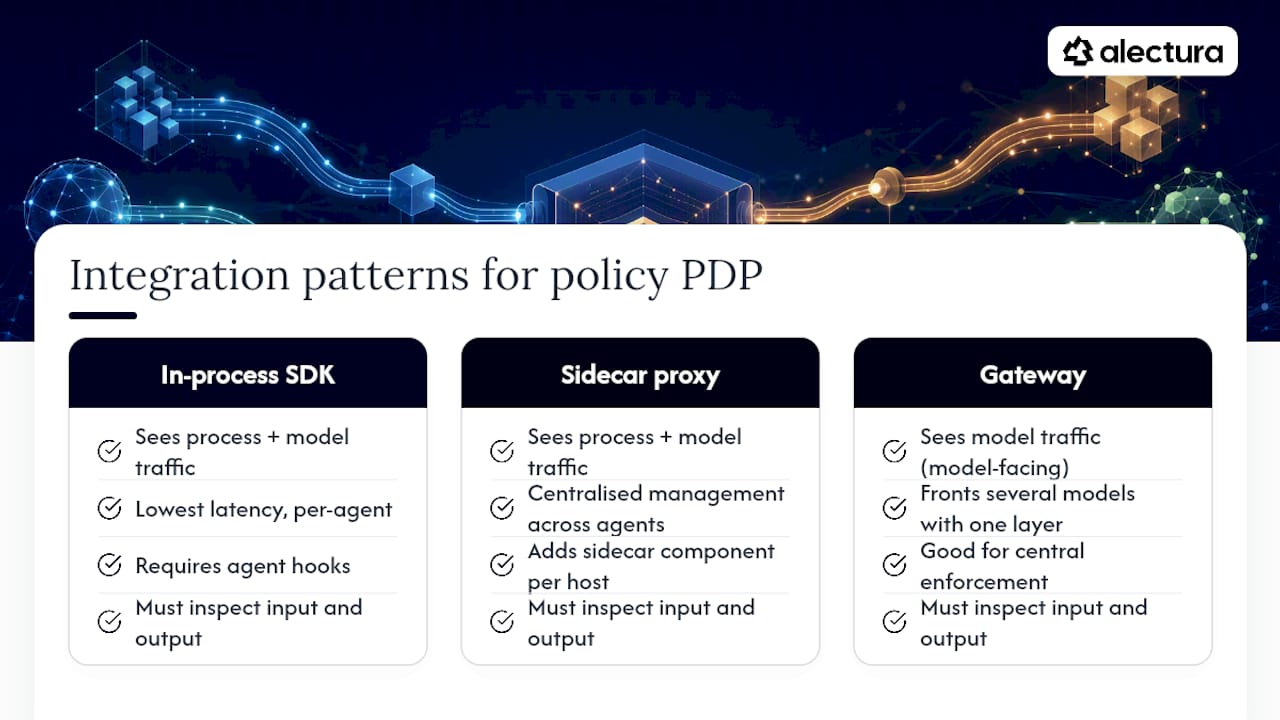
Most enterprise security stacks weren't built with LLM traffic in mind, which means integration is rarely a single API call. The cleanest pattern places the policy decision point where it can see both the endpoint's process activity and the model traffic leaving it, an in-process SDK for lowest latency, a sidecar proxy where you need centralised management across many agents, or a gateway when you're fronting several models with one enforcement layer.
Whichever pattern you choose, the enforcement point has to sit on the output path as well as the input path. A PDP that only checks prompts going out and never checks what comes back has already lost half the battle, particularly against attacks that plant instructions inside retrieved documents or tool outputs.
Endpoint detection and response platforms already track process lineage and file activity; AIDR extends that same discovery discipline to AI tools, copilots, browser extensions, IDE assistants, and the MCP servers they connect to. Feeding your policy templates the same identity and device context your EDR already collects means a rule can reference "this device, this user, this session" without rebuilding identity plumbing from scratch. Where an agent framework doesn't expose native event hooks, network-level inspection of the traffic between the agent and its model provider fills the gap, at some cost to payload fidelity. Locking down agent permissions at the runtime layer before you even reach policy evaluation removes an entire class of requests your templates would otherwise have to catch.
How do you handle policy updates and rollback safely?
Policy bundles change constantly as new models ship, new data types show up in prompts, and new attack patterns get discovered. Treat every update the way you'd treat a firmware push: versioned, tested, and reversible.
Each bundle update should get a new version hash rather than mutating the existing one in place. That gives you an immutable audit trail, and it means a rollback is just re-pinning to the previous hash rather than trying to reconstruct what the old rules actually said. Keep at least the last three to five bundle versions readily available, not archived somewhere that takes an hour to retrieve during an incident.
Before any update reaches production, run it through the same evaluate-only bake window a brand-new bundle would get, just shorter, since you're validating a delta rather than a whole rule set. A week of shadow evaluation against live traffic is usually enough to catch an update that would spike false positives or, worse, silently widen a gap in coverage.
Rollback rehearsals deserve a place on your incident response calendar, not just your deployment runbook. Practise the actual mechanics, who has authority to trigger it, how fast the new bundle propagates to every endpoint, and whether your fail-closed defaults hold during the propagation window itself. A rollback that takes twenty minutes to reach every device is a twenty-minute window where some endpoints are running old rules and others new ones.
How should you test policy templates before deployment?
Testing an LLM policy template is closer to testing infrastructure-as-code than testing application logic, because the cost of a false negative is a security incident and the cost of a false positive is a furious business unit.
Start with unit tests against individual rules: feed known-good and known-bad inputs and confirm the verdict matches expectations, including the reason code and severity, not just pass or fail. Then run coverage tests across the whole bundle. These should fail loudly if any intervention point that's supposed to be governed turns out to have no matching rule, catching the silent gaps that don't show up until an attacker finds them first.
Escalate outcomes need dedicated approval-path testing. It's not enough to confirm the policy correctly identifies a request as needing human review, you also need to confirm the escalation actually reaches someone, that the approval workflow doesn't time out silently, and that a rejected escalation resolves to deny rather than defaulting to allow.
Load and latency testing matters just as much as correctness testing. A rule set that's accurate but adds 400 milliseconds to every model call will get disabled by frustrated engineering teams within a month, regardless of how good the detections are. Test against realistic concurrent request volumes, not synthetic single-request benchmarks.
Finally, run adversarial tests specifically designed to probe your transform and redaction logic, since that's where partial failures hide best. A redaction rule that catches nine out of ten formats of a secret pattern looks fine in a demo and fails quietly in production.
How do you manage policies across multiple tenants or applications?
Once you're running policy templates across more than one business unit, product line, or customer tenant, a single flat rule set stops scaling. Different teams need different data classification rules, different model allowlists, and sometimes entirely different escalation chains, without any one team's changes affecting another's enforcement.
The cleanest structure separates a baseline organisational bundle, the non-negotiable rules every tenant inherits, from tenant-specific overlays that add stricter constraints on top. Never let an overlay loosen a baseline rule; only tighten. That ordering matters: it means a central security team can guarantee a floor of protection regardless of what any individual application team configures.
Namespace your policy IDs and bundle version hashes by tenant so audit records are unambiguous about which rule set fired for which application. This becomes critical during incident response, when you need to know instantly whether a violation happened under the shared baseline or a tenant-specific rule that only exists for one product.

Give each tenant or application owner visibility into their own evaluate-only metrics before you promote their overlay to enforce mode, but keep bundle signing and final promotion authority centralised. Decentralising visibility while centralising control is what keeps multi-tenant policy management from turning into either a bottleneck or a free-for-all.
Who should be allowed to edit and deploy policy bundles?
A policy engine that anyone in engineering can push changes to is a policy engine an attacker only needs to compromise one credential to defeat. Access control around policy editing deserves the same rigour you'd apply to production infrastructure credentials, arguably more, since a malicious or careless change here can disable detection across your entire fleet silently.
Separate the roles of policy authoring, policy review, and policy deployment wherever your team size allows it. The person writing a new rule shouldn't also be the only approver signing off on pushing it live. Require signed commits or equivalent attestation for any bundle change, and verify that signature at load time so an unsigned or tampered bundle simply refuses to run.
Log every edit to policy source with the same audit rigour you apply to the verdicts the policy produces, who changed what, when, and why, tied to a ticket or change request. Restrict production deployment credentials to a small, named group, and require a second approver for any change that loosens an existing deny rule or removes a data classification. Tightening a rule can go through a faster path; loosening one is exactly the kind of change an attacker who's gained internal access would want to make quietly.
What Alectura has learned turning templates into real enforcement
Deploying policy templates at scale surfaces problems that look small in a design doc and become urgent in week one of a rollout. Alectura's endpoint discovery consistently finds agents and copilots that security teams didn't know were running, which means the identity binding in a template has to cover devices and processes the org hasn't formally inventoried yet, not just known service accounts.
The most common early mistake isn't a bad rule, it's asymmetric audit writes: verdicts get logged on the deny path but not on the allow or transform path, leaving a blind spot exactly where a slow data exfiltration would show up first. The second is treating fail-closed as a documentation exercise rather than a tested behaviour, only discovering during an outage that a manifest load failure quietly defaulted to allow.
Our recommendation for any team starting out: write a handful of narrow, high-confidence deny rules, instrument telemetry heavily from day one, and keep the evaluate-only bake window shorter than you think you need, then extend it if the data tells you to.
— Nathan
Turning templates into enforcement without slowing your team
Writing a solid LLM policy template is only half the job; it discovers AI tools and agents on your fleet and enforces verdicts effectively with solutions like the AI Executive Agent from California Telecom. It discovers AI tools and agents on your fleet, maps them to the identity and data-class rules your templates define, and enforces verdicts at pre_tool_call, post_model_call and output without adding a noticeable delay to the request.

Security teams piloting AIDR typically start the same way this article recommends starting a policy rollout: evaluate-only first. Bundles can run in shadow mode against real endpoint traffic, feeding allow, warn, deny and escalate rates into SIEM or SOAR, and providing the audit trail, bundle hash, reason code, timestamp, needed to promote rules to enforce with confidence rather than guesswork. If you're not sure how many AI tools are actually running across your fleet right now, that's the place to start. Read how agentic endpoint security works, or request a pilot to see your own AI inventory before you write a single rule.