
A secure generative AI rollout is governance-first and phased: you write the safety plan before you write a line of integration code, gate every expansion behind measurable thresholds, and monitor from the first prompt onward. The three priorities that matter most in the first month are a documented safety plan with sign-off criteria, a phased rollout running shadow mode into canary into staged expansion, and monitoring wired into your existing incident response before any real user sees the model. Everything else in a secure generative AI rollout is detail sitting underneath those three decisions.
TL;DR:
- Fully inventory all AI tools and connections before deployment to accurately assess risk tiers and prevent overlooked vulnerabilities.
- Run shadow mode traffic logging for at least five business days to capture a full weekly pattern before moving to canary release.
- Issue short-lived credentials per agent and apply role-based access control to ensure precise identity verification and minimize misuse.
- Establish measurable gate thresholds for testing and rollout, with predefined rollback triggers based on specific metrics, not vague impressions.
- Monitor outputs, drift, and exfiltration patterns continuously through existing security tools, and maintain detailed logs for post-incident analysis.
Table of Contents
- Quick secure rollout checklist for enterprise AI teams
- What goes in the written safety plan?
- How do you architect a secure environment for generative AI?
- Who or what should be allowed to call your models?
- How long should shadow mode and canary testing run?
- What should AI monitoring and incident response actually catch?
- How do you control prompts and agent behaviour in production?
- How Alectura Labs supports a secure generative AI rollout
- Ready to map your rollout against a real environment?
- Balancing rollout speed against real security priorities
- Sources
Quick secure rollout checklist for enterprise AI teams
Before anything touches production, you need a short list of non-negotiables. Skip one of these and you're improvising your incident response during an actual incident, which is the worst possible time to discover a gap.
Pre-deployment essentials:
- A written safety plan naming the risk tier of each use case and the sign-off owner for each gate
- Documented gate criteria (not "looks fine", but specific metric thresholds) for every promotion step
- A decommissioning rule: what triggers a full rollback or shutdown, and who pulls that trigger
Technical must-haves before user exposure:
- Full inventory and discovery of every AI tool already touching your fleet, including copilots and browser extensions nobody formally approved
- Least-privilege inference access, so a model or agent can only reach the data and tools its task requires
- Encryption at rest and in transit, plus data loss prevention tuned for conversational input and output, not just file transfers
Deployment gates:
- Shadow mode logging real traffic without acting on it, run long enough to see a full cycle of typical traffic patterns
- Canary release capped at a low percentage of traffic with a fixed dwell time before you look at expanding
- Explicit rollback triggers defined in advance, not decided in the moment under pressure
Pro Tip: Write your rollback triggers as numbers, not adjectives. "Performance degrades noticeably" is not.
Monitoring has to be live before the first real user touches the system, not bolted on after the canary succeeds. That includes prompt logging, output sampling, and an alert path into whatever SIEM your security team already lives in.
What goes in the written safety plan?
Every credible generative AI security measure traces back to one document: the written safety plan. Microsoft's guidance on deploying AI safely is explicit that this plan must document detection and response capabilities strong enough to keep the wider system resilient even when the AI component itself fails. That's a higher bar than most teams set on their first draft.
A safety plan worth the name covers four things:
- Scope — which use cases, which models, which business units, and which data classifications are in play.
- Risk tier definitions — not every use case deserves the same scrutiny. A summarisation tool reading public marketing copy is a different risk tier to an agent with write access to a customer database. The NIST generative AI profile provides a structured way to map use cases against governance, monitoring, and deployment actions, and it's the closest thing the industry has to a shared risk-tiering language.
- Testing and gate criteria — the measurable thresholds a use case must clear before promotion, tied to a named decision owner rather than a vague "the team agreed."
- Decommissioning rules — the conditions under which a deployment gets pulled, and who has authority to pull it without waiting for a committee meeting.
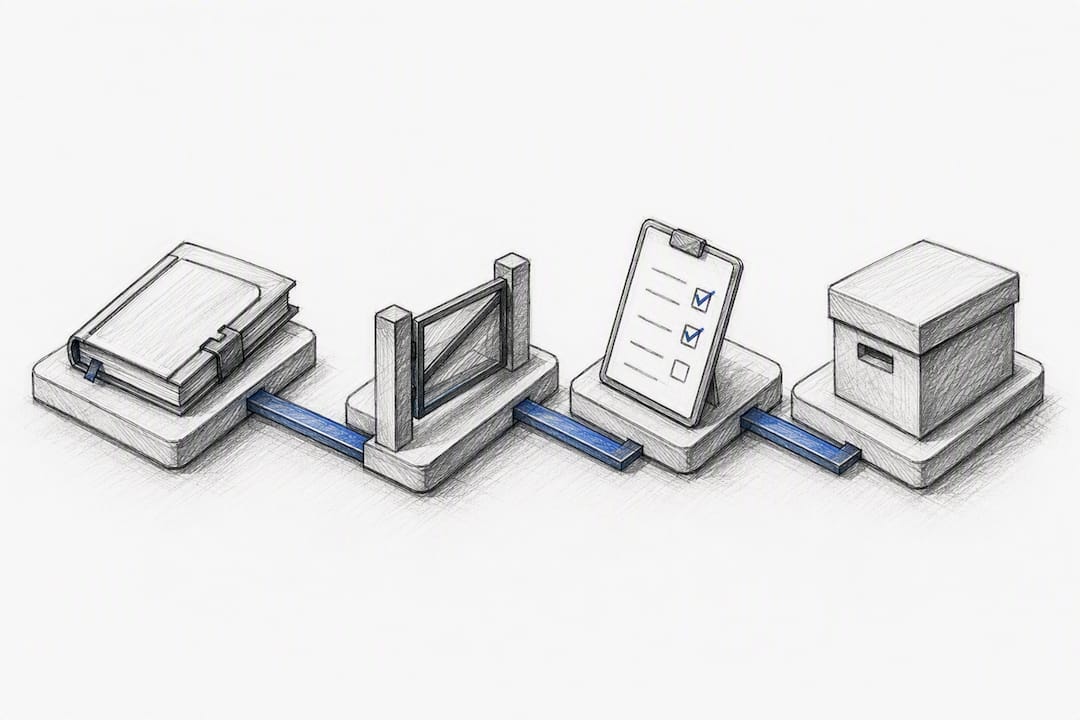
Governance only works when someone is actually accountable at each gate. Name the sign-off owner for shadow-to-canary, the separate owner for canary-to-staged, and a third for staged-to-full. These can be the same person in a smaller organisation, but the roles need to exist on paper even then.
Document retention matters more than most teams initially budget for. Regulators and internal audit will eventually ask what a model saw, when, and who approved its exposure to that data — keep the safety plan, the gate approvals, and the test results as a single audit trail rather than scattered across Slack threads and someone's personal notes.
How do you architect a secure environment for generative AI?
Architecture decisions made in week one tend to be the ones you're stuck defending in year three. Get the separation right from the start and most other controls become easier to enforce.
- Separate accounts or environments for training, staging, and inference. AWS's Generative AI Lifecycle Operational Excellence guidance recommends exactly this kind of multi-account isolation, with a model promotion workflow that moves an artefact through gated security validation at each stage rather than letting anyone push straight to production.
- Private VPCs with restricted egress. Inference endpoints shouldn't have an open path to the public internet, and outbound traffic should be limited to the destinations the use case actually needs. AWS's security reference architecture for generative AI pairs this with restrictive IAM policies and customer-managed encryption keys as baseline controls, not optional extras.
- Customer-managed keys and immutable model artefacts. If you don't control the encryption keys, you don't fully control the data. Immutable artefacts stop a "quick fix" pushed directly into a running model from bypassing your promotion pipeline entirely.
- Semantic gateways at the boundary. A gateway that inspects inputs and outputs before they cross a security boundary catches malformed prompts, injected instructions, and leaking outputs that a firewall built for HTTP traffic was never designed to see.
None of this is exotic engineering. It's the same isolation logic security teams have applied to payment systems and identity providers for years, applied to a new kind of workload that happens to be probabilistic instead of deterministic.
Who or what should be allowed to call your models?
Identity is where most generative AI security measures quietly fall apart, because teams default to a single shared API key and call it done. That single key can't tell you whether a request came from a legitimate agent, a compromised script, or a departing employee's leftover credential.
- Issue short-lived credentials per agent or service, not long-lived keys shared across a team.
- Apply least privilege to inference endpoints: an agent that only needs to read a knowledge base shouldn't hold write access to anything.
- Build time-limited elevated access workflows for the rare cases where a human genuinely needs broader model or tool access, with automatic expiry rather than a manual reminder to revoke it later.
- Combine RBAC and ABAC patterns so both human users and autonomous agents get access decisions based on role and attributes (department, data classification, task type), not a single flat permission tier.
- Run regular audit and revocation sweeps so credentials tied to closed projects or departed staff don't sit active for months.
Distinguishing a legitimate agent action from a misuse pattern is nearly impossible if every request looks identical in your logs. Per-agent identity and short-lived credentials aren't extra security theatre, they're the difference between forensics that takes an hour and forensics that takes a week. Agent-swarm covers this in depth for teams running multiple agents in coordination, where the identity problem multiplies fast.
Pro Tip: Treat every AI agent as its own service identity from day one, even a "temporary" pilot. Retrofitting per-agent credentials after 40 agents are running on a shared key is a project that gets deprioritised until an incident forces it.
How long should shadow mode and canary testing run?
Gate criteria only work if they're measured, not felt. Checklist guidance on phased AI rollouts is blunt about this: shadow and canary thresholds need to be written down and quantified before the rollout starts, not agreed on informally once the data starts coming in.
- Shadow mode: run for a minimum of five business days, logging real production traffic and comparing model outputs against expected or human-reviewed baselines without letting the model act on anything. Industry deployment checklists converge on this five-day floor because it's roughly the shortest window that captures a full weekly traffic pattern, including the Monday spike and Friday drop-off most enterprise systems see.
- Canary release: cap traffic at around 5%, with a dwell time of at least 48 hours before you even consider expanding, and pre-set metric thresholds (error rate, latency, flagged-output rate) that trigger an automatic hold if breached.
- Adversarial testing integrated into CI: prompt injection attempts, data exfiltration probes, and jailbreak variants should run as part of your regular pipeline, alongside functional regression suites, not as a one-off red team engagement before launch.
- Rollback drills: actually run the rollback, don't just document it. Measure your real recovery time objective under drill conditions, because the number you assumed on paper is rarely the number you get under pressure.
The recurring failure mode here isn't a missing test category, it's a gate with no teeth. A canary threshold that gets waived because "the demo went fine" isn't a gate, it's a suggestion, and suggestions don't hold up when something goes wrong in front of a customer.
What should AI monitoring and incident response actually catch?
Monitoring for generative AI has to watch different signals to traditional application monitoring, because the failure modes are different. A model doesn't throw a stack trace when it leaks a customer record into a response, it just answers the question.
- Prompt and output logs, retained long enough to reconstruct a session during a post-incident review.
- Output distribution drift, flagging when a model's responses shift meaningfully from its established baseline, which can signal anything from a prompt injection succeeding to a quiet model version change upstream.
- Exfiltration patterns, especially large or unusual data volumes moving through a model interface that normally handles short conversational exchanges.
- Rolling traffic windows rather than isolated prompts. Anthropic's enterprise safety guidance makes a strong case for this: sophisticated attacks often span multiple sessions, and a system that only inspects one prompt at a time misses the pattern entirely. Anthropic also recommends prioritising zero data retention where feasible, so a breach of stored logs can't expose conversation history that was never kept.
Feed these signals into your existing SIEM and SOAR tooling rather than standing up a separate AI-only monitoring silo, and build AI-specific playbooks for your incident response team so an on-call analyst isn't improvising the first time a model starts behaving strangely. Serious incidents deserve a coordinated disclosure path too, whether that's an internal registry of known AI failure modes or an external one, and every incident needs enough retained evidence (logs, prompts, gate approval records) to support a proper post-incident review rather than a guess about what happened.
How do you control prompts and agent behaviour in production?
Prompts are code, and they deserve the same operational discipline. AWS's GLOE guidance treats prompt changes exactly like application code changes: version them, review them, test in staging, and promote through a pipeline with automated regression checks rather than editing a live system prompt directly.
- Maintain a prompt store with versioning, so you can trace which exact prompt produced which exact output during an investigation.
- Tune DLP rules for conversational patterns, since a data leak through a chat interface looks nothing like a leak through a file upload, and generic DLP tooling often misses it entirely.
- Use semantic gateways or auxiliary safety-check models to inspect inputs and outputs in real time, catching injected instructions before they reach the primary model.
- Sandbox any AI-generated code at the kernel level rather than trusting it to run with normal process privileges, and pair that with hardware-backed keys so every write to a production database carries a cryptographic signature. Google's guidance on building zero-trust AI agents recommends gVisor-style user-space sandboxing specifically because generated code shouldn't be trusted with the same runtime privileges as reviewed, human-authored code.
- Set strict runtime resource limits on agents so a runaway loop or a malicious instruction can't spiral into a denial-of-service event against your own infrastructure.
How Alectura Labs supports a secure generative AI rollout
Every control above needs evidence behind it, not just intent. That's the gap between a safety plan that looks good on paper and one that survives an audit.
An AI Detection and Response platform maps directly onto the checklist: it discovers the AI tools already running across your fleet (including copilots and browser assistants nobody formally onboarded), inventories what each one can access, and tracks connections through MCP and other integrations that most security stacks can't currently see.
- Discovery and inventory give you the risk-tiering data your written safety plan actually needs, instead of a guess.
- Real-time detection flags secrets, PII, and prompt injection attempts as they happen, feeding the monitoring layer your canary gates depend on.
- Policy governance and enforcement let you set guardrails for LLMs and agents centrally, rather than per-tool.
- On-device audit logging builds the traceability regulators and internal audit will eventually ask for.
A practical starting point looks like discovery first, then policy definition, then canary-stage monitoring layered on top, mirroring the phased gates covered earlier. Teams building their own governance documentation from scratch can pair that process with Alectura's frameworks for enterprise AI governance and its agentic AI security guide for the deeper technical detail on agent-specific controls.
Ready to map your rollout against a real environment?
A safety plan is only as good as the visibility behind it, and most security teams don't actually know which AI tools are already running across their fleet before they start planning a formal rollout. This platform closes that gap first: discovery and inventory before governance, not after, so your risk tiers are built on what's genuinely in your environment rather than what IT approved on a spreadsheet six months ago.

A proof-of-concept with Alectura typically covers three things: full discovery of AI tools and agent connections across your endpoints, a risk-tiering pass mapped against your existing data classifications, and a canary-stage monitoring runbook you can hand straight to your SOC. If data leaving through AI tools is the risk keeping you up at night, Alectura's data loss prevention solution is built specifically for that exfiltration pattern, and the AI app risk directory breaks down exactly what leaks through tools like ChatGPT and the guardrails that stop it. Request an assessment, and you'll have a concrete map of your AI exposure before your next rollout decision is due.
Balancing rollout speed against real security priorities
The pressure on most security teams isn't a lack of knowledge about what good looks like. It's the business asking for generative AI in production by next quarter, and a governance process that wasn't designed to move that fast.
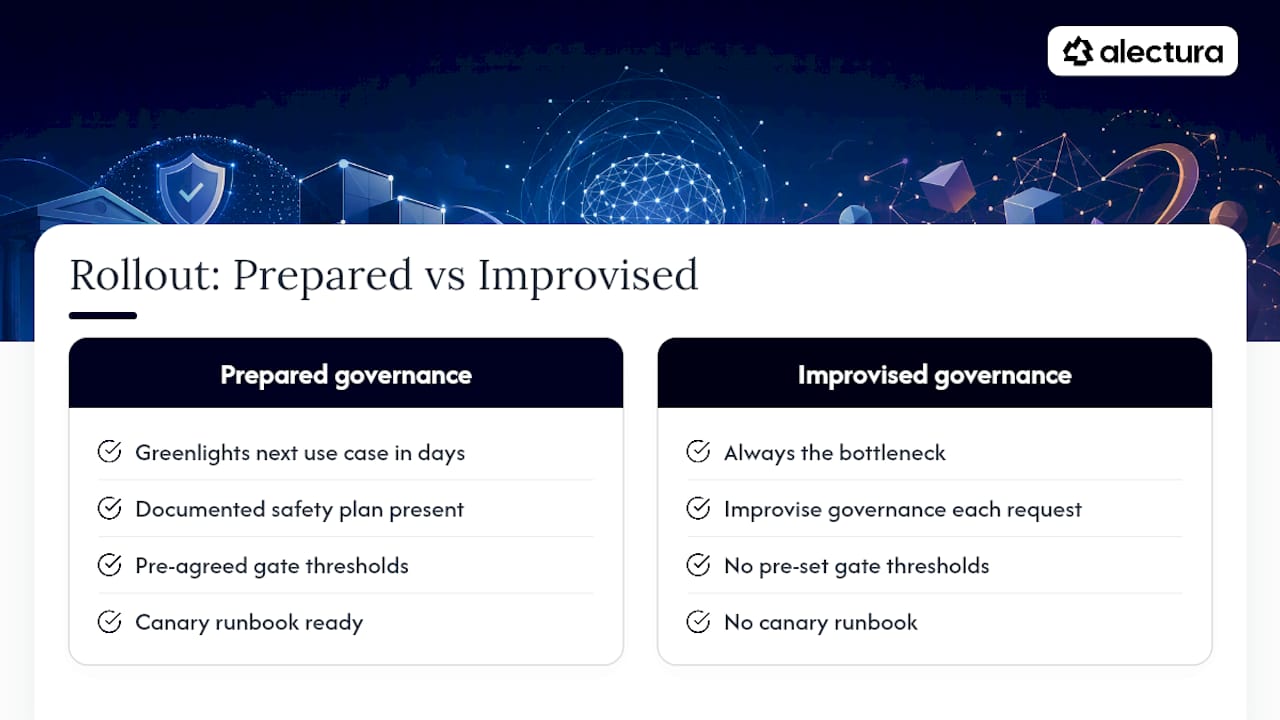
Here's the uncomfortable truth: you can satisfy both, but only if you stop treating security gates as a delay and start treating them as the thing that lets you say yes faster the second time. A team with a documented safety plan, pre-agreed gate thresholds, and a working canary runbook can greenlight the next use case in days. A team improvising governance from scratch for every new model request will always be the bottleneck, and will eventually be blamed for it.
The minimum sensible bar for a go decision is simple: a named risk tier, a written gate threshold, and monitoring that's live before the first real user touches the system. Nothing else needs to be perfect on day one. It just needs to be true, and it needs to be checked at every phase, not assumed after the first one passes.
— Nathan
Sources
- NIST: Generative AI profile (AI RMF companion)
- Microsoft: How to deploy AI safely (blog)
- AWS: Generative AI Lifecycle Operational Excellence (GLOE)
- Anthropic: Enterprise frontier safeguards