
The NIST AI Risk Management Framework is a voluntary, practical guidance document that helps organisations design, develop, deploy, and use AI systems in ways that manage risk to people, organisations, and society. It is not mandatory, it does not require certification, and it is deliberately adaptable. For Australian organisations, that flexibility is the point: the AI RMF gives security, risk, and compliance teams a defensible, audit-ready structure that maps cleanly onto local regulatory expectations from the OAIC to APRA.
The short verdict: adopt it, instrument it, and treat it as an operational framework rather than a documentation exercise.
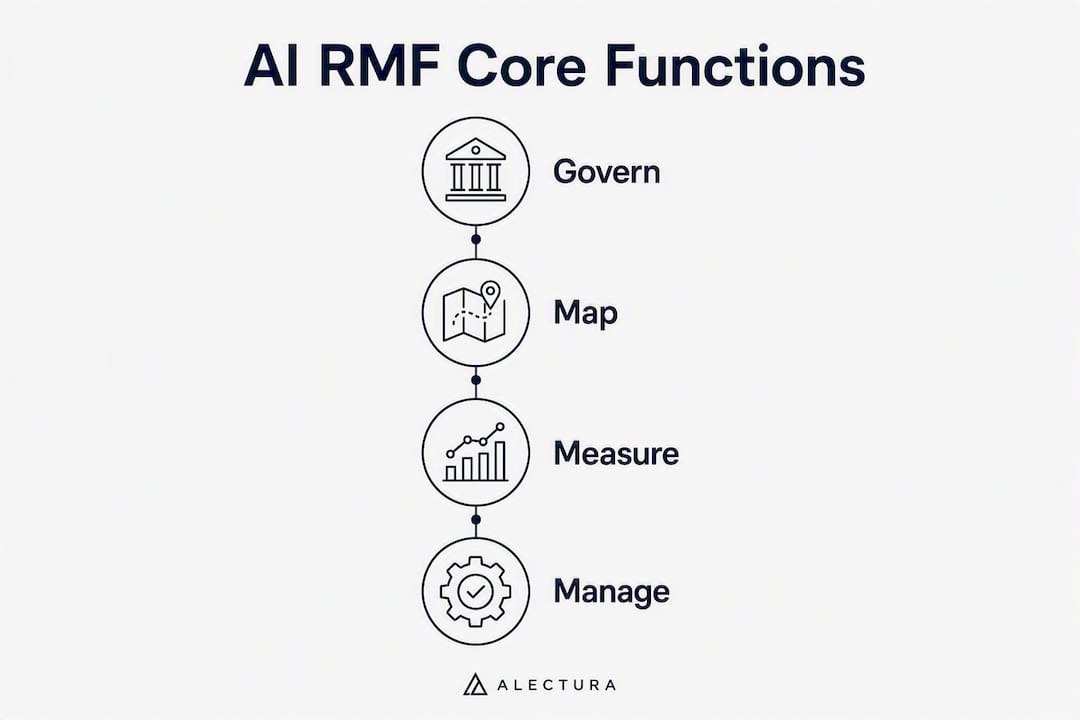
TL;DR — the four core functions:
- Govern: Establish the culture, policies, roles, and accountability structures that make AI risk management possible across the organisation.
- Map: Identify and catalogue every AI system in use, its context, its data flows, and the people it affects.
- Measure: Collect evidence — metrics, tests, runtime logs — that tells you whether risks are within acceptable bounds.
- Manage: Treat, prioritise, and respond to AI risks using the evidence Measure produces, with clear incident playbooks and governance-driven resourcing.
The full framework is published as AI RMF 1.0 (NIST.AI.100-1) and is free to download directly from NIST.
Table of Contents
- What does the NIST AI RMF actually cover?
- What do Govern, Map, Measure, and Manage mean in practice?
- How do you build a roadmap from pilot to scale?
- What are the AI RMF Playbook, Generative AI Profile, and AIRC?
- How does the NIST AI RMF align with Australian regulation and ISO 42001?
- What operational controls and tooling support the AI RMF?
- How Alectura operationalises the RMF with AIDR
- 90-day implementation checklist for an AI RMF pilot
- Key takeaways
- The gap between governance and operations is where AI risk actually lives
- Alectura AIDR: operational AI risk management for Australian enterprises
- Primary sources and further reading
What does the NIST AI RMF actually cover?
The AI RMF defines an AI system as an engineered or machine-based system that can, for a given set of objectives, make predictions, recommendations, decisions, or content that influences real or virtual environments. The intended audience is "AI actors" — anyone who designs, develops, deploys, evaluates, or uses AI systems. That covers a wide range of roles: data scientists, security engineers, procurement leads, compliance officers, and board members all sit within scope.
The framework is voluntary and adaptable, not a certifiable standard. Organisations cannot be audited against it the way they can against ISO 42001. What it offers instead is a structured, flexible approach to embedding AI risk management into existing governance and risk processes. NIST explicitly designed it to complement, not replace, existing risk frameworks — so if your organisation already runs NIST CSF, ISO 31000, or an internal enterprise risk management process, the AI RMF slots in rather than competes.
Structurally, the document has two parts. Part 1 provides contextual framing: the nature of AI risk, the socio-technical perspective (people, processes, and technology together), and the characteristics of trustworthy AI. Part 2 describes the Core — the four functions and their subcategories. NIST also publishes a suite of companion resources that extend the Core into practical territory:
- AI RMF 1.0 PDF (NIST.AI.100-1): — The primary document. Download it, read Part 2 first if you are time-poor.
- AI RMF Playbook: Converts Core subcategories into suggested actions with action IDs. The practical workhorse.
- AIRC (Trustworthy and Responsible AI Resource Center): NIST's online hub for use cases, implementation guidance, and Playbook access.
NIST treats the framework as a living document, with a versioning approach for major and minor updates. That matters for Australian organisations building compliance programmes: the framework you implement today may gain new profiles and subcategories, so governance processes should include a periodic review cycle tied to NIST update releases.
What do Govern, Map, Measure, and Manage mean in practice?
The AI RMF Core structures AI risk management into four iterative functions. They are not sequential phases; they operate in parallel and feed each other continuously across the AI lifecycle.
Govern: build the foundation before anything else
Govern is the function that makes the other three possible. Without clear accountability, defined policies, and a culture that takes AI risk seriously, Map and Measure produce reports nobody acts on.
In practice, Govern means:
- Mapping applicable legal and regulatory requirements (Privacy Act 1988, sector-specific obligations under APRA CPS 230, ACSC Essential Eight) to AI-specific policies.
- Defining roles: who owns AI risk at the executive level, who owns it for each system, and who has authority to halt a deployment.
- Establishing a policy lifecycle — not just writing policies, but scheduling reviews, assigning owners, and tracking exceptions.
- Setting risk tolerance thresholds that the Measure function will test against.
The socio-technical framing NIST uses here is deliberate. Trustworthy AI requires changes to people and processes, not just code. A governance structure that only addresses model performance misses the human and organisational factors that most AI incidents trace back to.
Pro Tip: Start Govern by mapping your existing risk committee structure. In most Australian enterprises, AI risk can be anchored to an existing risk and compliance committee rather than creating a new body — this accelerates adoption and avoids governance fatigue.
Map: you cannot manage what you cannot see
Map is the inventory and context-setting function. Before any risk can be measured or managed, teams need to know which AI systems exist, what they do, who they affect, and what data they touch.
Practical Map activities include:
- Building an AI system inventory: every model, copilot, assistant, and AI-enabled SaaS tool in use across the organisation, including shadow AI that security teams have not sanctioned.
- Documenting use-case context: what decision or action does each system influence, and what is the consequence of an error?
- Tracing data lineage: what training data was used, what runtime data does the system process, and where does output go?
- Identifying affected stakeholders: employees, customers, third parties, and regulators who interact with or are affected by each system.
Lack of visibility is the single most common blocker to useful RMF measurement. Organisations that skip a thorough Map phase find that their Measure activities are incomplete because they are only measuring the AI systems they already knew about. Shadow AI detection is not optional — it is the prerequisite for everything else.
Measure: evidence over assertions

Measure is where the framework moves from policy to proof. It covers the metrics, tests, and evidence collection activities that tell you whether an AI system's risks are within the bounds Govern defined.
Pre-deployment Measure activities include validation suites, red-teaming, fairness and bias checks, adversarial robustness testing, and model cards that document known limitations. Runtime Measure activities include performance monitoring, output sampling, drift detection, and logging of anomalous behaviour.
A common trade-off teams face: explainability versus model performance. A highly accurate model may be a black box; a more interpretable model may be less accurate. The RMF does not resolve this tension for you, but it does require you to document the trade-off, assign accountability for the decision, and monitor the consequences at runtime.
Manage: treat risks, not just document them
Manage is the function that converts Measure outputs into action. It covers risk treatment decisions, incident response playbooks, prioritisation of remediation work, and governance-driven resourcing.
In practice, Manage means:
- Triaging detected risks against the thresholds Govern set, and deciding whether to accept, mitigate, transfer, or avoid each one.
- Maintaining incident playbooks specific to AI failure modes: model drift, data poisoning, prompt injection, and output hallucination each require different response steps.
- Communicating risk status to stakeholders, including regulators when incidents meet notification thresholds.
- Feeding lessons from incidents back into Govern and Map to close the loop.
Pro Tip: Map your AI incident playbooks to your existing SIEM and SOAR workflows. Australian enterprises with mature security operations already have incident triage processes — extending them to cover AI-specific failure modes is faster than building parallel processes from scratch.
How do you build a roadmap from pilot to scale?
Adopting the AI RMF is not a single project. It is a programme with a pilot phase that proves value and a scale phase that embeds the framework into normal operations. The sequence below reflects what works in practice for Australian mid-size and enterprise organisations.
Phased adoption roadmap
- Prepare (weeks 1–4): Establish governance. Appoint an executive sponsor and an RMF owner. Run a gap analysis against existing risk processes. Stand up an AI system inventory process and begin populating it.
- Pilot (weeks 5–12): Select two or three AI systems with different risk profiles (one high-risk, one medium, one low). Apply all four functions to each. Instrument runtime monitoring. Capture evidence. Run the first triage cycle.
- Iterate (weeks 13–20): Review pilot evidence. Refine metrics and thresholds. Identify gaps in tooling or process. Update policies based on what the pilot revealed. Measure pilot KPIs against targets.
- Scale (weeks 21 onwards): Extend the framework to all AI systems in the inventory. Embed RMF activities into the software development lifecycle (SDLC), procurement processes, and vendor management. Schedule quarterly governance reviews.
Roles and responsibilities
| Role | Primary responsibility | RMF function ownership |
|---|---|---|
| Executive sponsor | Accountability, resourcing, escalation | Govern |
| RMF owner | Framework coordination, policy lifecycle, reporting | Govern, Map |
| Risk owners (per system) | System-level risk assessment and treatment decisions | Map, Manage |
| Engineering / ML teams | Model documentation, validation, and testing | Measure |
| Security team | Runtime monitoring, incident detection, SIEM/SOAR integration | Measure, Manage |
| Privacy / legal | Regulatory mapping, PIAs, contractual clauses | Govern, Map |
Pilot KPIs
A successful pilot should demonstrate measurable progress on at least four of these:
- AI system inventory coverage: percentage of known AI systems with completed Map documentation.
- Detection latency: time from a runtime anomaly occurring to a triage decision being made.
- Evidence capture completeness: percentage of pilot systems with runtime logs, test records, and model cards in place.
- Incidents triaged: number of risk events identified, classified, and resolved during the pilot period.
- Policy coverage: percentage of identified regulatory requirements mapped to an AI-specific policy or control.
What are the AI RMF Playbook, Generative AI Profile, and AIRC?
The AI RMF Core defines what to do. The companion resources explain how to do it.
The AI RMF Playbook
The Playbook converts each Core subcategory into suggested actions with unique action IDs. For example, a subcategory under Govern might generate five or six suggested actions, each with an ID that lets teams track implementation status. The Playbook is the document practitioners open when they need to move from "we need to implement Govern 1.1" to "here are the specific things we should do."
It is updated after the AI RMF 1.0 release, so check the AIRC for the current version rather than relying on a cached copy.
The Generative AI Profile (NIST-AI-600-1)
The Generative AI Profile addresses risks unique to large language models and generative AI systems: hallucination, data privacy leakage, prompt injection, and misuse. Published in July 2024, it provides suggested actions specifically targeting these failure modes, mapped to the Core functions. If your organisation is deploying LLMs, copilots, or any generative capability, this profile is not optional reading — it is the document that makes the Core actionable for that technology class.
The Generative AI Profile is also the template for how NIST is building sector-specific profiles. In April 2026, NIST released a concept note for a Trustworthy AI in Critical Infrastructure profile, which is directly relevant to Australian operators in energy, water, and financial services.
The AIRC
The AIRC is NIST's online implementation hub. It hosts the Playbook, use cases from across sectors, and practical tools. NIST developed the framework with input from more than 240 organisations, and the AIRC is where that collective knowledge surfaces in searchable, usable form. For Australian teams starting implementation, the AIRC use cases are a faster path to practical examples than reading the primary document cover to cover.
Runtime evidence: what NIST recommends capturing
NIST's guidance points to several categories of runtime evidence that organisations should collect and retain:
- Logs: system-level and application-level logs capturing AI inputs, outputs, and decisions.
- Test records: pre-deployment validation results, red-team outputs, and fairness assessment reports.
- Model cards: structured documentation of model purpose, training data, known limitations, and performance metrics.
- Incident records: documented triage decisions, remediation actions, and post-incident reviews.
These artefacts are what an auditor or regulator will ask for. Building the habit of capturing them during the pilot phase means they exist when needed, rather than being reconstructed after the fact.
How does the NIST AI RMF align with Australian regulation and ISO 42001?
Australian organisations do not operate in a regulatory vacuum. The AI RMF is voluntary, but the regulatory expectations it helps you meet are not.
NIST AI RMF versus ISO 42001
| Dimension | NIST AI RMF | ISO 42001 |
|---|---|---|
| Core functions and focus | Govern, Map, Measure, Manage — risk-based, socio-technical | AI management system requirements — process and control oriented |
| Scope and intended use | Voluntary guidance for any AI actor; flexible and adaptable | Certifiable international standard; formal audit and certification path |
| Implementation/readiness level | Scalable from small pilots to enterprise; no formal prerequisites | Requires documented management system; higher organisational maturity baseline |
| Evidence and measurement approaches | Suggested actions, runtime evidence, model cards, incident records | Mandatory documented procedures, internal audits, management review |
| Applicability to Australian requirements | Strong alignment with OAIC, APRA, ACSC expectations; no direct certification | Certification recognised by some procurement and regulatory bodies; growing Australian uptake |
The key practical difference: ISO 42001 gives you a certificate; the NIST AI RMF gives you a working risk management practice. Many Australian organisations will eventually want both. The sensible sequence is to build operational capability using the RMF first, then formalise it into an ISO 42001-compliant management system when certification becomes a procurement or regulatory requirement.
Australian regulatory considerations
OAIC and the Privacy Act: The Office of the Australian Information Commissioner's guidance on privacy and AI requires organisations to conduct privacy impact assessments (PIAs) for AI systems that handle personal information. RMF Map activities — data lineage, stakeholder identification, use-case documentation — directly support PIA preparation. The Measure function's runtime logging supports the accountability obligations under Australian Privacy Principle 1.
APRA CPS 230 and financial services: APRA's operational risk management standard requires financial institutions to identify, assess, and manage operational risks, including those arising from technology and third-party arrangements. AI systems used in credit decisioning, fraud detection, or customer service fall squarely within CPS 230 scope. The RMF's Govern and Manage functions map directly to CPS 230's requirements for risk ownership, escalation, and incident response.
ACSC Essential Eight and security guidance: The Australian Cyber Security Centre's Essential Eight provides a baseline for cyber security controls. AI systems introduce new attack surfaces — prompt injection, model extraction, data poisoning — that the Essential Eight does not fully address. The RMF's Measure and Manage functions extend the Essential Eight's coverage into AI-specific threat categories.
Actionable alignment steps for Australian organisations:
- Conduct a PIA for every AI system that processes personal information, using RMF Map outputs as the input data.
- Include AI-specific clauses in vendor contracts: data handling obligations, model documentation requirements, incident notification timelines.
- Maintain audit trails that satisfy both OAIC accountability requirements and APRA's record-keeping expectations.
- Map RMF Govern policies to the specific regulatory obligations that apply to your sector.
Australian organisations in regulated sectors — finance, critical infrastructure, health — are increasingly expected to demonstrate structured AI risk management. The RMF offers a defensible, internationally recognised structure to meet those expectations without waiting for a mandatory Australian AI standard to emerge.
What operational controls and tooling support the AI RMF?
Policy without tooling is aspiration. The controls below are the categories teams need to generate the evidence and enforcement the RMF requires.
Control-to-function mapping
| Control category | Primary RMF function | What it produces |
|---|---|---|
| Discovery and inventory | Map | AI system register, access inventory, shadow AI detection |
| Model governance | Govern, Map | Model cards, approval workflows, version control |
| Data controls and DLP | Measure, Manage | Sensitive data detection, exfiltration prevention, redaction logs |
| Testing and validation | Measure | Pre-deployment test records, fairness reports, red-team outputs |
| Runtime monitoring and observability | Measure | Performance metrics, drift alerts, anomaly logs |
| Incident detection and response | Manage | Triage records, remediation logs, post-incident reviews |
| SIEM/SOAR integration | Manage | Centralised alerting, automated response playbooks, audit exports |
Integration considerations
Most Australian enterprises already run a SIEM — Splunk, Microsoft Sentinel, and IBM QRadar are common. The RMF does not prescribe which tools to use, but it does require that evidence be captured, retained, and retrievable. Integrating AI-specific telemetry into an existing SIEM means AI risk events appear in the same dashboards and workflows security teams already monitor, rather than in a separate system that gets checked quarterly.
MLOps pipelines (MLflow, Kubeflow, and similar) are the natural home for pre-deployment test records and model cards. If your engineering teams already use a pipeline, the governance requirement is to ensure that pipeline outputs are retained and accessible to risk and compliance teams, not just engineering.
AI observability tools for enterprise security teams cover the runtime monitoring gap that traditional application performance monitoring tools miss: they capture AI-specific signals like prompt content, output classification, and model confidence alongside standard infrastructure metrics.

For agentic AI security, the control requirements extend further. Autonomous AI agents that take actions on behalf of users — booking systems, code-writing assistants, workflow automation — require controls that monitor not just outputs but actions: what did the agent do, on whose behalf, and with what data?
Vendor categories (not a vendor comparison)
- Discovery and observability platforms: tools that scan endpoints and network traffic to identify AI tools in use, including unsanctioned ones.
- Model validation suites: testing frameworks that run pre-deployment checks for bias, robustness, and performance against defined thresholds.
- DLP for AI: tools that detect and prevent sensitive data — PII, credentials, confidential documents — from being sent to AI systems or exfiltrated via AI outputs.
- Policy enforcement engines: platforms that apply governance rules to AI interactions in real time, blocking or redacting based on defined policies.
- Runtime detectors: tools that monitor live AI interactions for security events: prompt injection attempts, jailbreaks, data exfiltration patterns, and policy violations.
How Alectura operationalises the RMF with AIDR
Alectura's AI Detection & Response (AIDR) platform is built for exactly the gap the RMF exposes: the distance between governance policy and operational evidence. Here is how the operational flow maps to RMF functions.
Discovery to audit log: the operational sequence
- Prompt timeline tracking (Measure): — Alectura captures a timeline of AI interactions at the endpoint level — what was sent, what was returned, and when. This is the runtime evidence NIST recommends: logs that are retrievable, auditable, and tied to specific systems and users.
Deployment notes for Australian enterprises
Alectura operates at the endpoint level, which means AI telemetry is captured before data leaves the device. For Australian organisations with data residency requirements under the Privacy Act or sector-specific obligations, this architecture reduces the risk of sensitive data transiting to offshore logging infrastructure. SIEM and SOAR integrations allow AI risk events to flow into existing Australian-hosted or Australian-configured security operations infrastructure.
90-day implementation checklist for an AI RMF pilot
A pilot that produces no measurable evidence is not a pilot — it is a planning exercise. The checklist below is structured to ensure that by day 90, your organisation has real artefacts: an inventory, runtime logs, triage records, and a measurement baseline.
Days 1–30: establish and inventory
- Appoint executive sponsor and RMF owner.
- Conduct gap analysis: map existing risk processes to RMF functions and identify gaps.
- Select two or three AI systems for the pilot scope (vary risk levels).
- Deploy discovery tooling across pilot scope endpoints.
- Complete initial AI system inventory for pilot systems: use-case, data flows, stakeholders, access.
- Draft or update AI risk policy to cover pilot systems.
- Identify applicable regulatory requirements (Privacy Act, sector obligations) for pilot systems.
Days 31–60: instrument and baseline
- Instrument runtime monitoring for all pilot systems.
- Capture pre-deployment test records and model cards for each pilot system.
- Run first triage cycle on any detected events.
- Conduct PIA for pilot systems that process personal information.
- Establish evidence repository: where logs, test records, and model cards are stored and who has access.
- Review and refine risk thresholds based on initial monitoring data.
- Brief risk committee on pilot progress and initial findings.
Days 61–90: measure, refine, and plan for scale
- Measure pilot KPIs against targets (inventory coverage, detection latency, evidence completeness).
- Document lessons learned: gaps in tooling, process, or policy that the pilot revealed.
- Produce a pilot evidence package: inventory, test records, triage log, runtime evidence summary.
- Draft scale plan: timeline, resourcing, and SDLC integration approach for full deployment.
- Present pilot outcomes and scale plan to executive sponsor and risk committee.
- Schedule first quarterly RMF governance review.
Suggested next steps after a successful pilot: extend discovery tooling to the full endpoint fleet, integrate AI risk events into your SIEM, embed Map and Measure activities into your SDLC gates, and schedule an ISO 42001 readiness assessment if certification is a medium-term goal. The AI detection and response pilot checklist covers the tooling side of this in more detail.
For AI data loss prevention controls specifically, the 60-day mark is the right time to review what the runtime monitoring has revealed about sensitive data flows and tighten DLP policies accordingly.
Key takeaways
The NIST AI RMF gives Australian organisations a voluntary but audit-ready structure to govern, inventory, measure, and manage AI risk across the full system lifecycle.
| Point | Details |
|---|---|
| Voluntary, not optional | The AI RMF is not mandatory, but Australian regulators increasingly expect structured AI risk management in finance and critical infrastructure. |
| Inventory first | Lack of AI system visibility is the most common blocker to useful measurement; complete the Map function before investing in Measure tooling. |
| Companion resources matter | The Playbook, Generative AI Profile, and AIRC convert the Core into specific, trackable actions — use them alongside the primary AI RMF 1.0 document. |
| Align with local obligations | Map RMF activities to Privacy Act PIAs, APRA CPS 230 requirements, and ACSC guidance to satisfy Australian regulatory expectations with a single evidence set. |
| Alectura AIDR | Alectura's AIDR platform automates discovery, runtime evidence capture, and policy enforcement, converting RMF Measure and Manage functions into operational controls. |
The gap between governance and operations is where AI risk actually lives
Most organisations that adopt the NIST AI RMF do so by producing documents. They write an AI risk policy, complete an inventory spreadsheet, and file a model card. Then they call it done. That is not risk management — it is risk theatre.
The framework's real value is in the Measure and Manage functions, and those functions only work if they are instrumented at runtime. A model card written at deployment tells you what the model was supposed to do. Runtime logs tell you what it actually did. The gap between those two things is where most AI incidents originate.
Australian security and risk teams face a specific version of this problem. AI is already running on endpoints across your organisation — copilots in browsers, assistants in development environments, AI woven into the SaaS tools your people use every day. Most of it is invisible to your existing security stack. You cannot measure what you cannot see, and you cannot manage what you have not measured.
The priority order for Australian teams is clear: get the inventory first, instrument runtime evidence second, and align governance with existing risk processes third. Do not wait for a perfect governance structure before starting the inventory. Do not wait for a complete inventory before instrumenting the highest-risk systems. The RMF is iterative by design — NIST built it that way deliberately.
One more thing worth saying plainly: the AI governance trends shaping 2026 point toward mandatory frameworks in Australia within the next few years. Organisations that have already built operational AI risk management capability — real inventory, real runtime evidence, real triage processes — will adapt to mandatory requirements far more easily than those starting from scratch. The voluntary window is the time to build the muscle, not to wait and see.
Alectura AIDR: operational AI risk management for Australian enterprises
Most AI risk programmes stall at the governance layer because the tooling to operationalise Measure and Manage does not exist in the security stack. Alectura closes that gap.

Alectura's AIDR platform gives security teams endpoint-level visibility over every AI tool running across the fleet — copilots, assistants, MCP servers, and AI embedded in SaaS applications. It discovers and inventories AI tools automatically, tracks prompt timelines, detects sensitive data exfiltration and prompt injection in real time, and enforces policy guardrails without disrupting users. Every detection, triage, and enforcement action is captured in audit logs that satisfy Australian privacy and compliance requirements.
For RMF implementation specifically, Alectura maps directly to the Measure and Manage functions: automated runtime evidence capture, real-time risk detection, SIEM and SOAR integrations for Australian security operations environments, and on-device data handling that supports Privacy Act compliance.
Australian enterprises can request a pilot or demo through alecturalabs.com. The pilot is scoped to your environment, your AI systems, and your regulatory obligations — not a generic product walkthrough.
Primary sources and further reading
The sources below are the authoritative references for the content in this guide. Each is freely available and worth bookmarking for ongoing reference as the framework evolves.
NIST primary sources:
- Artificial Intelligence Risk Management Framework (AI RMF 1.0) — the primary document (NIST.AI.100-1). Read Part 2 for the Core functions; Part 1 for the socio-technical framing. Referenced throughout this guide for the four functions, voluntary nature, and update cadence.
- AI Risk Management Framework | NIST — the NIST landing page for the AI RMF, including news of new profiles (such as the April 2026 Critical Infrastructure concept note) and links to all companion resources.
- NIST AI RMF Playbook — converts Core subcategories into suggested actions with action IDs. The practical implementation companion. Referenced in the Profiles and Companions section.
- Generative AI Profile (NIST-AI-600-1) — specific guidance for LLMs and generative AI systems, published July 2024. Referenced in the Profiles and Companions section and the Tools and Controls section.
- AIRC (Trustworthy and Responsible AI Resource Center) — NIST's online hub for use cases, implementation guidance, and Playbook access. Referenced in the Profiles and Companions section.
Australian regulatory references:
- Office of the Australian Information Commissioner (OAIC): The OAIC publishes guidance on privacy and AI, including expectations for privacy impact assessments and accountability under the Australian Privacy Principles. Relevant to the Map function's data lineage and stakeholder documentation, and to the Manage function's incident notification obligations. Visit oaic.gov.au for current guidance.
- Australian Cyber Security Centre (ACSC): The ACSC's Essential Eight and sector-specific guidance provide the baseline cyber security controls that AI-specific RMF Measure and Manage activities extend. Visit cyber.gov.au for current guidance.