
An AI governance framework is the combination of policies, roles, controls, and lifecycle processes that determine how AI tools are adopted, secured, and overseen across your organisation. For endpoint security teams in Australia, the immediate priorities are: inventory every AI tool running on your fleet, deploy detection for sensitive data exposure and prompt anomalies, and enforce policy at the device level before the next incident lands in your inbox.
Start here — your 72-hour checklist:
- Run a discovery scan across all managed endpoints to identify AI tools, copilots, and MCP-connected agents currently in use
- Flag any AI tool with access to credentials, PII, or code repositories as high-risk pending formal risk assessment
- Assign a named owner (CISO or delegate) to the AI inventory and schedule a governance council meeting within the week
Table of Contents
- What are AI governance frameworks and how do the three pillars work on endpoints?
- Who owns what — mapping decision rights from board to engineer
- What technical controls does your endpoint AI security programme need?
- How does AI detection and response fit into your governance model?
- A practical implementation roadmap for Australian security teams
- How does your governance framework map to Australian regulation?
- What KPIs should you use to measure AI governance effectiveness?
- AI incident response playbook for endpoint events
- Initial operational checklist for deploying AI governance across endpoints involves discovery and documenting AI tools, activating monitoring and enforcement controls, completing self-assessments, running scenario exercises, and finally governance reporting with active classification and inventory handover.
- Key takeaways
- The gap most governance programmes never close
- Alectura gives your governance programme its ground truth
- Useful sources for Australian AI governance
What are AI governance frameworks and how do the three pillars work on endpoints?
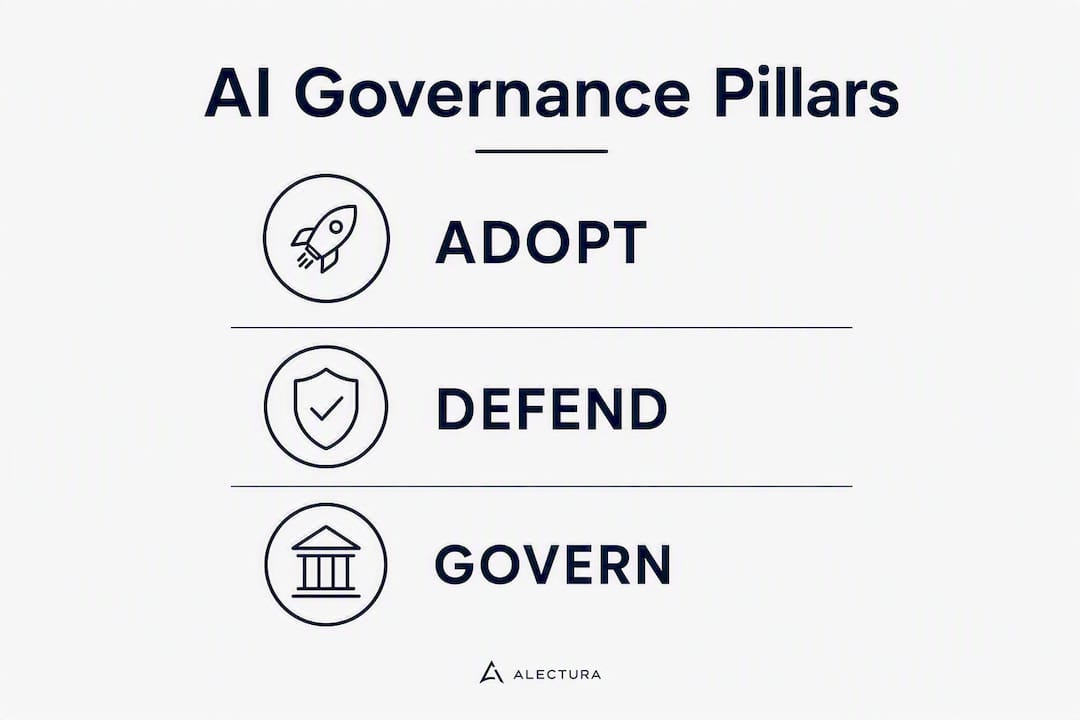
The EC-Council's ADG framework structures enterprise AI governance into three pillars — ADOPT, DEFEND, and GOVERN — and defines 12 minimum auditable controls spanning the full AI lifecycle, from initial deployment through decommissioning. Each pillar maps directly to endpoint work your team is already doing, or should be.
| Pillar | Lifecycle stage | Endpoint artefact |
|---|---|---|
| ADOPT | Onboarding and deployment | Approved AI tool register; access scope documentation |
| DEFEND | Operation and monitoring | Prompt telemetry logs; DLP alert records; anomaly detection events |
| GOVERN | Oversight and assurance | Policy documents; audit trails; risk assessment records; board reporting |
ADOPT is where you decide which AI tools are permitted, under what conditions, and with what access. The artefact is a live, organisation-wide inventory — not a spreadsheet per department. DEFEND is the operational layer: monitoring prompts, detecting secrets exfiltration, and enforcing guardrails in real time. GOVERN closes the loop with oversight, audit evidence, and board-level accountability.
The ADG whitepaper expands these pillars across nine governance surfaces — Model, Prompt, Context, Tools, Orchestration, Identity, Safety Layer, Telemetry, and Learning Loop — giving auditors a named surface for every evidence artefact.
Pro Tip: Embed ADOPT gates into your CI/CD pipeline. Require a completed AI risk assessment and tool registration before any AI-assisted feature ships to production. This turns governance from a retrospective audit into a release condition.
Who owns what — mapping decision rights from board to engineer
Accountability for AI governance sits at the board level and flows down through the CISO to product and security engineers. Ambiguity here is the single most common reason governance programmes stall.

| Role | Responsibility | Decision right |
|---|---|---|
| Board / Risk Committee | Approve AI risk appetite; receive quarterly governance reports | Approve or reject high-risk AI deployments |
| CISO | Own the AI governance policy; chair the AI Governance Council | Escalate to board; approve DEFEND controls |
| Security Engineering | Implement and operate endpoint controls; maintain telemetry | Enforce policy; triage incidents |
| Product / Dev Teams | Register AI tools; complete risk assessments pre-deployment | ADOPT decisions within approved risk appetite |
| Legal / Privacy | Review data governance and NDB obligations | Approve data handling for AI tools |
The AI Governance Council — typically the CISO, a senior privacy officer, a legal representative, and a product lead — resolves the tension between ADOPT and DEFEND. When a business unit wants to deploy a new copilot and security has concerns about its MCP integrations, the Council is the escalation path, not an email thread.
The governance council is not a committee that slows things down. It is the mechanism that lets the business move fast without creating incidents that cost ten times more to clean up. Its job is to make a decision, not to deliberate indefinitely.
What technical controls does your endpoint AI security programme need?
The three non-negotiable control classes for endpoints are: discover what AI is running, monitor what it touches, and enforce what it is allowed to do. Everything else builds on those three.
Discovery and inventory
- Scan all managed endpoints for installed AI tools, browser extensions, IDE plugins, and MCP server connections
- Record each tool's data access scope, network destinations, and identity context
- Flag unsanctioned tools immediately; see the shadow AI detection guide for discovery methodology
Monitoring and telemetry
- Capture prompt timelines and model interaction logs for audit and anomaly detection
- Alert on sensitive data patterns (PII, credentials, API keys) appearing in prompts or completions
- Feed events into your SIEM via structured log formats; LLM observability tooling can normalise this telemetry
Enforcement and isolation
- Apply on-device policy to block or redact prohibited content before it reaches an external model
- Isolate endpoints where a confirmed AI-related incident is in progress
- Integrate with MDM and EDR so AI policy violations trigger the same response workflows as malware events
For AI data loss prevention specifically, map each control to an evidence artefact: DLP alerts become audit evidence for VAISS guardrail 3 (data governance) and ISM GOV-08 (executive AI accountability).
Pro Tip: Route AI policy alerts through your existing SOAR playbooks rather than building a parallel workflow. Your SOC already knows how to triage a DLP alert — AI incidents should land in the same queue with an AI-specific tag, not in a separate tool no one checks.
How does AI detection and response fit into your governance model?
Endpoint AIDR fills the visibility gap that traditional EDR and DLP leave open. EDR tells you what processes are running; AIDR tells you what those processes are saying to external models, what data they are sending, and whether an agent is taking actions your policy does not permit.
Without endpoint-level AI telemetry, your governance framework has no ground truth. You can write policies all day, but if you cannot observe what the AI is actually doing on the device, you are governing on assumptions.
Where AIDR maps to the three pillars:
- ADOPT: Automated discovery populates the AI inventory continuously, so the register stays current without manual effort
- DEFEND: Real-time prompt monitoring, secrets detection, and prompt-injection alerting provide the telemetry DEFEND controls require
- GOVERN: Audit-ready logs, policy artefacts, and SIEM/SOAR integrations give the evidence layer GOVERN needs for board reporting and regulatory queries
Real-world use cases:
- A developer's IDE copilot begins sending database credentials in a prompt; AIDR detects the secret, redacts it, and raises an alert before it reaches the model
- An agentic orchestration tool starts making API calls outside its approved tool list; AIDR flags the deviation and isolates the endpoint pending review
- A browser-based AI assistant connects to an unapproved MCP server; AIDR surfaces it in the inventory as a new, unregistered tool
Alectura delivers this capability as a per-endpoint SaaS subscription, with SIEM and SOAR integrations built in. The AIDR pilot checklist walks through deployment sequencing for enterprise rollouts.
A practical implementation roadmap for Australian security teams
Start with the foundation, then layer controls, then extend to agentic deployments, and then mature the programme. Trying to do all four phases simultaneously is how governance programmes produce documentation without producing security.
| Phase | Timeline | Activities | Acceptance criteria |
|---|---|---|---|
| Foundation | 0–3 months | Endpoint discovery; AI inventory; governance council formation; policy drafts | 100% managed endpoints scanned; inventory owner assigned |
| Control deployment | 3–9 months | DLP and telemetry controls live; SIEM integration; VAISS self-assessment completed | Alerts flowing to SIEM; VAISS gap analysis documented |
| Agentic readiness | 9–15 months | Autonomy tier classification; MCP and agent monitoring; incident playbooks tested | All agentic tools classified; tabletop exercises completed |
| Maturity | 15–24 months | Continuous assurance; board reporting cadence; Essential Eight alignment review | Quarterly KPI reports to board; audit evidence package ready |
The ADG four-phase roadmap underpins this sequencing. Cost drivers to budget for: per-endpoint licensing for AIDR tooling, telemetry storage (prompt logs grow fast in large fleets), and integration effort for SIEM/SOAR connectors.
For change management, run a pilot on a single business unit before fleet-wide rollout. Brief department heads on what telemetry is collected and why — transparency here prevents the "surveillance" objection that kills adoption.
How does your governance framework map to Australian regulation?
The Voluntary AI Safety Standard (VAISS) is the practical compliance baseline for Australian organisations. Its ten guardrails map directly to governance controls:
- Guardrail 1 (accountability): Satisfied by the RACI table and AI Governance Council charter
- Guardrail 2 (risk management): Satisfied by documented risk assessments per AI tool, tiered by autonomy level
- Guardrail 3 (data governance): Satisfied by DLP controls, data flow maps, and on-device enforcement logs
- Guardrail 5 (human oversight): Satisfied by autonomy tier classifications and escalation thresholds in the incident playbook
- Guardrail 9 (record keeping): Satisfied by audit-ready prompt logs, policy artefacts, and SIEM event records
Cyber.gov.au's GOV-08 principle assigns executive accountability for AI security — your board reporting cadence and CISO ownership documentation satisfy this directly. The Guidance for AI Adoption published in October 2025 ties VAISS guardrails to the Essential Eight, so your existing cyber maturity programme already covers part of the control set.
For Notifiable Data Breaches: if an AI tool exfiltrates PII, the NDB scheme under the Privacy Act applies. The 72-hour containment window in your incident playbook should align with OAIC notification timelines.
Pro Tip: Involve your legal and privacy team before your first VAISS self-assessment, not after. They will identify data handling obligations for specific AI tools — particularly those processing health or financial data — that your security controls alone will not catch.
SOC 2 AI compliance guidance covers how these artefacts map to audit evidence packages for third-party assessors.
What KPIs should you use to measure AI governance effectiveness?
Governance that cannot be measured cannot be reported to the board, and cannot be improved.
A governance programme without metrics is a policy document. Metrics are what turn policy into accountability.
| KPI | Measurement method | Target threshold | Evidence artefact |
|---|---|---|---|
| AI inventory coverage | Endpoints with AI tools detected / total managed endpoints | 100% of managed fleet | Discovery scan reports |
| Detection lead time | Time from AI incident trigger to SOC alert | Under 5 minutes | SIEM event timestamps |
| Policy violation rate | Policy breach alerts per 1,000 endpoint-days | Trending down quarter-on-quarter | SOAR alert logs |
| VAISS self-assessment score | Guardrails met / 10 | 8 of 10 guardrails met by month 9 | Self-assessment documentation |
| Incident closure rate | AI incidents closed within SLA / total AI incidents | Above 90% | Incident management records |
Report inventory coverage and detection lead time monthly to the CISO. Bring the full KPI set to the board risk committee quarterly, alongside the VAISS self-assessment score and any open high-risk findings.
AI incident response playbook for endpoint events
Immediate containment (first 15 minutes):
- Isolate the affected endpoint from network and AI service connections
- Preserve prompt logs, process memory, and network connection records before any remediation
- Escalate to the CISO and legal if PII or credentials are confirmed in the exfiltrated data
| Scenario | Inject | Expected decision |
|---|---|---|
| Secrets exfiltration via copilot | Developer's IDE assistant sends an AWS key in a prompt; AIDR raises a secrets alert | Isolate endpoint; rotate credential immediately; assess whether model provider received and cached the key; notify CISO |
| Agentic unauthorised action | An AI agent connected via MCP begins deleting files outside its approved scope | Terminate agent session; isolate endpoint; review MCP tool permissions; escalate to AI Governance Council for autonomy tier review |
Notification checklist:
- Internal: CISO, Legal, Privacy Officer, affected business unit head
- Regulatory: OAIC if NDB threshold is met (serious harm likely); ASD if the incident affects critical infrastructure
- Affected individuals: as required under the Privacy Act NDB scheme
Initial operational checklist for deploying AI governance across endpoints involves discovery and documenting AI tools, activating monitoring and enforcement controls, completing self-assessments, running scenario exercises, and finally governance reporting with active classification and inventory handover.
Key takeaways
Effective AI governance for Australian enterprise endpoints requires a single organisation-wide inventory, clear decision rights from board to engineer, and endpoint-level telemetry that feeds directly into your SIEM and audit evidence package.
| Point | Details |
|---|---|
| Inventory is the foundation | A single, organisation-wide AI tool register is the prerequisite for every other governance control. |
| ADOPT / DEFEND / GOVERN maps to endpoint work | Each pillar produces specific artefacts — register, telemetry logs, policy documents — that satisfy VAISS and GOV-08. |
| VAISS is your compliance baseline | Australia's Voluntary AI Safety Standard guardrails map directly to governance controls your team can implement and evidence. |
| Metrics make governance auditable | KPIs like inventory coverage, detection lead time, and VAISS self-assessment score turn policy into board-reportable accountability. |
| Alectura covers the AIDR layer | Alectura's per-endpoint AIDR delivers the discovery, telemetry, and enforcement controls the DEFEND pillar requires, with SIEM integration built in. |
The gap most governance programmes never close
Most AI governance programmes I see in Australian enterprises are well-intentioned and structurally sound on paper. The board has approved a policy. The CISO has a framework. The VAISS self-assessment is underway. And then someone asks: "What AI is actually running on our endpoints right now?" Silence.
The inventory problem is not a process failure. It is a visibility failure. Governance frameworks assume you know what you are governing. But AI tools proliferate at the endpoint level faster than any manual register can track — a new browser extension here, an IDE plugin there, an MCP server a developer spun up last Tuesday. By the time the policy document is approved, the threat surface has already moved.
The second pitfall is blurred decision rights. When a business unit deploys a new AI tool and security finds out three months later, it is rarely because someone was malicious. It is because nobody was clear about who needed to approve what. The RACI table in this article is not bureaucracy for its own sake. It is the mechanism that prevents that conversation from happening after an incident.
The third is mismatched autonomy tiers. A copilot that suggests code is not the same governance problem as an agent that executes code. Treating them identically either over-controls the former or under-controls the latter. Tier your controls to match the autonomy level of the tool, and revisit those tiers every time a tool's capabilities change.
Alectura gives your governance programme its ground truth
Most governance frameworks describe what should happen. Alectura shows you what is actually happening, at the endpoint, in real time.

Alectura's AIDR platform covers the full DEFEND layer: continuous discovery that keeps your AI inventory current without manual effort, prompt timeline tracking that feeds your audit evidence package, real-time detection of secrets and PII leaving the device, and on-device policy enforcement that does not require routing traffic through a proxy. It integrates with your existing SIEM and SOAR so AI incidents land in the same triage queue as everything else your SOC manages.
The subscription is per-endpoint, so you can start with a single business unit pilot and expand as the programme matures. Review Alectura's AIDR capabilities to see how it maps to the controls in this article, or check the subscription terms before your next procurement cycle.
This article is general information, not legal or compliance advice. Confirm current regulatory requirements with the OAIC, your legal team, or a qualified privacy professional.
Useful sources for Australian AI governance
- Guidance for AI Adoption | Department of Industry, Science and Resources — practical implementation guidance published October 2025; ties VAISS to the Essential Eight
- Australia's AI Ethics Principles | Department of Industry, Science and Resources — foundational ethical guidelines; useful for policy drafting and stakeholder communication
- Cyber security principles | Cyber.gov.au — GOV-08 and executive accountability controls; map directly to board reporting requirements
- AI and machine learning supply chain risks | Cyber.gov.au — technical guidance for organisations deploying or sourcing AI systems; relevant to third-party AI risk
- Cyber Security Act 2024 — legislative context for security obligations on connected products and ransomware payment reporting
- NIST AI Risk Management Framework (AI RMF 1.0) — internationally recognised risk management structure; useful for benchmarking your governance maturity against global practice