
Enterprise AI security protects AI models, agents, training data, inference endpoints, and the AI software supply chain from exploitation, leakage, and misuse across the full model lifecycle. The goal is to enable safe AI adoption without surrendering control over sensitive data or autonomous decision-making.
TL;DR: Start with three actions in the first 90 days: inventory every AI tool running across your fleet, enforce least-agency access on all agents and copilots, and deploy runtime observability so you can see what AI is doing in production.
Three priority actions to start now:
- Inventory and risk triage. You cannot protect what you cannot see. Most enterprises have dozens of AI tools running on endpoints that never touched a procurement process. Discover them first.
- Enforce least-agency access. Agents and copilots should hold only the permissions they need for a specific task, revoked immediately after. Broad standing access is the single fastest path to a serious incident.
- Deploy runtime observability. Log prompts, actions, reasoning steps, and errors. Without that telemetry, you are flying blind when something goes wrong at machine speed.
Table of Contents
- What does enterprise AI security actually cover?
- What are the core elements of an enterprise AI security programme?
- What AI security risks do enterprises face in practice?
- What controls should you deploy, and how do they fit together?
- How should you test and validate AI security defences?
- What compliance obligations apply to Australian enterprises?
- What does a practical 90-day to 12-month roadmap look like?
- How do AEGIS, Beyond Zero, and least-agency change your security architecture?
- Key takeaways
- What most security leaders get wrong about AI security
- Useful sources and further reading
- Alectura gives your security team visibility over the AI running on every endpoint
What does enterprise AI security actually cover?
Enterprise AI security is a multidimensional discipline protecting AI models, agents, data, and the software supply chain through governance, identity management, runtime monitoring, and threat response. That definition comes from Forrester's AEGIS framework, which is currently the most complete practitioner taxonomy for the space.
The scope is broader than most security teams initially assume. In-scope assets include:
- Large language models (LLMs) and fine-tuned variants running in production or development
- AI agents, copilots, and assistants operating on endpoints, in browsers, or inside SaaS platforms
- Model Context Protocol (MCP) servers and other integration layers that give agents access to tools and data
- Training datasets, fine-tuning corpora, and synthetic data pipelines
- Inference endpoints, APIs, and model registries
- Third-party and open-source models pulled from Hugging Face, GitHub, or vendor marketplaces
- Prompt histories, embeddings, and vector databases
What falls outside the scope? General application security, network perimeter controls, and standard endpoint protection remain in their existing domains. AI security does not replace those programmes; it extends them.
The critical difference from traditional perimeter security is autonomy. A firewall rule is static. An AI agent makes continuous decisions, calls external APIs, reads files, and can take actions on behalf of users without a human in the loop for each step. That changes the threat model entirely. Ephemeral agent identities, dynamic tool access, and continuous decision loops mean point-in-time audits and perimeter controls are structurally insufficient on their own.
What are the core elements of an enterprise AI security programme?
The AEGIS framework prescribes a unified approach across governance, IAM, data security, application security, and threat operations rather than isolated controls. That interlocking design is deliberate: a gap in one domain undermines every other.
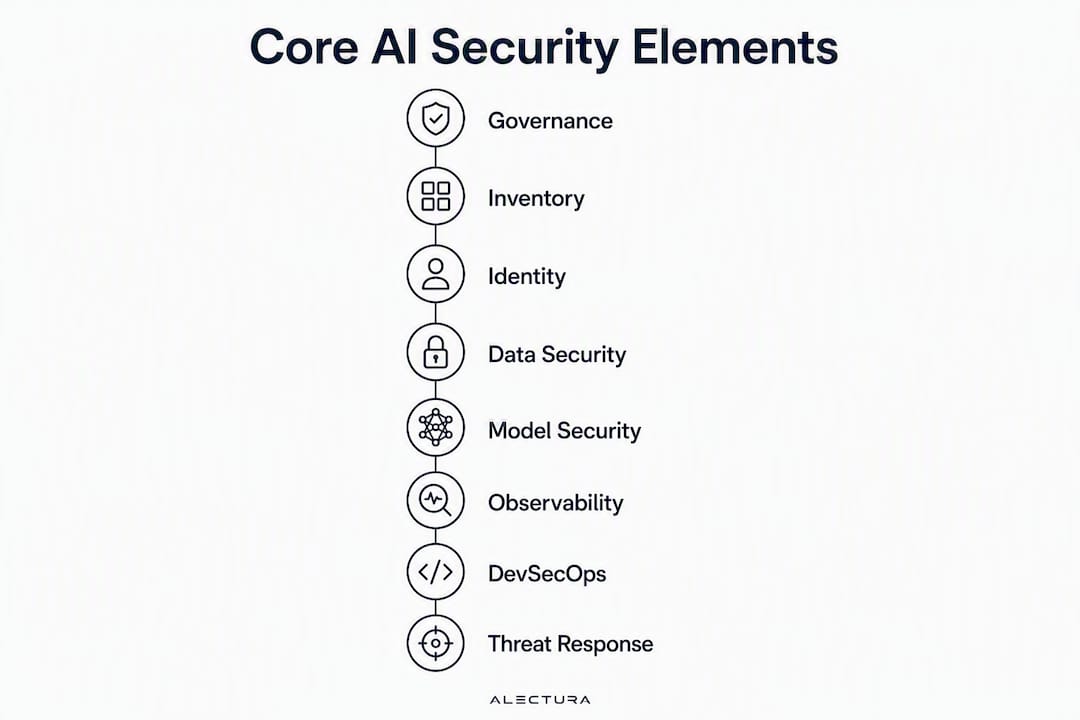
Think of the programme architecture as three concentric rings: inventory at the centre (you must know what exists), runtime controls in the middle (you must watch what it does), and governance on the outside (you must be able to prove and enforce policy at scale).
Governance and policy Owned by the CISO and data protection officer. Defines acceptable use, risk appetite, and the policy-as-code rules that enforce it automatically. Without this, every other control is discretionary.
Inventory and asset management Owned by the security operations team with input from platform engineering. Maintains a live register of every AI tool, model, agent, and integration across the fleet. This is the foundation everything else depends on.

Identity and agent lifecycle management Owned by IAM and platform engineering. Agents need lifecycle management, short-lived credentials, and auditability as first-class entities, not afterthoughts bolted onto human identity systems. Static API keys shared across agents are a known failure mode.
Data security (DSPM and DLP for AI) Owned by the data protection officer and security engineering. Covers classification, access controls, on-device redaction, and prevention of sensitive data leaving the organisation through prompt inputs or model outputs.
Model security and provenance Owned by ML engineering and AppSec. Validates model integrity, tracks lineage, and maintains an AI Bill of Materials (AI-BOM) for every model in production. Covers both first-party and third-party models.
Runtime observability and detection Owned by the SOC. Instruments prompt timelines, agent actions, tool calls, and errors. Feeds SIEM and SOAR for automated detection and response.
DevSecOps, MLOps, and LLMOps integration Owned by platform and ML engineering. Embeds security gates into model build, test, and deployment pipelines so controls are not retrofitted after the fact.
Threat response and auditability Owned by the SOC and incident response team. Covers playbooks for AI-specific incidents, device isolation, and the audit logs needed for regulatory obligations.
Pro Tip: Build your inventory before you build your policy. A policy that covers only the AI tools you know about is a policy with unknown gaps. Run discovery across endpoints, browser extensions, IDE plugins, and SaaS integrations before you write a single guardrail.
What AI security risks do enterprises face in practice?
The threat surface for AI is different from traditional IT risk in one important way: agents operate at machine speed, across cloud and hybrid environments, often without a human approving each action. A misconfigured agent can exfiltrate data, call external APIs, or modify records in seconds. The risks below are ordered roughly by current likelihood and business impact for Australian enterprises.
-
Data leakage and prompt oversharing. An employee pastes a customer contract into a public LLM to get a summary. The contract contains personal information covered by the Privacy Act 1988. The data is now in a third-party training pipeline with no retrieval path. This is the most common AI security incident type in 2025–2026.
-
Model theft and intellectual property loss. A fine-tuned model trained on proprietary data is extracted through repeated API queries using model-inversion techniques. The attacker reconstructs training data or replicates the model's behaviour without access to the underlying weights.
-
Prompt injection and jailbreaks. Malicious instructions are embedded in a document, email, or web page that an agent reads as part of a task. The agent follows the injected instructions rather than its original system prompt, potentially exfiltrating data or taking unauthorised actions. This is particularly dangerous for agentic workflows where the agent has broad tool access.
-
Data poisoning and training-time attacks. An attacker introduces corrupted samples into a training dataset or fine-tuning corpus, causing the model to behave incorrectly in specific, attacker-controlled scenarios. Backdoor triggers can remain dormant until activated in production.
-
Supply-chain risks from third-party models and toolchains. A model pulled from a public registry contains a backdoor or was trained on poisoned data. An MCP server or agent plugin from a third-party vendor has undisclosed data access. These risks mirror software supply-chain attacks but are harder to detect because model behaviour is probabilistic, not deterministic.
-
Agentic and LLM emergent behaviour. A multiagent system designed to automate procurement begins making purchasing decisions outside its intended scope because one agent's output becomes another's instruction. Cascading failures in multiagent pipelines can amplify a small misconfiguration into a significant business incident before any human notices.
-
Insider misuse and shadow AI. Employees use unapproved AI tools that bypass DLP controls, or deliberately use AI to exfiltrate data in ways that look like normal productivity activity. Shadow AI detection is now a distinct operational requirement, not a subset of general shadow IT.
What controls should you deploy, and how do they fit together?
Start with discovery and policy-as-code guardrails. Then layer in observability. Then automate response playbooks tied to specific agent actions. Skipping to automated response before you have inventory and telemetry produces playbooks that fire on incomplete data.

| Control | Security goal | Example implementation |
|---|---|---|
| Discovery and inventory | Know every AI tool and its access | Endpoint agent scanning browser extensions, IDE plugins, MCP servers |
| DLP for AI (on-device) | Prevent prompt leakage of PII and sensitive data | On-device redaction before prompt leaves the endpoint |
| API gateway and access broker | Enforce least-agency at the model API layer | Scoped tokens, rate limits, request filtering on inference endpoints |
| Model provenance and AI-BOM | Validate integrity and lineage of every model | AI-BOM generated at build time, signed and stored in model registry |
| LLM observability and telemetry | Detect injection, drift, and anomalous behaviour | LLM observability tools feeding structured logs to SIEM |
| SIEM and SOAR integration | Correlate AI events with broader threat picture | AI telemetry ingested into Microsoft Sentinel or Splunk SOAR playbooks |
| Endpoint enforcement and device isolation | Contain an active incident at the device level | Isolate endpoint when agent exfiltration event is confirmed |
| Policy-as-code guardrails | Enforce acceptable-use rules automatically | OPA or similar policy engine evaluating agent actions at runtime |
Tool categories and integration points:
- Discovery and inventory tools integrate with endpoint management (Intune, Jamf) and network proxies to surface AI tools across the fleet.
- DLP for AI operates at the endpoint and API layer; AI data loss prevention controls must understand prompt structure, not just file types.
- Model provenance and AI-BOM tools integrate with ML pipelines (MLflow, Weights & Biases) and CI/CD systems.
- Observability and LLM telemetry platforms feed structured prompt and action logs to SIEM for correlation.
- SIEM and SOAR (Microsoft Sentinel, Splunk, Elastic) need AI-specific detection rules and playbooks, not just generic log ingestion.
- API gateways (Azure API Management, AWS API Gateway) enforce token scoping and rate limits at the inference layer.
Instrumenting detailed logging of prompts, actions, reasoning steps, and errors is essential to detect prompt injection, hallucinations, and behaviour drift. Without that telemetry, your SIEM has no signal to work with.
How should you test and validate AI security defences?
Security testing for AI systems requires a different cadence and methodology from traditional penetration testing. Models behave probabilistically, so a single test pass does not confirm safety. You need continuous validation alongside periodic deep assessments.
Testing types and recommended cadence:
-
Adversarial robustness testing (pre-deployment and after every significant model update): Tests model behaviour under adversarial inputs, including out-of-distribution prompts and edge cases designed to elicit unsafe outputs.
-
Red-teaming for prompt injection and jailbreaks (quarterly for production models, pre-deployment for new agents): A structured exercise where a dedicated team attempts to subvert model behaviour through crafted inputs, indirect injection via documents or web content, and multi-turn manipulation.
-
Model provenance and AI-BOM review (pre-deployment and when updating third-party models): Validates that every model in the registry has a complete lineage record, a signed AI-BOM, and no known vulnerabilities in its dependency chain.
-
Dependency and supply-chain review (monthly for active pipelines): Scans model dependencies, plugins, and MCP servers for known CVEs and unexpected data access patterns.
-
Continuous chaos testing for multiagent scenarios (weekly in staging, monthly in production): Introduces unexpected inputs and failure conditions into multiagent pipelines to surface emergent behaviour before it reaches customers.
-
Regression testing for model drift (weekly automated, monthly manual review): Compares current model outputs against a baseline to detect behavioural drift caused by fine-tuning, RAG corpus changes, or upstream model updates.
Example red-team exercise:
Scope: A customer-facing AI assistant with access to a CRM via MCP integration.
Objective: Determine whether an attacker can use indirect prompt injection (via a malicious customer record in the CRM) to exfiltrate other customers' data.
Expected detection signals: Anomalous tool call volume, queries to records outside the session's customer scope, outbound data transfer to unexpected endpoints.
Remediation playbook: Isolate the agent session, revoke the MCP server's credentials, review prompt logs for the preceding 24 hours, notify affected customers if personal information was accessed, and file a breach notification assessment under the Notifiable Data Breaches scheme if required.
Checklist of testing assets to maintain:
- Adversarial prompt library (updated after each red-team exercise)
- AI-BOM for every production model
- Baseline output snapshots for drift comparison
- MCP server and plugin access audit log
- Documented red-team scope, findings, and remediation status
AI agent monitoring patterns for SOC teams should be built from the telemetry these tests generate, not designed in isolation.
What compliance obligations apply to Australian enterprises?
Australian enterprises face a layered set of obligations when AI systems handle personal information or operate in regulated sectors. The Privacy Act 1988 and its Australian Privacy Principles (APPs) are the baseline. Sector-specific rules add further requirements.
Relevant Australian instruments and guidance:
- Privacy Act 1988 / Australian Privacy Principles (APPs): Governs collection, use, disclosure, and storage of personal information. APP 11 requires entities to take reasonable steps to protect personal information from misuse, interference, loss, and unauthorised access. AI systems that process personal information are squarely in scope.
- OAIC guidance on privacy and AI: The Office of the Australian Information Commissioner has published guidance on privacy-by-design for AI systems, including expectations around transparency, purpose limitation, and data minimisation.
- Notifiable Data Breaches (NDB) scheme: A breach involving personal information accessed or exfiltrated by a compromised AI agent likely triggers NDB notification obligations. The 30-day notification window applies.
- APRA prudential expectations (CPS 234 and CPG 234): For APRA-regulated entities (banks, insurers, superannuation funds), CPS 234 requires information security capability commensurate with the size and extent of threats. AI systems handling financial data fall within this obligation.
- My Health Records Act 2012 and the Australian Privacy Act health provisions: Healthcare organisations using AI to process clinical data face additional obligations. HIPAA AI compliance guidance is a useful reference for sector-specific data handling controls, though Australian healthcare organisations should map to the My Health Records framework and OAIC health privacy guidance as their primary obligations.
- Sector-specific rules: ASIC's regulatory guidance on digital advice (RG 255) is relevant for financial services AI. The Therapeutic Goods Administration has separate guidance for AI-based medical devices.
Actionable compliance checklist:
- Classify all personal information processed by AI systems and document the legal basis for processing under the APPs.
- Apply purpose-bounded access: AI agents should access only the data necessary for the specific task, with access revoked after completion.
- Maintain complete audit logs of AI system actions, prompt histories, and data access events for a minimum of 12 months (longer for regulated sectors).
- Include contractual clauses in third-party model and AI vendor agreements covering data residency, sub-processing restrictions, breach notification, and audit rights.
- Conduct a Privacy Impact Assessment (PIA) before deploying AI systems that process sensitive information categories (health, financial, biometric).
- Test breach notification workflows specifically for AI-related incidents, including scenarios where an agent exfiltrates data without a human initiating the action.
Mapping to NIST CSF 2.0 and the AI RMF: The NIST AI Risk Management Framework provides a practical taxonomy to map AI security controls into enterprise risk management and governance processes. Its four functions (Govern, Map, Measure, Manage) align well with Australian regulatory expectations and give security teams a vendor-neutral structure for documenting compliance. SOC 2 AI compliance mapping is also relevant for Australian enterprises with US customer obligations.
What does a practical 90-day to 12-month roadmap look like?
A phased approach is the only realistic path: strengthen foundations before adding advanced capabilities. Trying to deploy automated multiagent containment before you have a complete inventory is a common and expensive mistake.
Phase 1: Days 1–90 (foundations and quick wins)
- Complete AI tool discovery across all endpoints, browser profiles, and SaaS integrations.
- Build the AI asset inventory with access mapping (what data can each tool reach?).
- Identify and remediate the highest-risk shadow AI tools immediately.
- Deploy on-device DLP for AI to catch prompt leakage of PII and credentials.
- Establish a governance working group with CISO, DPO, legal, and ML engineering.
- Conduct a Privacy Impact Assessment for the top three AI use cases in production.
Phase 2: Days 91–180 (governance and observability)
- Publish an AI acceptable-use policy and enforce it via policy-as-code guardrails.
- Implement agent identity lifecycle management with short-lived credentials.
- Deploy LLM observability and feed structured telemetry into your SIEM.
- Run the first red-team exercise against your highest-risk agent deployment.
- Complete AI-BOM for all production models and establish a model registry.
- Map controls to NIST AI RMF and document compliance posture for APRA or OAIC obligations.
Phase 3: Months 7–12 (automated response and maturity)
- Implement automated SOAR playbooks for AI-specific incident types (prompt injection, agent exfiltration, credential misuse).
- Extend least-agency enforcement to all agent and copilot deployments.
- Establish continuous chaos testing for multiagent pipelines.
- Conduct quarterly red-team exercises as a standing programme.
- Report AI security KPIs to the board quarterly.
Cost drivers to budget for:
- Discovery and observability tooling (per-endpoint licensing)
- Integration engineering effort for SIEM/SOAR AI telemetry pipelines
- Red-team and adversarial testing services (internal or external)
- AI-BOM tooling and model registry infrastructure
- Training and change management for security, ML, and business teams
Sample KPIs:
- Mean time to detect agent security events is a key focus area
- Tracking trends in prompt leakage incidents is critical for risk management
- Goal is to achieve complete lineage and AI-BOM coverage for production models
- Reducing mean time to contain agent-led incidents is a priority metric
- Expanding policy-as-code guardrail coverage across AI tools is an ongoing objective
The AI detection and response pilot checklist is a useful companion for structuring Phase 1 and Phase 2 milestones.
How do AEGIS, Beyond Zero, and least-agency change your security architecture?
Two frameworks are reshaping how enterprise security teams think about AI: Forrester's AEGIS and Google's Beyond Zero paradigm. Both are worth understanding before you design your controls architecture, because they change the assumptions underneath IAM and runtime authorisation.
AEGIS prescribes that least agency extends Zero Trust by limiting not only access but the decisions an agent can make, enforced with microsegmentation and privilege constraints. This is a meaningful shift. Zero Trust asks "should this identity access this resource?" Least agency asks "should this agent be allowed to take this action, right now, given its current context?" Those are different questions, and the second one requires runtime evaluation, not just identity verification at session start.
Beyond Zero reframes authorisation for the AI era: decisions should be evaluated at the level of individual actions on resources, with dynamically enriched context available at machine speed. Static role assignments cannot keep pace with agents that change tools, contexts, and data sources within a single session.
Three-milestone pilot to implement these concepts:
-
Milestone 1: Inventory and policy-as-code (Days 1–60) Complete AI asset discovery and publish machine-readable policies that govern what each agent is permitted to do. Success criterion: every AI tool in the fleet has a documented policy and an owner.
-
Milestone 2: Agent identity and least-agency enforcement (Days 61–120) Replace static API keys with short-lived, scoped credentials for every agent. Implement microsegmentation so agents cannot reach data sources outside their task scope. Success criterion: zero standing broad-access credentials for production agents.
-
Milestone 3: Runtime telemetry and automated containment (Days 121–180) Instrument full prompt and action telemetry. Build SOAR playbooks that automatically isolate an agent or revoke credentials when a detection rule fires. Success criterion: mean time to contain an agent security event under 60 minutes.
Agentic AI security guidance covers agent identity and least-agency enforcement in more depth for teams working through Milestone 2.
Pro Tip: Instrument prompt and action telemetry from day one of any agent deployment, even in development. The logs you generate during testing become your baseline for anomaly detection in production. Retrofitting telemetry after an incident is painful and often incomplete.
For a vendor-neutral view of governance tooling and selection criteria, the AI governance software guide from Keystone Consulting is a useful external reference when evaluating platforms for Milestone 1.
Key takeaways
Securing AI in the enterprise requires inventory first, least-agency access second, and runtime observability third, mapped to Australian Privacy Act obligations and validated through regular red-teaming.
| Point | Details |
|---|---|
| Inventory is the foundation | You cannot govern or protect AI tools you have not discovered; run fleet-wide discovery before any other control. |
| Least-agency limits blast radius | Agents should hold only the permissions needed for a specific task, with credentials revoked immediately after. |
| Runtime telemetry enables detection | Logging prompts, actions, and errors is the only way to detect injection, drift, and exfiltration at machine speed. |
| Australian compliance is active | Privacy Act APPs, NDB obligations, and APRA CPS 234 all apply to AI systems handling personal or financial data. |
| Alectura covers the full stack | Alectura's AIDR platform delivers endpoint discovery, policy enforcement, prompt telemetry, and SIEM/SOAR integration in a single per-endpoint subscription. |
What most security leaders get wrong about AI security
The most common implementation mistake is treating AI security as a policy problem before it is an inventory problem. Teams spend weeks drafting acceptable-use policies for AI tools, then discover during a red-team exercise that half the AI running on their fleet was never in scope because nobody knew it was there. A policy that covers only the AI you know about is a policy with unknown gaps.
A few practical observations from working through this with enterprise teams:
- Start with the endpoint, not the cloud. Most AI exposure in 2025–2026 comes from copilots, browser extensions, and IDE assistants running on employee devices, not from the LLM APIs your platform team provisioned. Discovery has to reach the endpoint.
- Scope pilots tightly. Pick one high-risk agent deployment for your first red-team exercise, not your entire AI estate. A focused exercise produces actionable findings; a broad one produces a report nobody acts on.
- Include ML engineering from day one. Security teams that design AI controls without ML engineering involvement consistently miss the model lifecycle risks: training data access, model registry permissions, and pipeline secrets. These teams need to be in the room before the first policy is written.
- Measure what matters to the board. "We deployed observability" is not a board metric. "Mean time to detect an agent security event dropped from unknown to 12 minutes" is. Build your KPI set before you deploy tooling, not after.
- Change management is not optional. Developers and data scientists will route around controls they find obstructive. The goal is guardrails that protect the organisation without slowing people down. That requires explaining the why, not just enforcing the what.
Useful sources and further reading
Authoritative references for Australian enterprise teams building or maturing an AI security programme:
- NIST AI Risk Management Framework: The primary vendor-neutral framework for governing, mapping, measuring, and managing AI risk. Essential reading for any enterprise aligning AI security to an existing risk management programme.
- AEGIS framework: Securing agentic AI with enterprise guardrails: Forrester's practitioner framework covering governance, IAM, data security, application security, and threat operations for agentic AI. The most complete taxonomy currently available.
- Google's Beyond Zero paradigm: Google's paper on action-level, context-enriched authorisation for the AI era. Directly relevant to designing least-agency enforcement and runtime controls.
- Microsoft Security for AI: Microsoft's guidance on unified controls across identity, data, observability, and governance for enterprises using cloud vendor toolchains to secure agents at scale.
- OAIC privacy and AI guidance: The Office of the Australian Information Commissioner's guidance on privacy-by-design for AI systems, including purpose limitation and data minimisation expectations.
- NIST CSF 2.0: The updated Cybersecurity Framework with a new Govern function that maps well to AI security programme governance requirements.
- Alectura: AI agent governance endpoint playbook: Practical playbook for governing AI agents at the endpoint, covering policy enforcement, identity lifecycle, and incident response.
- Alectura: Agentic AI security guide for enterprise teams: Deep-dive on agent identity, least-agency principles, and governance for security teams working through AEGIS Milestone 2.
- What is AI governance: a guide for leaders: A vendor-neutral primer on governance roles, frameworks, and tooling selection from Keystone Consulting.
Alectura gives your security team visibility over the AI running on every endpoint
Most of the AI risk your organisation carries right now is invisible to your existing security stack. Copilots in the browser, assistants in the IDE, MCP servers connecting agents to your internal tools: none of it shows up in your EDR telemetry, and much of it can read sensitive data and act on it without a human approving each step.

Alectura is AI Detection & Response (AIDR), built specifically for this problem. It discovers every AI tool running across your fleet, inventories each one and the access it holds, watches what it connects to through MCP and other integrations, catches sensitive data heading out the door, and lets you set and enforce guardrails without slowing your people down. Per-endpoint pricing means you can start with your highest-risk device population and scale from there.
If you have just worked through the 90-day roadmap above and you are looking for a platform that covers discovery, policy enforcement, prompt telemetry, and SIEM/SOAR integration in a single deployment, see how Alectura works and request a pilot scoped to your environment.