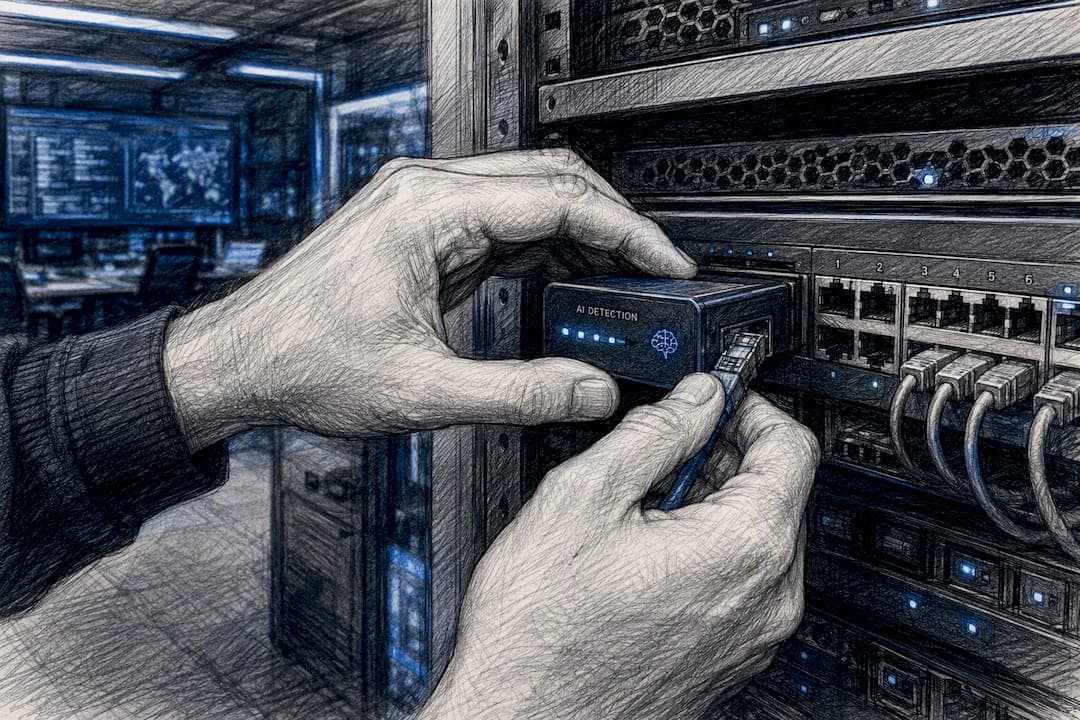
Keep deterministic SOAR playbooks for policy actions. Use AI agents for investigation, adaptive triage and decision points where context matters more than speed. That's the practical split cybersecurity teams should draw right now, and it holds regardless of how good the underlying models get.
Deterministic logic still wins for anything irreversible or compliance-sensitive: blocking an IP, isolating a host, revoking a credential. AI earns its place in the messier middle ground: correlating fifteen scattered alerts into one incident story, weighing ambiguous context, or drafting the first-pass summary an analyst would otherwise write from scratch.
- Keep deterministic: IP blocking, host isolation, ticket creation, credential revocation.
- Hand to AI: alert correlation, incident timeline construction, phishing triage summarisation, exploitability context-gathering.
- Blend both: vulnerability prioritisation, where AI ranks risk and a fixed rule still gates the patch ticket.
Pro Tip: Pilot one hybrid playbook first, not ten. Pick a high-volume, low-blast-radius workflow like phishing triage, set two or three KPIs, and run it in shadow mode before you let AI touch a single action.
Confidence-based routing is the mechanism that makes this safe in practice: AI-enhanced playbooks introduce decision points where LLMs evaluate context, with high-confidence outputs auto-executing and low-confidence ones dropping to human review.
Key Takeaways
AI-enhanced SOAR playbooks work best when deterministic logic handles enforcement and AI handles context, judgement, and summarisation, gated by confidence thresholds and human review.
| Point | Details |
|---|---|
| Keep enforcement deterministic | Irreversible actions like isolation and blocking stay rule-based, never model-decided. |
| Route by confidence score | High-confidence AI outputs auto-execute; low-confidence outputs escalate to human review. |
| Insert a judge layer | A non-LLM policy check between AI and action stops prompt injection reaching production systems. |
| Pair actions with rollback | Every containment step needs a tested, documented un-do path before it ships. |
| Measure before scaling | Track investigation time, automation coverage, and rollback rate from the pilot's first day. |
Table of Contents
- What are AI SOAR playbooks and how do they differ from traditional ones?
- What do AI SOAR playbooks look like in practice?
- Where do playbooks excel, and where do they break down?
- How do AI-enhanced playbook patterns actually work?
- How should you architect AI-enhanced SOAR playbooks?
- What design patterns keep AI decision points safe?
- What KPIs and governance make AI playbooks scale?
- How do you pilot and roll out AI-enhanced playbooks safely?
- How does Alectura's AIDR fit into AI-enhanced SOAR playbooks?
- Where to read more on this topic
- An editorial take on where the industry gets this wrong
- Sources
What are AI SOAR playbooks and how do they differ from traditional ones?
A SOAR playbook is a codified response workflow: a trigger fires, the platform enriches the alert with context, a decision point applies logic, and one or more actions execute. AI SOAR playbooks keep that same skeleton but replace or augment the decision layer with a model that reasons over unstructured context instead of a fixed if/then tree.
The four core parts haven't changed:
- Trigger — a SIEM alert, a scheduled vulnerability scan, a user-reported phishing email, or an EDR detection. Most triggers consume a narrow set of fields: source IP, hostname, hash, sender domain, CVE ID.
- Enrichment — pulling threat intelligence, asset context, user risk scores and historical incident data into the case before any decision gets made.
- Decision logic — traditionally a branching if/then structure ("if hash matches known malware AND host is a server, isolate"). This is the layer AI increasingly occupies.
- Action — the actual enforcement step: block, isolate, notify, ticket, or escalate.
Step types have converged into a fairly standard vocabulary across platforms, which matters when you're comparing vendors or writing your own logic: enrich, investigate, notify, block_ip, isolate_host and create_ticket appear again and again in open-source playbook packs, each with defined on-failure behaviours (retry, escalate, or fail-open to a human queue).
Maintenance is where traditional playbooks quietly bleed hours. API drift breaks integrations without warning, vendor endpoints get versioned and deprecated, and every branch added to the decision tree needs its own test case. Teams running dozens of playbooks often spend more analyst time patching brittle logic than they spend building new automation, which is exactly the gap AI-assisted authoring tools are starting to close.
What do AI SOAR playbooks look like in practice?
Four playbook types cover most of what a SOC actually runs day to day, and each one shows where AI slots in without replacing the guardrails.
Phishing triage. The trigger is a reported email or a mail-gateway detection. Enrichment pulls sender reputation, URL sandboxing results and prior reports from the same sender domain. An AI layer reads the email body and attachments to summarise intent (credential harvesting, invoice fraud, malware delivery) far faster than an analyst skimming headers. Quarantine and user remediation stay deterministic actions; the ticket gets auto-populated with the AI's summary instead of a blank template.

Malware containment. Host isolation triggers on EDR detection. Before isolation, a snapshot step captures forensic data, because you can't investigate a host that's already been wiped. IOC enrichment cross-references the hash against threat feeds. Blocking outbound C2 traffic is a fixed rule, no negotiation.
Vulnerability prioritisation. Raw CVSS scores are close to useless without asset context. AI pulls exploitability data, checks whether the vulnerable service is internet-facing, and cross-references active exploitation reports, then ranks the queue. The patch ticket still gets created by a deterministic rule once the AI-scored risk crosses a threshold.
SIEM alert enrichment. This is where AI adds the most obvious value: correlating a dozen low-severity alerts into a single incident timeline, then routing the merged case by priority instead of drowning an analyst in duplicate tickets.
Where do playbooks excel, and where do they break down?
Deterministic playbooks are unbeatable at the things security operations actually needs most of the time: predictable enforcement, low-latency action, and a clean audit trail. When a known-bad hash shows up on a workstation, you don't want a model "thinking about it." You want isolation in milliseconds and a log entry nobody can argue with.
- Strengths: consistent enforcement every time, sub-second action on clear-cut cases, straightforward compliance auditing, easy rollback because the logic is known in advance.
- Failure modes: brittle branching logic that snaps the moment an attacker deviates from the expected pattern, insufficient context to judge ambiguous alerts, novel techniques that don't match any existing rule, and a maintenance burden that scales with every new branch.
The trade-off is speed against context. A rigid playbook responds in milliseconds but can't tell the difference between a red-team exercise and a real breach if both trip the same signature. Practitioner guidance on AI-SOAR platforms increasingly frames this as a routing problem rather than a replacement problem: send the clean cases through the fast lane, send the ambiguous ones through a reasoning layer with a human checkpoint.
Coverage is the other constraint worth naming directly. Most SOCs automate a fraction of their alert volume with deterministic logic alone, not because the tooling is bad but because writing a rule for every conceivable variant is a losing race against attacker creativity.
How do AI-enhanced playbook patterns actually work?
There's a spectrum here, not a binary switch. Each point on it needs a different confidence threshold and a different fallback.
| Pattern | What AI does | When it auto-executes | Fallback behaviour |
|---|---|---|---|
| AI enrichment | Adds context (summaries, entity extraction) to the case | Never, it only informs | N/A, always advisory |
| AI-assisted triage | Ranks and prioritises the alert queue | Low-risk reordering only | Analyst can override ranking anytime |
| AI decision point with approval gate | Recommends an action with a confidence score | Above a set threshold, with logged approval | Below threshold, routes to human review queue |
| Agentic investigator | Runs multi-step investigation, gathers evidence, proposes remediation | Rarely, usually still gated | Full escalation to senior analyst on low confidence |
Confidence-based routing is the pattern doing the real work across all four rows. High-confidence outputs move fast; low-confidence outputs stop and wait. Vendor guidance on next-generation SOC automation frames the AI's job as building a coherent incident narrative, not making the final call, and that framing holds up well operationally.
Map it back to the phishing example: an AI enrichment step reads the email and produces a timeline ("sender domain registered six days ago, first seen in three other reports this week, attachment matches a known credential-harvesting template"). That timeline feeds an AI decision point. If confidence is high and the action is reversible (quarantine), it executes automatically. If the action would touch a VIP mailbox or a legal hold, it routes to a human regardless of confidence score.
Pro Tip: Never let an agentic investigator's own confidence score be the only gate. Pair it with a second, deterministic check on the specific action, not just the finding, because a model can be highly confident about the wrong thing.
How should you architect AI-enhanced SOAR playbooks?
Think in five layers, each with a narrow job and a clean interface to the next: trigger, orchestration, AI, action, and audit.
The trigger layer stays exactly as it is today: SIEM alerts, EDR detections, scheduled scans. Orchestration routes the case and manages state. The AI layer sits in the middle doing enrichment and reasoning, never touching an action directly. Action executes enforcement. Audit captures everything, independent of whether a human or a model made the call.
The critical design decision is where the deterministic judge layer sits. It belongs between the AI layer and the action layer, not folded into either. Playbook automation frameworks built for agent deployments describe exactly this: a deterministic judge that intercepts every proposed action, evaluates it against policy, and enforces the decision with sub-5ms latency. That matters for two reasons. First, prompt injection targeting the AI layer can't reach the action layer without passing through a policy check that doesn't reason, it just enforces. Second, enforcement stays fast enough for latency-sensitive containment, because you're not waiting on an LLM round-trip to isolate a host that's actively exfiltrating data.
- API stability across every integrated tool, because AI-generated playbooks fail quietly when an endpoint changes shape underneath them.
- Secrets management that keeps API keys and credentials out of prompts and out of model context windows entirely.
- A simulation harness that lets you test playbook changes against historical incidents before they touch production.
- Observable telemetry on every AI decision: what it saw, what it recommended, and what confidence score it assigned.
| Layer | Primary job | Key risk if missing |
|---|---|---|
| Trigger | Detect and normalise events | Missed or duplicate alerts |
| Orchestration | Route, sequence, manage state | Case fragmentation |
| AI | Enrich, reason, summarise | Hallucinated context |
| Judge/action | Enforce policy deterministically | Prompt injection reaching production systems |
| Audit | Capture evidence and decisions | No defensible record for compliance |
Microsoft's Sentinel playbook generator is a useful reference point here too: it lets teams co-author playbooks with an AI coding agent inside a testing environment, generating documentation and flow diagrams alongside the logic itself, which shortens the review cycle considerably.
What design patterns keep AI decision points safe?
Three rules cover almost every safety decision you'll need to make.
- Reserve human-in-the-loop for irreversible actions. Anything that can't be cleanly undone, credential revocation on a production service account, a firewall rule change affecting multiple business units, needs a person to click approve. On-the-loop automation, where a human reviews after the fact rather than before, is fine for triage and enrichment steps that carry low blast radius.
- Pair every containment action with a rollback path. If a playbook isolates a host, the same playbook needs a documented, tested un-isolation step. Practitioners building agent-safe automation frameworks treat this pairing as non-negotiable rather than optional cleanup.
- Package evidence at the moment of decision, not after. Every AI-driven action should generate a tamper-evident record: what data the model saw, what confidence score it assigned, what policy check it passed, and what the human reviewer (if any) approved.
The safest AI-enhanced playbooks aren't the ones with the smartest model. They're the ones where a deterministic layer double-checks the model's proposed action before it ever touches production, and where that check happens in milliseconds, not minutes.
Retention policy matters more than most teams initially budget for. Regulators and internal auditors both want to reconstruct exactly what an AI system recommended and why, months after the fact, which means your evidence packages need a retention window that outlasts your incident response SLA by a wide margin.
What KPIs and governance make AI playbooks scale?
Pilots stall for the same reason almost every time: nobody defined what "working" looks like before they started. Guidance on scaling enterprise AI is blunt about this, isolated pilots without governance and KPIs rarely survive contact with a budget review.
Track these from day one, not after the pilot proves itself:
- Mean investigation time — how long it takes to move from alert to a documented root cause.
- Automation coverage — the share of alert volume handled without a human touching a keyboard.
- Analyst throughput — cases closed per analyst per shift, which tends to be the metric leadership actually cares about.
- False positive rollback rate — how often an AI-approved action gets reversed, your single best signal for whether confidence thresholds are calibrated correctly.
- Time-to-containment — the metric that matters most when a real incident is unfolding.
Governance needs a named executive sponsor, a cross-functional steering group that includes legal and compliance alongside security, and a scheduled model-review cycle rather than an ad-hoc one. Drift detection and error budgets belong on that same cadence: models degrade quietly as attacker behaviour shifts, and scaling AI in security requires moving from isolated pilots to enterprise strategy with governance built in from the start, not bolted on after the first embarrassing false positive.
How do you pilot and roll out AI-enhanced playbooks safely?
- Pick one high-volume, low-blast-radius workflow, phishing triage is the usual starting point, and define two or three success metrics before writing a line of logic.
- Build a test harness that replays historical incidents against the new logic, so you catch failure modes before production does.
- Run the AI recommendation in shadow mode alongside human reviewers for a defined period, comparing its calls against what an analyst actually decided.
- Set explicit confidence thresholds, and write down what happens below each one, escalate, log, or hold for review.
- Define rollback plans for every action the playbook can take, tested, not theoretical.
- Build an observability dashboard covering the KPIs above before you expand scope.
- Capture analyst feedback continuously, feed it into prompt or model tuning, and schedule recurring audits rather than one-off reviews.
Pro Tip: Run shadow mode for at least one full incident cycle that includes a genuine false positive. Teams that skip this step usually discover their confidence threshold was wrong the hard way, in production.
How does Alectura's AIDR fit into AI-enhanced SOAR playbooks?
Every pattern above assumes you can see the AI acting on the endpoint in the first place, and that's the gap most SOC stacks have right now. Alectura's AI Detection & Response platform discovers the copilots, assistants and MCP connections running across your fleet, inventories what each one can access, and feeds that visibility straight into your existing SIEM and SOAR tooling.
- Endpoint-level discovery gives your judge layer real data to enforce against, rather than assuming AI activity you can't actually see.
- Real-time detection of secrets, PII and prompt injection attempts maps directly onto the audit and action layers described earlier.
- Policy enforcement and evidence packaging support the tamper-evident audit trail every AI decision point needs.
For deeper technical patterns on the governance side, Nathan's writing on agent governance for endpoint security teams and monitoring AI agent behaviour covers the observability layer in more detail than fits here.
Where to read more on this topic
- SOAR AI playbook patterns and confidence routing (Threatbasis)
- Generate playbooks using AI in Microsoft Sentinel (Microsoft Docs)
- PLAYBOOK judge-layer architecture (GitHub)
- Alectura's AI detection and response pilot checklist
An editorial take on where the industry gets this wrong
Most vendor pitches treat AI SOAR playbooks as a replacement narrative, rip out the old logic, install a model, done. That framing sells software but it doesn't survive an audit or a genuinely novel attack. The article's own evidence points the other way: the value sits in the handoff, not the swap.
What's underrated is how much of this comes down to a single design choice, whether the deterministic judge sits before or after the model in your architecture. Get that order wrong and you've built a system that's fast to demo and slow to trust. Get it right and you've built something that scales past the pilot stage, which is where most AI security projects actually die.
Prioritise the judge layer and the rollback pairing before you touch confidence thresholds or KPI dashboards. Everything else in this article is tuning. That part is architecture, and architecture is much harder to fix retroactively than a threshold value in a config file.
Sources
- PLAYBOOK — Automated incident response system for AI agent deployments (GitHub)
- Generate playbooks using AI in Microsoft Sentinel (Microsoft Docs)
- SOAR AI Playbooks - Intelligent security automation (Threatbasis)
- AiSOC playbooks (GitHub)