
For Australian enterprises, the best AI risk management approach starts with endpoint-level detection and response, then layers in governance and financial quantification. Alectura AIDR is the recommended lead pick for security teams: it discovers every AI tool running across your fleet, tracks prompt-level events in real time, and feeds audit-ready logs directly into your SIEM or SOAR. Pair it with a governance platform and a quantification tool, and you have a defensible, board-grade AI risk programme.
Here is the shortlist:
- Alectura AIDR — endpoint AI detection and response; the right starting point for any enterprise that needs to know what AI is actually running on its devices before it can govern it.
- OneTrust (AI governance modules) — privacy-first governance for enterprises that already run OneTrust controls and need to extend them to AI.
- Axio AIR — translates AI exposure into dollar figures; the go-to for CISOs who need to present AI risk to a board or insurer.
- Trustible — deterministic, reproducible scoring with full audit trails; strong for high-risk system assessments mapped to NIST AI RMF and the EU AI Act.
- AI Sigil — component-level risk modelling that anchors each risk to the model, dataset, or prompt that originated it.
- Naaia — continuous monitoring with regulatory classification across jurisdictions, including Australian data-residency considerations.
Pro Tip: Pilot endpoint detection first. You cannot govern AI you have not discovered. Run Alectura AIDR across a representative fleet segment for 30 days before selecting a governance platform, so your governance tool is scoped to real AI inventory, not assumptions.
The EU AI Act sets the compliance stakes: highest-tier penalties reach €35 million or 7% of global turnover. Australian enterprises with EU exposure or global operations face those obligations now, and local regulators are watching the same risk categories closely.
Table of Contents
- How do these AI risk management platforms compare for Australian enterprises?
- What does each vendor actually deliver, and when should you pick them?
- How did we select and evaluate these platforms?
- What questions should you ask vendors before you buy?
- How do you quantify AI risk and present it to the board?
- What is the recommended approach for procurement and piloting?
- Key takeaways
- What security teams actually find useful in practice
- Alectura AIDR: endpoint AI detection and response for Australian enterprises
- Authoritative frameworks and further reading for Australian enterprise teams
How do these AI risk management platforms compare for Australian enterprises?
The table below covers the full shortlist against the dimensions that matter most in an Australian enterprise procurement. Deployment model, APAC presence, and compliance mapping columns reflect publicly available vendor information; cells marked "—" indicate details not publicly listed.
| Platform | Best for | Core capabilities | Deployment | SIEM/SOAR integrations | Compliance mapping | Audit & reporting | Pricing model | AU support / data residency |
|---|---|---|---|---|---|---|---|---|
| Alectura AIDR | Endpoint AI discovery, detection & response | Endpoint discovery, prompt timeline, real-time detection (PII, secrets, prompt injection), policy enforcement, DLP, device isolation | Cloud (SaaS), on-device agent | Native SIEM/SOAR integrations | NIST AI RMF, ISO 27001 | On-device audit logs, exportable artefacts | Per-endpoint subscription | APAC-serviceable; data residency options available |
| OneTrust | Privacy-led AI governance across existing GRC | AI inventory, policy management, privacy-risk modules, GRC integrations | Cloud (SaaS) | GRC/API integrations | NIST AI RMF, ISO 42001, ISO 27001, GDPR | Policy audit trails, exportable reports | Enterprise licence | Global presence; AU customers supported |
| IBM Watson Governance (Watsonx) | Enterprises already on IBM stack | Model lifecycle governance, bias detection, explainability, OpenScale monitoring | Cloud / hybrid / on-prem | IBM ecosystem integrations | NIST AI RMF, ISO 42001 | Model cards, governance dashboards | IBM enterprise pricing | AU data centres available |
| Credo AI | Structured model assessments and policy traceability | Policy-to-model mapping, automated assessment templates, model lifecycle tracking | Cloud (SaaS) | API-based integrations | NIST AI RMF, EU AI Act, ISO 42001 | Assessment reports, evidence packages | SaaS subscription | — |
| CENTRL / CentrlGPT | Policy orchestration across AI inventories | Policy automation, vendor AI inventory, pre-built compliance mappings | Cloud (SaaS) | API integrations | NIST AI RMF, ISO 42001 | Compliance dashboards, audit exports | SaaS subscription | — |
| LogicGate | Extending existing GRC workflows to AI risk | Configurable risk engine, workflow builder, AI risk templates | Cloud (SaaS) | GRC/API integrations | NIST AI RMF, ISO 27001 | Risk register exports, audit trails | SaaS subscription | — |
| Resolver | Enterprise risk register with operational risk | Risk register, incident management, operational risk modules | Cloud / on-prem | API integrations | ISO 27001, operational risk standards | Risk register exports, dashboards | Enterprise licence | AU customers supported |
| Axio AIR | Board-grade financial quantification of AI risk | CRQ-style AI risk quantification, framework mapping, insurer-facing outputs | Cloud (SaaS) | Framework/API integrations | NIST AI RMF, ISO 42001 | Board-ready financial reports | SaaS subscription | — |
| Trustible | Deterministic scoring and audit-ready evidence | Rules-based scoring engine, structured impact assessments, evidence capture | Cloud (SaaS) | API integrations | NIST AI RMF, EU AI Act, ISO 42001 | Structured evidence packages, exportable | SaaS subscription | — |
| AI Sigil | Component-level risk modelling | Entity graph (models, datasets, prompts, interfaces), mitigation tracking, residual risk | Cloud (SaaS) | API integrations | NIST AI RMF, ISO 42001 | Evidence-linked mitigation records | SaaS subscription | — |
| Naaia | Regulatory classification and continuous monitoring | Continuous monitoring, regulatory classification, framework alignment, anomaly detection | Cloud (SaaS) | API integrations | NIST AI RMF, ISO 42001, EU AI Act | Monitoring dashboards, periodic reports | SaaS subscription | Global framework support; AU residency — |
| SafetyCulture | Operational teams and checklist-driven audits | Inspection workflows, checklist-based risk assessments, audit reporting | Cloud (SaaS) | Workflow integrations | ISO 27001-adjacent | Inspection reports, exportable audits | SaaS subscription | AU-headquartered; local support |
| AccuKnox | Cloud-native runtime and container protection | Runtime workload protection, AI deployment telemetry, container security | Cloud-native / hybrid | SIEM integrations | NIST, CIS benchmarks | Runtime telemetry reports | SaaS subscription | — |
| Holistic AI | Fairness, explainability and bias management | Bias auditing, explainability tooling, model portfolio assessment | Cloud (SaaS) | API integrations | EU AI Act, NIST AI RMF | Bias and explainability reports | SaaS subscription | — |
| Calypso AI | Model validation, testing and lineage tracing | Model verification, testing pipelines, lineage tracking | Cloud / on-prem | API integrations | NIST AI RMF | Validation reports, lineage records | Enterprise pricing | — |
| LogicManager | GRC-centric risk programme management | Risk taxonomy, control mapping, workflow automation | Cloud (SaaS) | GRC integrations | ISO 27001, NIST | Risk dashboards, audit exports | SaaS subscription | — |
| Riskonnect | Enterprise-wide integrated risk management | IRM platform, risk register, incident tracking | Cloud (SaaS) | Enterprise integrations | ISO 27001, NIST | IRM dashboards, exportable reports | Enterprise licence | — |
| Qualys | Vulnerability and asset risk management | Vulnerability scanning, asset inventory, risk scoring | Cloud (SaaS) | SIEM/SOAR integrations | ISO 27001, NIST | Vulnerability reports, dashboards | SaaS subscription | AU customers supported |
| nTask | Project-level risk tracking for smaller teams | Task-based risk registers, issue tracking, project risk | Cloud (SaaS) | Limited integrations | — | Basic risk reports | SaaS subscription | — |
| Lendflow | Credit and financial risk decisioning with AI | AI-driven credit risk, financial data integrations | Cloud (SaaS) | Financial API integrations | Financial regulatory standards | Credit risk reports | SaaS subscription | — |
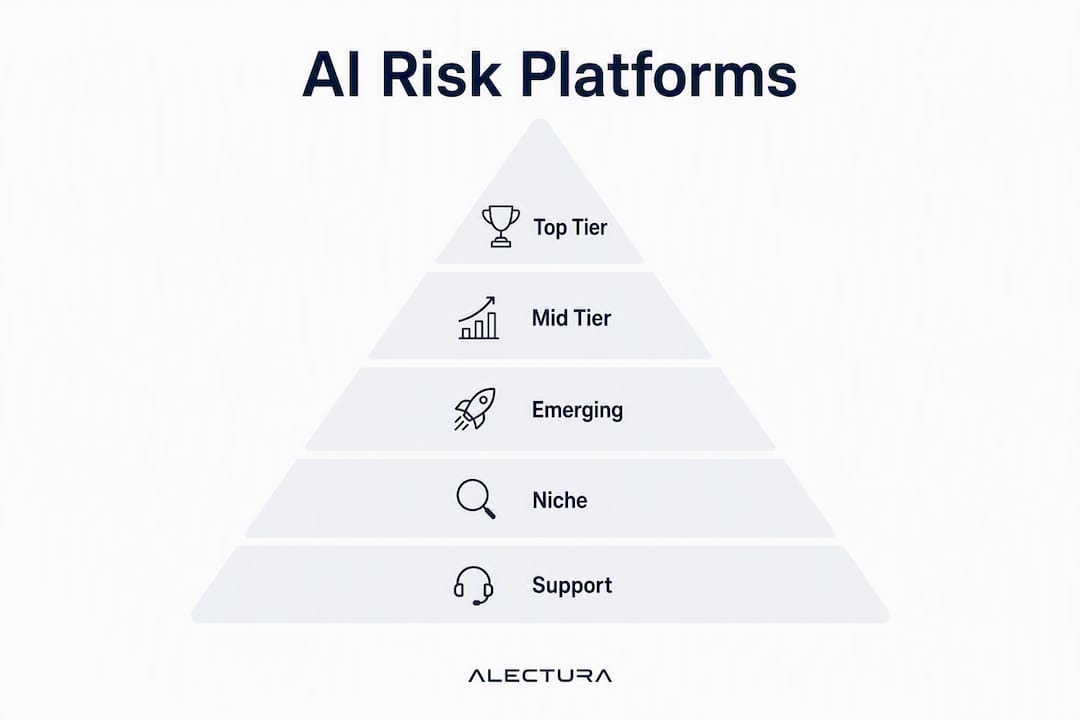
A note on reading this table: "Core capabilities" covers what the platform does natively, not what it can be configured to approximate. "Compliance mapping" reflects vendor-stated framework support; always verify current mapping depth during a demo. For Australian enterprises, the APAC presence and data residency column is the first filter to apply.
What does each vendor actually deliver, and when should you pick them?
Alectura AIDR
Most AI risk programmes start with a governance spreadsheet and no idea what AI is actually running. Alectura AIDR solves the discovery problem first. It deploys an on-device agent that inventories every AI tool across your fleet, including browser copilots, IDE assistants, and MCP-connected agents, then tracks prompt-level events in real time. When sensitive data moves toward an unsanctioned model, the platform flags it, logs it, and can isolate the device. The SIEM and SOAR integrations mean your SOC sees AI events in the same console as every other security signal. For Australian security teams, that endpoint-native visibility is the foundation everything else builds on. See the enterprise pilot checklist for scoping guidance.

OneTrust

OneTrust's AI governance modules sit on top of a mature privacy and GRC platform that many large Australian enterprises already licence. The advantage is integration depth: AI risk assessments, data maps, and policy controls live in the same system as existing privacy obligations. The limitation is that it approaches AI risk from a policy and data-privacy lens, so it is less suited to teams whose primary concern is runtime detection or model-level technical risk.
IBM Watson Governance (Watsonx)
IBM's governance capabilities are genuinely enterprise-grade for organisations already running IBM infrastructure. Model cards, bias detection, and explainability tooling are mature. The honest caveat: if you are not already in the IBM ecosystem, the integration overhead is substantial and the pricing reflects that.
Credo AI
Credo AI is purpose-built for model governance. Its automated assessment templates and policy-to-model traceability make it well suited to teams managing a portfolio of models that need to demonstrate compliance with NIST AI RMF or the EU AI Act. The MIT AI Risk Initiative catalogues over 1,700 distinct AI risks across 65 frameworks; Credo AI's structured templates are one of the more practical ways to work through that taxonomy systematically.
CENTRL / CentrlGPT
CENTRL's strength is orchestration: it automates policy propagation across vendor AI inventories and foundation-model catalogues. Useful when you are managing third-party AI risk at scale, less useful when your primary gap is internal endpoint visibility.
LogicGate and LogicManager
Both are GRC platforms that can be configured for AI risk workflows. LogicGate's configurable risk engine is the more flexible of the two; LogicManager is stronger on taxonomy and control mapping. Neither is purpose-built for AI risk, which means configuration effort is real. Pick one if you already have a GRC investment and want to extend it rather than add a new system.
Resolver
Resolver's mature risk register and operational risk modules make it a reasonable choice for enterprises that need AI risk integrated into a broader operational risk programme. It is not an AI-native platform, but its incident management and risk register features are well-regarded.
SafetyCulture
SafetyCulture is an Australian-headquartered company, which matters for data residency and local support. Its AI risk features are built on an inspection and checklist platform originally designed for operational safety. That heritage shows: it is strong for on-the-ground audit workflows and operational teams, less so for model-level governance or endpoint detection.
Axio AIR
Axio AIR translates AI exposures into financial metrics that boards and insurers can act on. It integrates continuous framework mapping with CRQ-style outputs, so a CISO can walk into a board meeting with a credible exposure figure rather than a heat map. For Australian enterprises with cyber-insurance programmes, the insurer-facing outputs are a practical differentiator.
Trustible
Trustible uses a deterministic rules engine rather than probabilistic scoring, which means two assessors running the same system get the same result. That reproducibility is exactly what regulators and auditors want to see. Its structured impact assessments and evidence capture map directly to EU AI Act and NIST AI RMF requirements.
AI Sigil
AI Sigil anchors risk to the component that originated it: the model, the dataset, the prompt, or the interface. That entity-graph approach means mitigations are traceable back to a specific artefact, not just a system-level label. For teams that need to demonstrate residual risk reduction at a granular level, this is the right architecture.
Naaia
Naaia combines regulatory classification with continuous monitoring. Its reassessment cadence guidance, including annual cycles for high-risk systems, aligns with what Australian regulators and international frameworks expect. The global framework support is broad; verify AU-specific data residency options directly with the vendor.
AccuKnox, Holistic AI, Calypso AI
AccuKnox is the right pick for security teams protecting deployed models in cloud-native environments: runtime workload protection with AI-relevant telemetry. Holistic AI focuses on fairness and explainability, making it relevant for organisations with bias-management obligations under the EU AI Act or Australian anti-discrimination frameworks. Calypso AI is narrowly focused on model validation and lineage tracing, which suits organisations with rigorous model testing requirements.
Riskonnect, Qualys, nTask, Lendflow
Riskonnect is a broad IRM platform with AI risk as one module among many. Qualys brings strong vulnerability and asset risk management with SIEM/SOAR integrations, and has AU customer support. nTask is a project-level risk tracker suited to smaller teams or simple one-off assessments, not enterprise AI governance programmes. Lendflow is a credit-risk platform; its AI capabilities are specific to financial decisioning, not general AI risk management.
Pro Tip: Before any vendor demo, ask to see a residual risk workflow: how does the platform track a risk from initial assessment through mitigation to reassessment? Vendors that cannot show this in 10 minutes are likely wrapping a generic GRC tool in AI-risk branding.
How did we select and evaluate these platforms?
The shortlist was built by evaluating each platform against eight dimensions, weighted for Australian enterprise context.
- Core AI risk capabilities — does the platform address detection, governance, model assessment, and monitoring natively, or only through configuration?
- Compliance mapping — stated support for NIST AI RMF, ISO 42001, ISO 27001, and EU AI Act; verified against vendor documentation and public framework references.
| Dimension | Weight | Primary evidence source |
|---|---|---|
| Core AI risk capabilities | High | Vendor documentation, product pages |
| Evidence and auditability | High | Framework references, vendor demos |
| Compliance mapping | High | NIST AI RMF, ISO 42001, EU AI Act texts |
| AU support / data residency | High | Vendor disclosures, APAC partner pages |
| Integrations | Medium | Vendor integration documentation |
| Deployment model | Medium | Vendor architecture documentation |
| Pricing transparency | Medium | Public pricing pages |
| APAC references | Medium | Public case studies |
Australian regulatory context shaped the weighting directly. The EU AI Act's highest-tier penalties reach €35 million or 7% of global turnover, and Australian enterprises with EU operations or EU-origin AI systems face those obligations. Local data-residency requirements under the Privacy Act and sector-specific rules (finance, health) mean that a platform with no AU data centre option carries real compliance risk regardless of its feature set.
What questions should you ask vendors before you buy?
A structured procurement process for AI risk management software should run six to eight weeks from shortlist to pilot decision. Here is the checklist.
Procurement checklist:
- Request a live demo of the residual risk workflow: initial assessment, mitigation assignment, evidence attachment, and reassessment trigger.
- Ask for a sample audit export in the format your compliance team uses (PDF, CSV, or structured JSON).
- Run an integration test against your SIEM or SOAR in a sandboxed environment before signing.
- Confirm data residency: where is assessment data stored, and can it be restricted to Australian or APAC data centres?
- Ask for two APAC or AU customer references, and speak to them before the pilot.
- Request the vendor's ISO 27001 certificate and any SOC 2 Type II report.
- Confirm the update and patching cadence for compliance framework mappings (NIST AI RMF updates, ISO 42001 revisions).
Questions to put directly to vendors:
- How does your platform model risk at the component level (model, dataset, prompt, interface) rather than at the system level?
- What does a residual risk reassessment look like after a mitigation is applied?
- How do your compliance mappings stay current when NIST or ISO publish updates?
- Which Australian data centres do you use, and what contractual data-residency guarantees do you offer?
- Can you show us an APAC customer case study with named outcomes?
Red flags:
- No component-level risk modelling; risk is assigned to a "system" with no traceability to the originating artefact.
- No residual risk workflow; the platform scores risk but does not track it through mitigation to reassessment.
- Evidence exports are screenshots or unstructured PDFs rather than structured, auditor-ready artefacts.
- Vendor cannot name a single APAC customer or reference.
- Compliance mapping is a static checklist updated annually, not a live framework integration.
Typical enterprise cost bands vary widely. Governance and GRC platforms generally run on annual SaaS licences negotiated per seat or per AI system assessed. Endpoint detection platforms like Alectura AIDR are priced per endpoint. Quantification tools like Axio AIR are typically priced per engagement or annual subscription. Budget for a pilot at a fraction of full-fleet cost, then scale on evidence.
Pro Tip: Ask every vendor: "Show me what an auditor sees." If the answer is a dashboard screenshot rather than an exportable, structured evidence package, the platform will create work for your compliance team rather than reducing it.
How do you quantify AI risk and present it to the board?
The gap between a technical risk assessment and a board decision is almost always a translation problem. Boards allocate budget to risks expressed in dollars, not heat maps. Presenting AI risk alongside cyber risk in financial terms is the mechanism that gets AI risk onto the agenda.
Axio AIR is the most direct tool for this: it applies CRQ-style quantification to AI exposures and produces outputs formatted for insurers and board packs. The underlying method maps AI risk scenarios to financial impact ranges, factoring in likelihood, exposure, and control effectiveness.
A practical board-ready AI risk summary has four components:
| Component | What it contains | Source in your risk programme |
|---|---|---|
| Exposure estimate | Dollar range for top AI risk scenarios | CRQ output from Axio AIR or equivalent |
| Control effectiveness | Current detection and governance coverage | AIDR detection data, governance assessment |
| Residual risk | Remaining exposure after controls | Residual risk scores from governance platform |
| Regulatory obligation | Applicable frameworks and penalty exposure | NIST AI RMF mapping, EU AI Act tier assessment |
Mapping NIST AI RMF's GOVERN, MAP, MEASURE, and MANAGE functions to your quantification inputs is the most defensible approach. GOVERN outputs (policies, roles, accountability) feed the control-effectiveness column. MEASURE outputs (assessments, monitoring data) feed the exposure and residual risk columns. When continuous monitoring from a platform like Naaia updates those inputs, the board pack reflects current exposure rather than a point-in-time snapshot.
The MIT AI Risk Initiative catalogues over 1,700 distinct AI risks across 65 frameworks. That breadth is useful for stress-testing your scenario set: if your board pack covers only three scenarios, cross-reference against the MIT taxonomy to identify gaps before an auditor does.
Key talking points for a board pack:
- State the top three AI risk scenarios by financial exposure, not by technical severity.
- Show the control gap: what detection and governance coverage exists today versus what is needed.
- Tie regulatory obligations to a specific penalty band (EU AI Act tier, Privacy Act obligations) so the board understands the floor of the risk.
- Commit to a reassessment cadence: quarterly for high-risk systems, annual at minimum for all AI in scope.
What is the recommended approach for procurement and piloting?
Start with endpoint detection. You cannot assess, govern, or quantify AI you have not found. A pilot of Alectura AIDR across a representative fleet segment will surface the actual AI inventory: which tools are running, what data they touch, and which events warrant immediate attention. That inventory becomes the input scope for every governance and quantification tool you evaluate next.
Minimum viable pilot checklist:
- Scope: 200–500 endpoints across a representative mix of roles (developers, finance, operations).
- Duration: 30 days for discovery; 60 days to baseline detection coverage.
- KPIs: AI tool discovery rate (percentage of fleet with confirmed inventory), mean time to detection for a simulated sensitive-data event, evidence completeness score (percentage of events with exportable audit artefacts), and reduction in unmanaged AI tool count.
- Success criteria: Full AI inventory for scoped endpoints; at least one SIEM integration live; exportable audit log for the pilot period.
After the pilot, select a governance platform based on the inventory data. If your primary obligation is model governance and compliance mapping, Credo AI or Trustible are the strongest fits. If you need to extend an existing GRC programme, LogicGate or OneTrust are the lower-friction options. Add Axio AIR for board reporting once your governance assessments are producing residual risk scores worth quantifying.
Pro Tip: Set your pilot KPIs before you start, not after. "We found a lot of AI tools" is not a success criterion. "We achieved full inventory coverage for 95% of scoped endpoints and detected three policy violations with exportable evidence" is.
For shadow AI detection scoping and AI agent governance playbooks, the Alectura blog has practical guidance tailored to enterprise security teams.
Key takeaways
The strongest AI risk management programmes for Australian enterprises combine endpoint detection, governance, and financial quantification, with evidence trails that satisfy both regulators and auditors.
| Point | Details |
|---|---|
| Start with endpoint discovery | You cannot govern AI you have not inventoried; pilot Alectura AIDR first to establish a real fleet inventory. |
| Map to NIST AI RMF from day one | Mapping assessments to GOVERN, MAP, MEASURE, and MANAGE functions produces audit-ready evidence and reduces reconciliation overhead. |
| Quantify risk in dollars for the board | CRQ-style outputs from tools like Axio AIR translate AI exposure into the financial terms that drive budget decisions. |
| Verify AU data residency before signing | Australian Privacy Act obligations and sector-specific rules mean data residency is a procurement filter, not a nice-to-have. |
| Alectura AIDR as the detection foundation | Endpoint-native discovery, prompt timeline tracking, and SIEM/SOAR integration make Alectura AIDR the recommended starting point for Australian enterprise AI risk programmes. |
What security teams actually find useful in practice
The platforms that get used are the ones that fit into existing security workflows without requiring a separate login, a separate evidence format, and a separate conversation with the compliance team. The most common failure mode is not a bad product choice; it is two good products that do not talk to each other. Risk records in one system, compliance controls in another, and a quarterly reconciliation exercise that nobody has time for.
Component-level risk modelling matters more than most procurement checklists acknowledge. When a risk is assigned to "the AI system" rather than to the specific model version, dataset, or prompt template that originated it, the mitigation design is guesswork. The origin of the risk determines what the fix looks like and what evidence the auditor needs to see. Teams that remedied this by adopting an entity-graph approach, whether through AI Sigil or a similar platform, consistently reported shorter audit preparation cycles.
The evidence trail is the product. A risk score that cannot be reproduced six months later, with documented rationale and tracked mitigations, is not an audit artefact; it is a snapshot. Regulators and auditors are not looking for a number. They want repeatable assessments, documented rationale, tracked mitigations, and a record of residual risk reassessment after each mitigation is applied. Build that trail from day one, and the compliance conversation becomes straightforward.
For AI data loss prevention controls and SOC 2 AI compliance evidence requirements, the operational details matter as much as the platform choice.
Alectura AIDR: endpoint AI detection and response for Australian enterprises
Most governance platforms assume you already know what AI is running. Alectura AIDR is the layer that makes that assumption true. It deploys an on-device agent that discovers every AI tool across your fleet, tracks prompt-level events in real time, catches sensitive data before it leaves the endpoint, and feeds structured audit logs directly into your SIEM or SOAR. Policy enforcement and device isolation happen without pulling your security team away from their existing toolchain.

For Australian enterprises building an AI risk programme from scratch, the practical sequence is: deploy AIDR to establish inventory and detection coverage, then select governance and quantification tools scoped to what AIDR finds. That sequence avoids the common trap of buying a governance platform for an AI inventory that turns out to be three times larger than expected.
Request a pilot at alecturalabs.com to see endpoint AI discovery running across your own fleet within days.
Authoritative frameworks and further reading for Australian enterprise teams
- NIST AI Risk Management Framework — the GOVERN, MAP, MEASURE, and MANAGE lifecycle functions are the most widely adopted structure for enterprise AI risk programmes. Start here for assessment design and compliance mapping.
- MIT AI Risk Initiative — a living repository of over 1,700 AI risks mapped across 65 frameworks. Use it to stress-test your scenario set and identify taxonomy gaps before an audit.
Australian-specific note: ISO 42001 (AI management systems) and ISO 27001 (information security) are the two certifications most relevant to Australian enterprise procurement. The Australian Privacy Act 1988 and sector-specific rules (APRA CPS 234 for financial services, My Health Records Act for health) add data-residency and incident-reporting obligations that international vendors may not address by default. Always verify AU data centre availability and contractual data-residency guarantees before finalising a vendor selection.