
Jailbreak detection, in the context of this article, means identifying attempts to bypass or remove safety controls in LLMs, copilots, and AI assistants running across your enterprise endpoints. It has nothing to do with detecting rooted or jailbroken mobile devices. The single most important first action your SOC can take right now: enable full input/output logging on every AI tool in your environment, then block outbound agent execution until you have visibility into what those agents are doing.
Start here — actions for the next 24–72 hours:
- Enable prompt I/O logging on all AI assistants and copilots in your fleet; without traces, you are blind to injection attempts.
- Block or gate outbound agent actions (API calls, file writes, email sends) until least-privilege identities are in place.
- Inventory every AI tool and integration (including MCP servers) touching your endpoints; unsanctioned tools are your biggest blind spot.
- Deploy Alectura (AIDR) as your enterprise-grade control plane for AI detection and response, covering discovery, prompt timeline tracking, and policy enforcement from day one.
Table of Contents
- What does "jailbreak detection" mean for enterprise LLMs?
- Four-week staged rollout your team can adopt immediately
- What does a solid detection stack look like?
- SOC playbook: contain, investigate, recover
- How do these controls map to Australian frameworks?
- How Alectura maps to this playbook
- Key takeaways
- Why this matters now for Australian organisations
- Trial Alectura for LLM jailbreak detection
- Authoritative sources and further reading
What does "jailbreak detection" mean for enterprise LLMs?
This article covers one thing: detecting attempts to manipulate or bypass the safety controls built into LLMs, AI copilots, and autonomous agents running on corporate infrastructure. That includes direct prompt injection, indirect injection via documents and RAG pipelines, role-hijack attacks, and agent chaining abuse.
It does not cover detecting whether an iOS or Android device is jailbroken. That is a separate discipline with a separate toolset, and conflating the two wastes your team's time.
The frameworks referenced throughout are the ASD Essential Eight, OWASP LLM Top 10, MITRE ATLAS, and Microsoft's enterprise AI security guidance. Each maps directly to the controls described below.
Four-week staged rollout your team can adopt immediately
This plan follows the enterprise AI security playbook principle: visibility first, permissioning second, testing third, guardrails fourth.
Week 1 — Visibility. Enable input/output logging on every AI tool and assistant. Assign trace IDs to each conversation. Set a minimum 90-day retention period for prompt logs. Without this baseline, you cannot measure anything else. Success metric: 100% of AI tools producing structured logs with trace IDs.
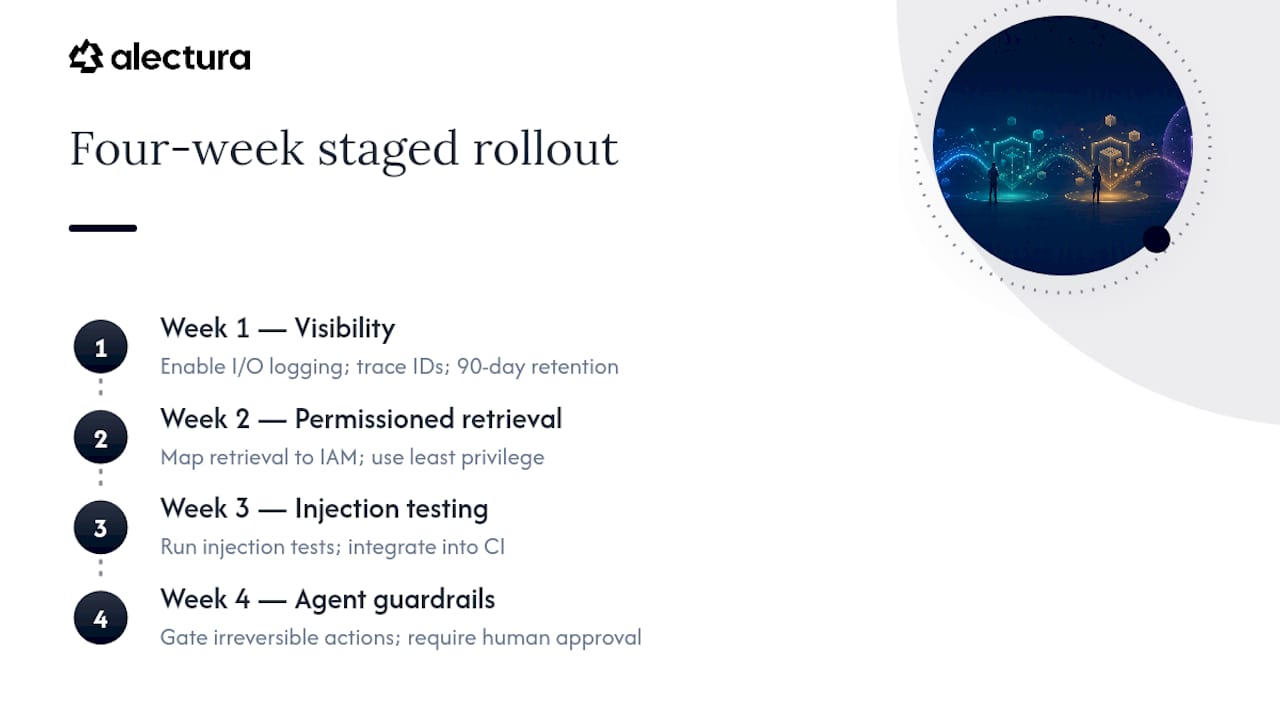
Week 2 — Permissioned retrieval. Map retrieval permissions to your existing IAM policies. No AI tool should retrieve documents a user cannot access directly. Assign least-privilege service accounts to every agent; treat them as you would a human identity. Success metric: zero retrieval calls that exceed the requesting user's IAM scope.
Week 3 — Injection testing. Run direct and indirect injection tests against your deployed assistants. Integrate tests into CI so any change to a system prompt or retrieval pipeline triggers a regression run. Prioritise XPIA test cases using synthetic documents. Success metric: documented detection rate against your test suite, with a target false-positive rate below 5%.
Week 4 — Agent guardrails. Add confirmation gates before irreversible actions (file deletion, email send, API writes). Require human approval for high-risk tool executions. Review provider terms and enforce no-training and data-residency controls where required. Success metric: all irreversible agent actions gated; provider data controls documented.
What does a solid detection stack look like?
A layered approach is the only one that works. Single-layer detectors fail against obfuscated or split payloads.
| Control layer | What to log | Where to enforce | Example SIEM signals |
|---|---|---|---|
| Pre-prompt sanitisation | Raw user input, sanitised output | Client endpoint or API gateway | Blocked input events, sanitisation rule hits |
| Pattern / jailbreak detector | Matched patterns, confidence scores | Model middleware or proxy | High-confidence jailbreak flag, pattern ID |
| Semantic / embedding check | Embedding distance from safe baseline | Retrieval layer | Anomalous cosine distance, indirect injection score |
| Tool-call monitoring | Tool name, parameters, caller identity | Agent runtime | Unexpected tool invocation, out-of-scope API call |
| Outbound channel control | Destination, payload size, data classification | Network / proxy | Exfiltration attempt, DLP policy hit |
Azure AI Content Safety's Prompt Shields cover both user-prompt and document-based attack categories, and their taxonomy is a useful reference when building your own detector rules. Open-source projects like PromptShield combine regex, ML classifiers, and heuristics to produce SIEM-friendly JSON outputs your SOC can ingest directly.
Pro Tip: The three highest-value early signals are prompt I/O traces with trace IDs, tool-execution call logs with caller identity, and retrieval-scope anomalies. Get these into your SIEM before tuning anything else. SARIF output from your scanner maps cleanly to SIEM alert severity fields.
For AI agent monitoring at scale, the telemetry above feeds SOAR runbooks that can auto-isolate a misbehaving agent within minutes of a confirmed detection.
SOC playbook: contain, investigate, recover
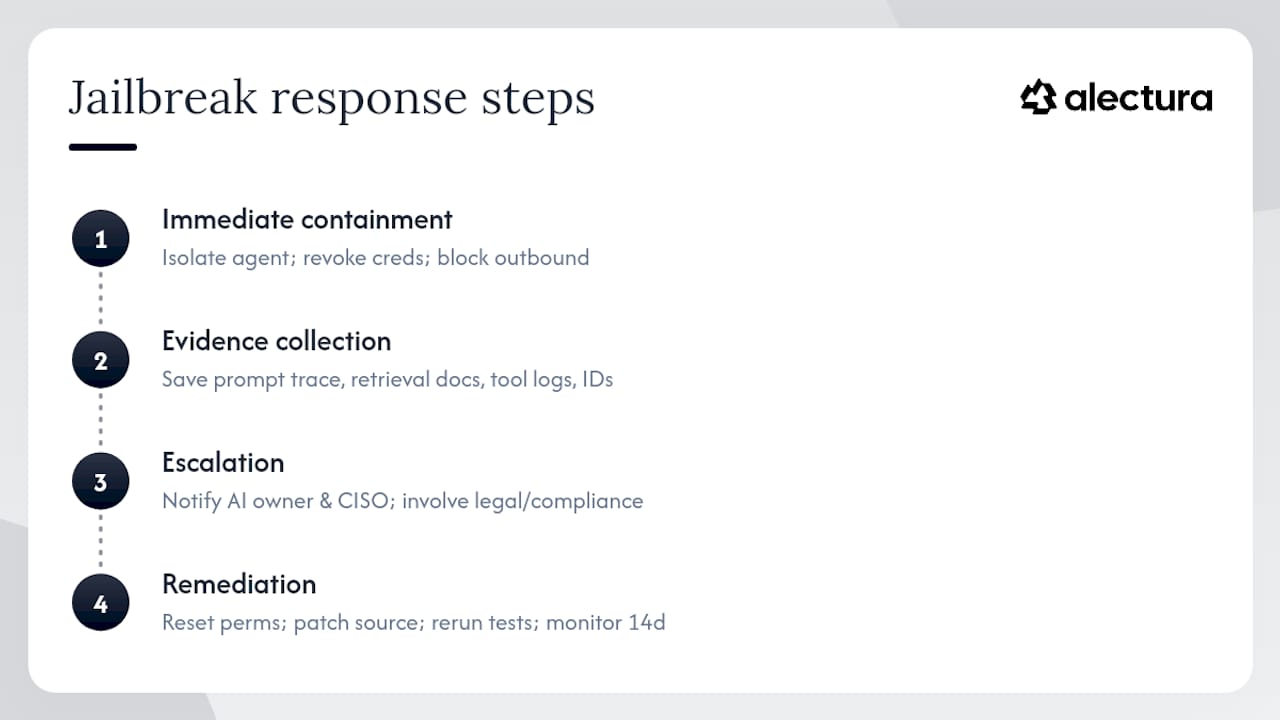
When a jailbreak attempt is confirmed, the sequence matters.
Immediate containment: Isolate the affected agent or assistant, revoke its service account credentials, freeze all pending tool executions, and block outbound channels from that agent's identity. Do not wait for root-cause analysis before isolating.
Evidence collection: Preserve the full prompt trace (input, system prompt, output), retrieval documents accessed, tool-call logs with parameters, and all associated trace and session IDs. This is your forensic record and your audit evidence. The Rasa enterprise AI security framework recommends logging everything at the time of the event; retroactive reconstruction is unreliable.
Escalation: Notify the AI tool owner and CISO immediately. Involve legal and compliance if personal data was accessed or exfiltrated. Australian Privacy Principle 11 requires reasonable steps to protect personal information; a confirmed exfiltration event may trigger notification obligations under the Notifiable Data Breaches scheme.
Remediation: Reconfigure retrieval permissions, patch or quarantine the content source that carried the payload, rerun your full adversarial test suite, and monitor for recurrence over the following 14 days.
How do these controls map to Australian frameworks?
| Playbook control | ASD Essential Eight | OWASP LLM category |
|---|---|---|
| Prompt I/O logging and retention | Application control (log all execution) | LLM01 Prompt Injection |
| Least-privilege agent identities | Restrict admin privileges | LLM06 Sensitive Information Disclosure |
| Retrieval permission enforcement | Application control | LLM01, LLM06 |
| Patching model middleware and plugins | Patch applications | — |
| MFA on AI tool access | Multi-factor authentication | LLM06 |
| Outbound channel controls | Application control, network segmentation | — |
The Australian Cyber Security Centre notes that frontier models accelerate vulnerability discovery and exploitation, making timely patching and layered defences more urgent, not less. The Essential Eight remains the right baseline; AI just raises the cost of not implementing it.
On privacy: retain prompt logs only as long as operationally necessary, redact PII before logs leave the endpoint, and document the contractual basis for any prompt data processed by a third-party model provider. For SOC 2 AI compliance requirements, audit trails from your detection stack are the evidence your auditors will ask for first.
How Alectura maps to this playbook
Alectura's AIDR platform covers the full detection stack described above from a single agent deployed per endpoint. Discovery and inventory run continuously, so you always know which AI tools and MCP integrations are active across your fleet. Prompt timeline tracking gives your SOC a full trace of every conversation, retrieval call, and tool execution, with the trace IDs your SIEM needs for correlation.
Alectura's jailbreak and prompt-injection detectors fire at both the ingress and retrieval layers, covering direct injection and XPIA. Policy enforcement and device isolation are built in, so containment is a single action rather than a multi-team coordination exercise. SIEM and SOAR integrations ship out of the box, with SARIF and JSON outputs that map to standard alert severity fields.
For ASD Essential Eight alignment, Alectura's on-device audit logs provide the evidence trail for application control, privilege restriction, and patching verification. The per-endpoint subscription model means you scale coverage as your fleet grows, without renegotiating contracts. For agentic AI security specifically, Alectura's agent identity inventory and tool-call monitoring close the gap that traditional EDR leaves open.
Key takeaways
Effective LLM jailbreak detection requires layered controls across ingress, retrieval, and tool-call layers, mapped to ASD Essential Eight and validated through continuous adversarial testing.
| Point | Details |
|---|---|
| Enable telemetry first | Deploy prompt I/O logging with trace IDs before any other control; visibility is the prerequisite for everything else. |
| Four-week rollout | Follow the staged plan: logging (Week 1), permissioned retrieval (Week 2), injection testing (Week 3), agent guardrails (Week 4). |
| Layer your detectors | Combine pattern matching, semantic checks, and tool-call monitoring; single-layer detection fails against obfuscated payloads. |
| Map to Essential Eight | Align controls to ASD Essential Eight (application control, least privilege, patching, MFA) to satisfy Australian compliance requirements. |
| Pilot with Alectura | Alectura (AIDR) covers discovery, prompt timeline tracking, jailbreak detection, and SIEM integration from a single per-endpoint deployment. |
Why this matters now for Australian organisations
The ValiDATA analysis of the 2026 Australian threat landscape makes the point plainly: AI accelerates how fast adversaries find and exploit vulnerabilities. That is not a reason to slow down AI adoption. It is a reason to instrument it properly before the attack arrives.
What I keep seeing in Australian enterprises is a gap between the speed of AI deployment and the speed of security instrumentation. Copilots and assistants go live in weeks; the logging, permissioning, and detection controls follow months later, if at all. The four-week playbook above is not a theoretical framework. It is the minimum viable security posture for any organisation running AI on managed endpoints.
The ASD's guidance and Microsoft's enterprise recommendations converge on the same point: existing controls work when configured correctly. Segmentation, least-privilege identities, and telemetry-driven detection are not new ideas. Applying them to AI agents is the new work. Start with visibility, add permissioning, then test. The organisations that do this now will have a measurable advantage when the first serious AI-enabled incident hits their sector.
Trial Alectura for LLM jailbreak detection
Security teams that have completed the four-week playbook above have a clear picture of their AI attack surface. Alectura's pilot takes that further: endpoint discovery runs on day one, prompt timeline tracking is live within hours, and your SIEM receives structured alerts before the end of week one.

A standard pilot covers endpoint discovery and AI tool inventory, the full four-week playbook with Alectura's detection stack active, SIEM integration and sample SARIF alert outputs, and a red-team test run against your deployed assistants using synthetic datasets. It excludes production data from test runs and does not require changes to your existing IAM or network architecture to begin.
Start your Alectura pilot or review the Master Subscription Agreement for procurement readiness. Your SOC can be instrumenting AI activity across your fleet within a week.
Authoritative sources and further reading
- Frontier models and their impact on cyber security — Australian Cyber Security Centre
- Applying security fundamentals to AI: Practical advice for CISOs | Microsoft Security Blog
- Jailbreak detection — Azure AI Content Safety
- PromptSentinel (GitHub)
- The Enterprise AI Security Playbook: Securing LLMs and Agents in Production — AI Insiders Research
- LLM security best practices 2026: Enterprise checklist — Ortem Technologies
- Enterprise AI security and compliance: A practical framework | Rasa
- AI cybersecurity in 2026: The threat landscape Australian businesses face | ValiDATA