
An AI risk score summarises the likelihood and potential consequence of an AI system causing harm into a single, actionable value, usually plotted on a scale like 0 to 100 or 0.0 to 1.0. Security and governance teams use it for three jobs: gating (should this AI tool be allowed to run?), prioritisation (which of 40 flagged tools gets reviewed first?), and monitoring (is this risk getting worse?). The single most important thing to get right isn't the maths behind the number. It's mapping that score to a governance framework and refreshing it as conditions change.
- Scores gate access, prioritise remediation queues, and feed monitoring dashboards
- A static score is a liability disguised as a control
- Map every score to a named framework before you operationalise it
Pro Tip: If your risk score hasn't changed in 90 days, it's not measuring risk anymore, it's measuring how long ago someone last looked at the spreadsheet.
Key Takeaways
Dynamic AI risk scoring only works when it's mapped to a governance framework, fed by real endpoint telemetry, and reviewed by humans, not automated end to end.
| Point | Details |
|---|---|
| Score is a living input | Recalculate scores after deployment changes, not just at initial assessment. |
| Separate inherent from residual risk | Track what mitigation actually removed versus what remains. |
| Anchor to NIST AI RMF | Use its four functions to structure audit-ready evidence and reporting. |
| Triage over zero risk | Follow CSIRO's guidance to prioritise mitigation budget by material harm. |
| Visibility precedes precision | Alectura's endpoint discovery and telemetry feed the access and sensitivity data any scoring model needs before enforcement through SIEM or SOAR. |
Table of Contents
- Why AI risk scoring matters in the risk lifecycle
- Which frameworks should your scores map to?
- How do you actually calculate a risk score?
- How do you keep scores accurate as AI use changes?
- A worked example: scoring an enterprise code assistant
- How Alectura instruments scoring on real endpoints
- What the frameworks get right, and what most teams skip
- Turning risk scores into enforceable action with Alectura
- Sources
Why AI risk scoring matters in the risk lifecycle
AI risk scoring isn't a one-off audit exercise. It's a thread that runs through four stages: assessment, mitigation, monitoring, and audit. You score a system when it's first deployed, again after you apply controls, and continuously after that as usage and data exposure shift.
Getting the terminology straight matters here, because loose language produces loose scores. Likelihood is the probability a harmful event occurs. Consequence is how bad it is if it does. Inherent risk is what you face before any controls exist; residual risk is what remains after mitigation. Risk tolerance is the threshold your organisation decides it can live with, and it should differ by system, not sit as one number for the whole fleet.
This distinction matters because a 272-respondent expert survey by MIT's AI Risk Initiative found that the people most exposed to a given AI risk are frequently not the people responsible for managing it. That misalignment is exactly why triage matters more than blanket coverage:
- Score at deployment, after mitigation, and on a recurring cadence, not just once
- Separate inherent from residual risk so mitigation effort is visible
- Set risk tolerance per system, tied to data sensitivity and blast radius
Which frameworks should your scores map to?
A number with nowhere to go is just trivia. The frameworks worth anchoring to are the ones auditors and boards already recognise.
The NIST AI Risk Management Framework and its companion playbooks give you a structure for governing, mapping, measuring, and managing AI trustworthiness, and they're the closest thing the industry has to a common vocabulary for evidence and audit trails. If your scoring system can't produce artefacts that slot into NIST's four functions, you'll be rebuilding your reporting from scratch the first time a regulator or client asks for it.
MIT's expert consensus adds a second layer: it ranks dangerous capabilities, competitive dynamics, weapons and cyberattacks, power centralisation, and false information as the five risk categories with the most severe expected harms, based on that same 272-expert survey. That ranking is a useful check on whether your scoring model is weighting the right things.
For a practical template on the likelihood/consequence logic itself, the guidance behind Australia's AI impact assessment tool asks assessors to rate likelihood and consequence per category and document the reasoning, not just the number. CSIRO's triage-and-tier guidance pushes the same point from a different angle: don't chase zero risk, allocate your limited mitigation budget to what's actually material.
- NIST AI RMF: governance structure and audit-ready artefacts
- MIT priorities: which risk categories deserve the heaviest weighting
- National impact-assessment guidance: a template for likelihood and consequence logic
- CSIRO triage guidance: resourcing rules for what gets fixed first
Our guide to AI governance frameworks walks through how these pieces fit together for security teams building this out from scratch.
How do you actually calculate a risk score?
There's no single correct formula, but there are three broad approaches, and picking the wrong one for your maturity level wastes effort.
- Heuristic risk matrix. Plot likelihood against consequence on a simple grid (say, 1 to 5 on each axis) and multiply them for a rough score. Fast to build, easy for non-technical stakeholders to read, but it flattens nuance and tends to cluster everything in the middle.
- Composite index. Weight several factors, data sensitivity, model capability, access scope, and impact domain, then combine them into one number. This is where most mature programs land, because it lets you tune weights as your risk appetite changes without rebuilding the whole model.
- Probabilistic risk assessment (PRA). Borrowed from high-reliability industries like aviation and nuclear power, PRA for AI models specific failure pathways and estimates calibrated likelihood and severity for each, producing a defensible, quantified estimate rather than a rough heuristic.
PRA earns its complexity when you need numbers a board or an insurer will accept, not just an internal sorting order. For day-to-day triage, a composite index usually does the job.
None of these should run fully automated. Academic research into AI-assisted risk analysis found that AI can support tasks like probability estimation, but it can't fully automate risk-informed decision-making. The hybrid model, automated signals feeding a human calibration step before a score gets finalised, is the one that survives an audit.
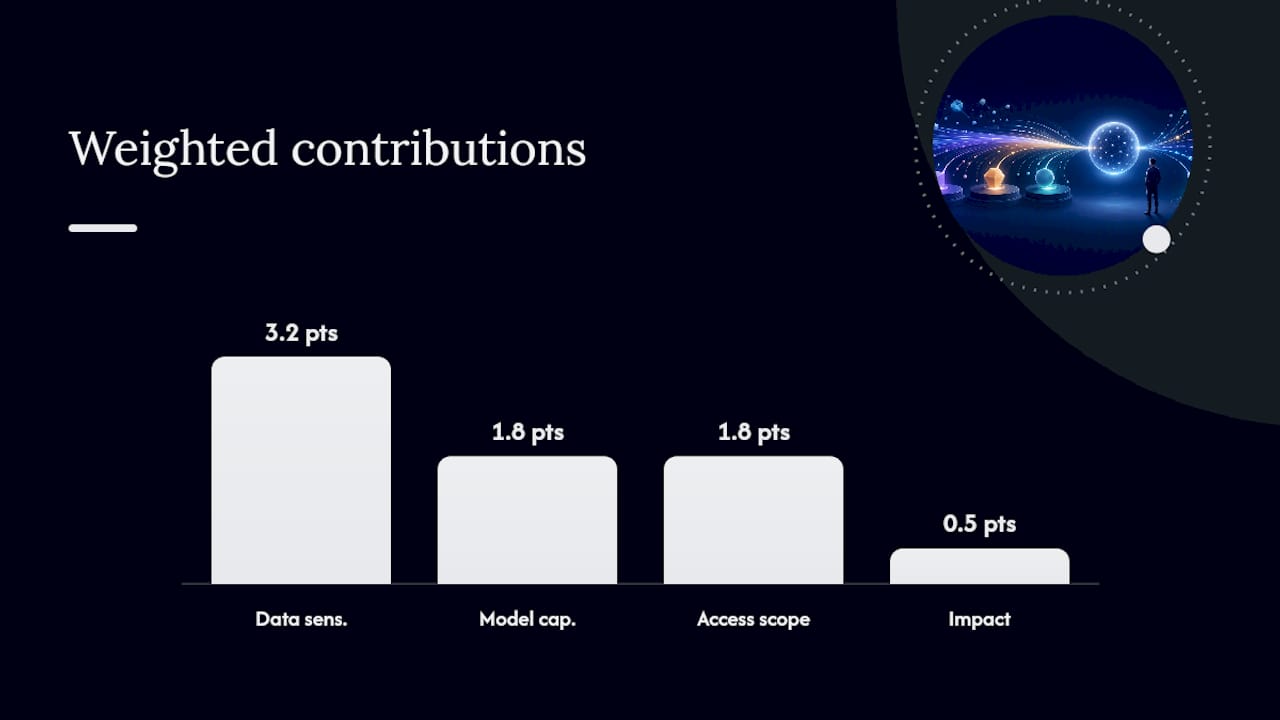
A rough worked example: data sensitivity (weight 0.4) scores 8/10, model capability (weight 0.3) scores 6/10, access scope (weight 0.2) scores 9/10, impact domain (weight 0.1) scores 5/10. Weighted sum: 7.3 out of 10, which lands the system in your "elevated" tier.
How do you keep scores accurate as AI use changes?
A score calculated once at deployment goes stale within weeks. Model behaviour drifts, usage patterns change, and new integrations open new access paths, none of which show up if you're not re-scoring.

Dynamic scoring means feeding live signals back into the model: model performance drift, data drift, prompt telemetry, and the endpoint access level a given tool actually holds versus what was originally approved. This is where discovery tooling earns its keep, because you can't score access you don't know exists.
The operational pattern that works in practice looks like this: AI Detection and Response (AIDR) tooling discovers what's running on an endpoint, calculates or updates a risk score from telemetry, and pushes that score into your existing SIEM or SOAR stack for enforcement, whether that's an automatic ticket, a block, or an escalation to a human reviewer.
- Recalculate on a fixed cadence, plus immediately after any material change (new integration, new data source, permission escalation)
- Ingest prompt-level telemetry, not just tool-level metadata, to catch risky behaviour early
- Set explicit escalation SLAs: a score crossing into "high" should trigger review within a defined window, not sit in a queue
Pro Tip: Tie your escalation SLA to the score tier, not the tool. A low-tier tool that suddenly spikes deserves faster attention than a high-tier tool sitting steady.
Our agentic AI security guide and endpoint governance playbook go deeper on where human review needs to sit in that pipeline.
A worked example: scoring an enterprise code assistant
Take a code assistant plugged into a developer's IDE with access to a private repository. It reads source code, suggests completions, and occasionally connects to external documentation via an integration.
- Sum the weighted scores: 7.4 out of 10, an "elevated" tier under most composite models.
- Trigger action: require the integration to run through an approved MCP connection rather than an open API call, and flag for quarterly re-scoring.
- Capture evidence: log the factor ratings, the reviewer's reasoning, and the mitigation applied, so the file stands up if an auditor asks why this tool was allowed to keep running.
How Alectura instruments scoring on real endpoints
Scoring theory only holds up if you can see what's actually running. Endpoint discovery builds the inventory that feeds the access-scope and data-sensitivity factors in any scoring model, copilots in the browser, assistants in the IDE, agents wired into internal apps most security stacks never see.
Telemetry worth collecting includes prompt timelines, the specific data types an AI tool has touched, and connection points through MCP servers or other integrations. That telemetry maps directly onto composite score inputs: access scope from what the tool connects to, impact domain from what it touches, and consequence severity from what leaves the device.
- Discovery builds the inventory that scores need before they mean anything
- Prompt timeline tracking gives you the behavioural signal a point-in-time audit misses
- SIEM and SOAR integration turns a score into an enforceable action, not a static report
The gap most security teams underestimate isn't the scoring formula, it's the blind spot before it. You can't score, gate, or triage an AI tool your monitoring stack has never registered.
What the frameworks get right, and what most teams skip
Most organisations treat AI risk scoring as a compliance checkbox: run the assessment once, file the score, move on. Every framework referenced here argues against that. NIST's structure, MIT's expert consensus, and CSIRO's triage guidance all assume the score is a living input to decisions, not a certificate you print once.
Where conventional advice falls short is in treating the scoring formula as the hard part. It isn't. The hard part is instrumentation: knowing what AI tools are actually running, what they touch, and whether that's changed since last quarter. A perfectly weighted composite index calculated from stale or incomplete data is worse than a rough heuristic calculated from live telemetry, because it gives false confidence.
If you take one thing from this, prioritise visibility before precision. Get discovery and telemetry working first, even with a crude heuristic matrix. Refine the maths once you can trust the inputs. Teams that build a sophisticated scoring model on top of blind spots end up auditing a fiction.
— Nathan
Turning risk scores into enforceable action with Alectura
Alectura is the practical layer between a risk score on paper and a risk score that actually blocks something. Frameworks tell you what to measure and CSIRO's triage logic tells you what to prioritise, but neither one can see the copilot your finance team installed last Tuesday. Alectura discovers every AI tool running across your endpoint fleet, inventories the access it holds, and tracks what it connects to through MCP and other integrations, feeding exactly the access-scope and data-sensitivity signals your scoring model needs.

When a score crosses your threshold, Alectura pushes it into your existing SIEM or SOAR stack for enforcement, device isolation, policy alerts, or a ticket, without slowing your developers down. If you're still mapping out the terminology before you pilot this, our AI security glossary is a fast way to get your team aligned on shadow AI, MCP, and AIDR before your first scoring rollout. Start by getting visibility into what's actually running on your endpoints today.
Sources
- MIT AI Risk Initiative — priorities
- NIST AI Risk Management Framework
- CSIRO — triage and tier AI bias risks
- Artificial intelligence for risk analysis — PMC article